The Essential Resources Behind the Modern World
From batteries and electric vehicles to smartphones, power grids and advanced technology, the materials beneath modern life are becoming strategically important.
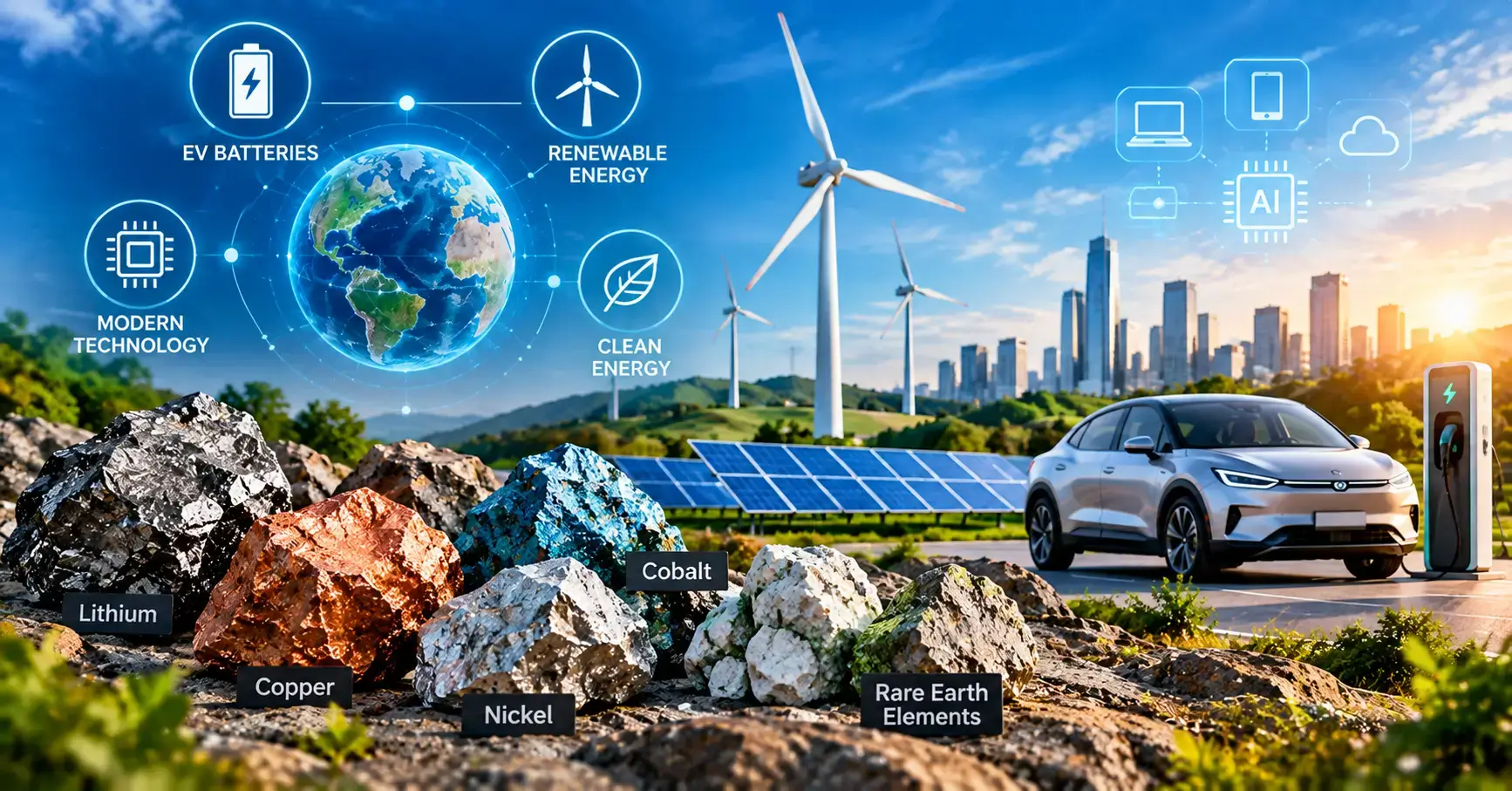
Critical minerals are becoming one of the most important resource stories of the modern economy. They sit quietly behind electric vehicles, smartphones, batteries, power grids, renewable-energy equipment, semiconductors, aerospace systems and countless everyday products. When supply is stable, most people never notice them. When supply is disrupted, prices, manufacturing schedules and even national strategies can change.
This guide explains what critical minerals are, why they matter, how supply chains work, why rare earths are only one part of the picture, and what governments, businesses and consumers can do to build a more resilient resource system. The aim is to make a complex subject understandable without reducing it to a simple claim that every important mineral is scarce.
The subject is changing quickly. The U.S. Geological Survey’s 2025 list contains 60 critical minerals, while the European Union maintains a separate list and policy framework. The International Energy Agency also tracks the minerals most closely connected with clean-energy technologies and examines supply, demand, investment, refining and recycling trends. This article uses those authoritative sources as a foundation while explaining the wider everyday meaning of the issue.
What Are Critical Minerals?
The modern world runs on materials that most people rarely think about. A smartphone, electric vehicle, laptop, power grid, wind turbine, medical device, aircraft and data center may look like finished products, but each one depends on a long chain of minerals and processed materials. Some of those materials are considered critical because they are economically important while their supply can be vulnerable to disruption.
The phrase critical minerals does not simply mean minerals that are rare. A material can be relatively common in the Earth’s crust and still be considered critical if production is concentrated in a small number of countries, if refining capacity is limited, if substitutes are difficult to find, or if demand can rise faster than new supply. In other words, criticality is about importance and supply risk rather than geological scarcity alone.
Different governments use different lists because their economies, industries and security priorities are not identical. The United States updated its list to 60 minerals in 2025, while the European Union maintains its own framework for critical and strategic raw materials. These lists can change as technology, trade patterns, production and geopolitical conditions change.
This distinction is important because the same mineral can play several roles at once. Lithium can support rechargeable batteries. Copper can carry electricity through power networks. Graphite can be used in battery anodes. Rare earth elements can help create powerful permanent magnets. Gallium and germanium are important in specialized electronics and optical applications.
The simplest way to understand the issue is to imagine the global economy as a machine. Energy is the fuel, technology is the control system, infrastructure is the body, and minerals are many of the physical building blocks. If a crucial building block becomes difficult to obtain, expensive, or politically exposed, the entire system can feel the pressure.
Why These Resources Matter More Than Ever
For decades, mineral supply was often treated as a background industrial issue. Manufacturers purchased materials, processors refined them, and consumers bought finished products. The growing importance of electrification and advanced technology has changed that relationship.
Modern batteries require large volumes of specialized materials. Electric motors can depend on magnet materials. Renewable power systems require metals for generators, wiring, transformers and electronic equipment. Data centers need enormous amounts of electrical infrastructure, and semiconductor manufacturing relies on highly specialized inputs. As more industries become digital and electric, the material foundation of those industries becomes strategically important.
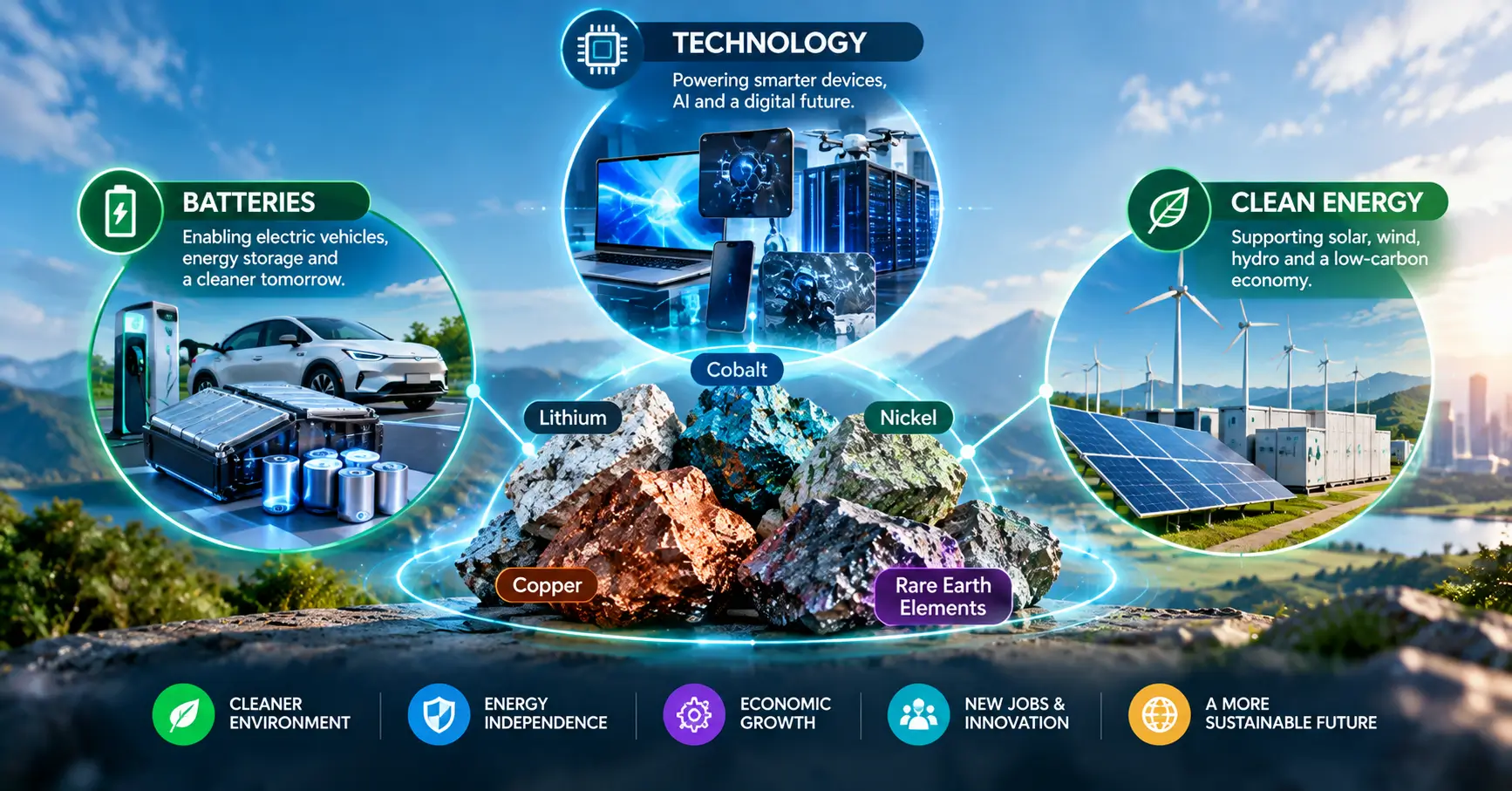
The energy transition is one major reason attention has increased. The International Energy Agency tracks minerals such as lithium, nickel, cobalt, graphite, copper and rare earth elements because they are important to clean-energy technologies. Its 2025 outlook notes that price volatility, supply bottlenecks and geopolitical concerns have made mineral security a major policy issue.
Demand growth is only one part of the story. Supply is often slow to respond. A mineral deposit may be known for years before it becomes a working mine because a project needs exploration, permits, financing, infrastructure, construction, skilled workers and processing capacity. Even after extraction begins, the material may need several stages of concentration, chemical processing, refining and manufacturing before it becomes useful to a factory.
That long chain creates a strategic challenge. A country can have access to a mineral in the ground but still depend heavily on foreign suppliers for refined material, specialized chemicals, processing equipment or finished components. The real question is therefore not simply who has the ore. It is who can move the material through the entire value chain reliably.
| Material | Example role | Why it matters |
|---|---|---|
| Lithium | Rechargeable batteries | Supports energy storage and electric mobility |
| Copper | Wiring and electrical equipment | Essential for electrification and grids |
| Graphite | Battery anodes | Important for many lithium-ion battery designs |
| Rare earths | Permanent magnets and specialized uses | Important in motors, electronics and advanced equipment |
Rare Earths Are Important, But Critical Does Not Mean Rare Earth
The terms rare earths and critical minerals are sometimes used as though they mean the same thing. They do not. Rare earth elements are a particular group of 17 elements. Critical minerals are a broader category that can include lithium, cobalt, copper, graphite, nickel, gallium, germanium, tungsten and many others.
Rare earth elements are especially important for technologies that need strong, lightweight and efficient magnets. Neodymium, praseodymium, dysprosium and terbium are associated with high-performance permanent magnets used in applications such as electric motors and wind turbines. Other rare earth elements have roles in optical materials, catalysts, electronics, lasers and specialized industrial products.
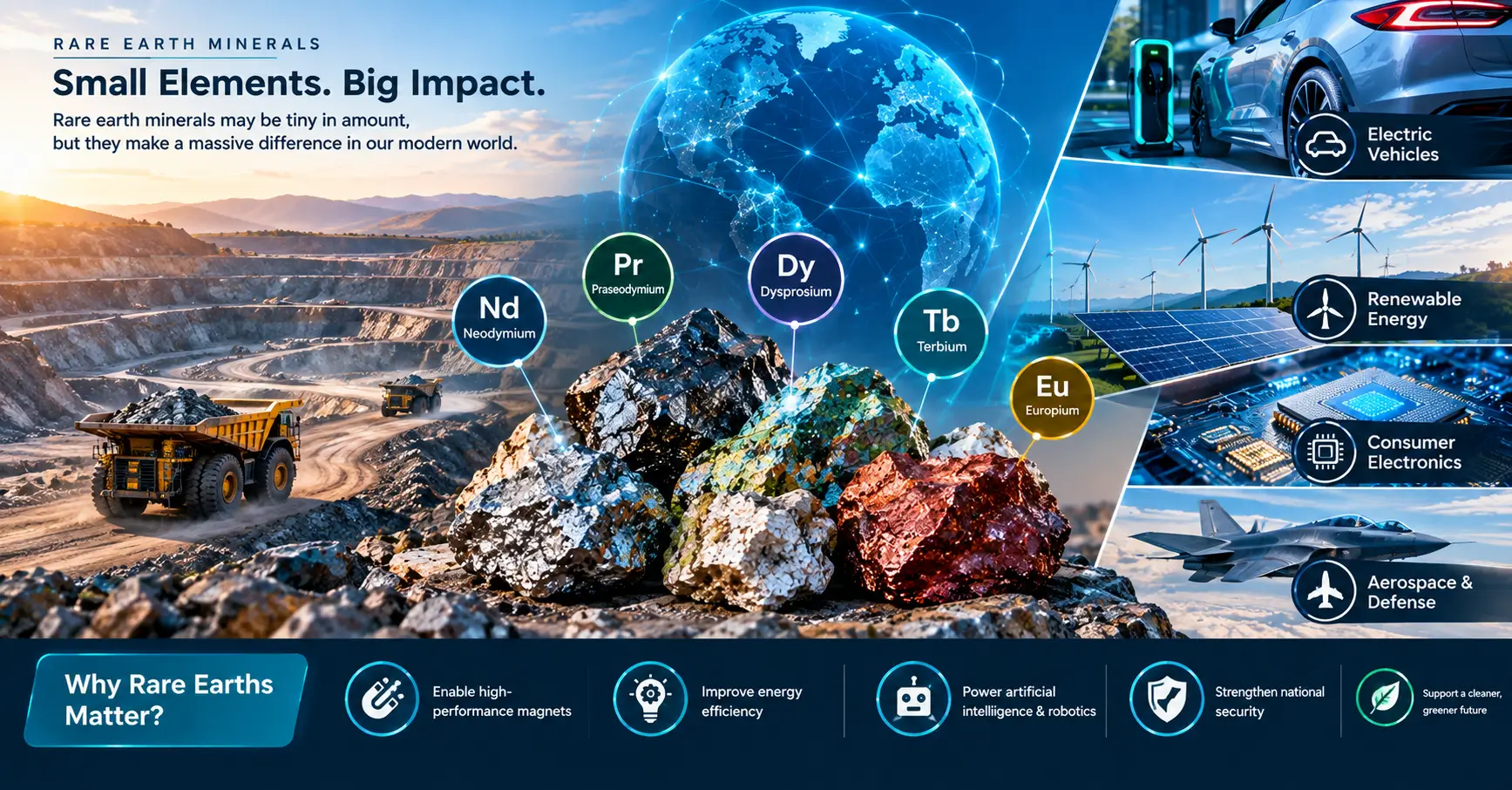
The word rare can also be misleading. Some rare earth elements are not extraordinarily scarce in the Earth’s crust. The difficulty is often finding deposits where they occur in concentrations that can be economically extracted and then separating the individual elements efficiently. Processing can be technically complex, and environmental management matters because extraction and separation can create waste streams that require careful handling.
This is a useful lesson for understanding resource security. Geological abundance is only one piece of the puzzle. A material becomes strategically sensitive when a combination of geology, economics, technology, infrastructure, policy and geography creates a difficult supply chain.
The United States Geological Survey’s 2025 list contains 15 rare earth elements among its 60 critical minerals. That demonstrates the overlap without making the categories identical. A country can therefore reduce one risk by diversifying rare-earth supply while still facing vulnerabilities in copper, graphite, lithium, gallium or another material.
For consumers, this distinction matters because headlines sometimes imply that every modern technology depends on a tiny group of exotic elements. The reality is more interesting. Some of the most important materials are familiar industrial metals, while others are specialized elements used in small but strategically important quantities.
Lithium and the Battery Economy
Lithium has become one of the most recognizable minerals in the modern energy conversation because rechargeable lithium-ion batteries are central to electric mobility, portable electronics and energy storage.
A battery is not simply a container filled with lithium. It is a carefully engineered system containing a cathode, anode, electrolyte, separator, current collectors and other components. Different battery chemistries use different combinations of materials. Lithium is important because its chemical and electrochemical properties make it suitable for high-energy rechargeable systems.
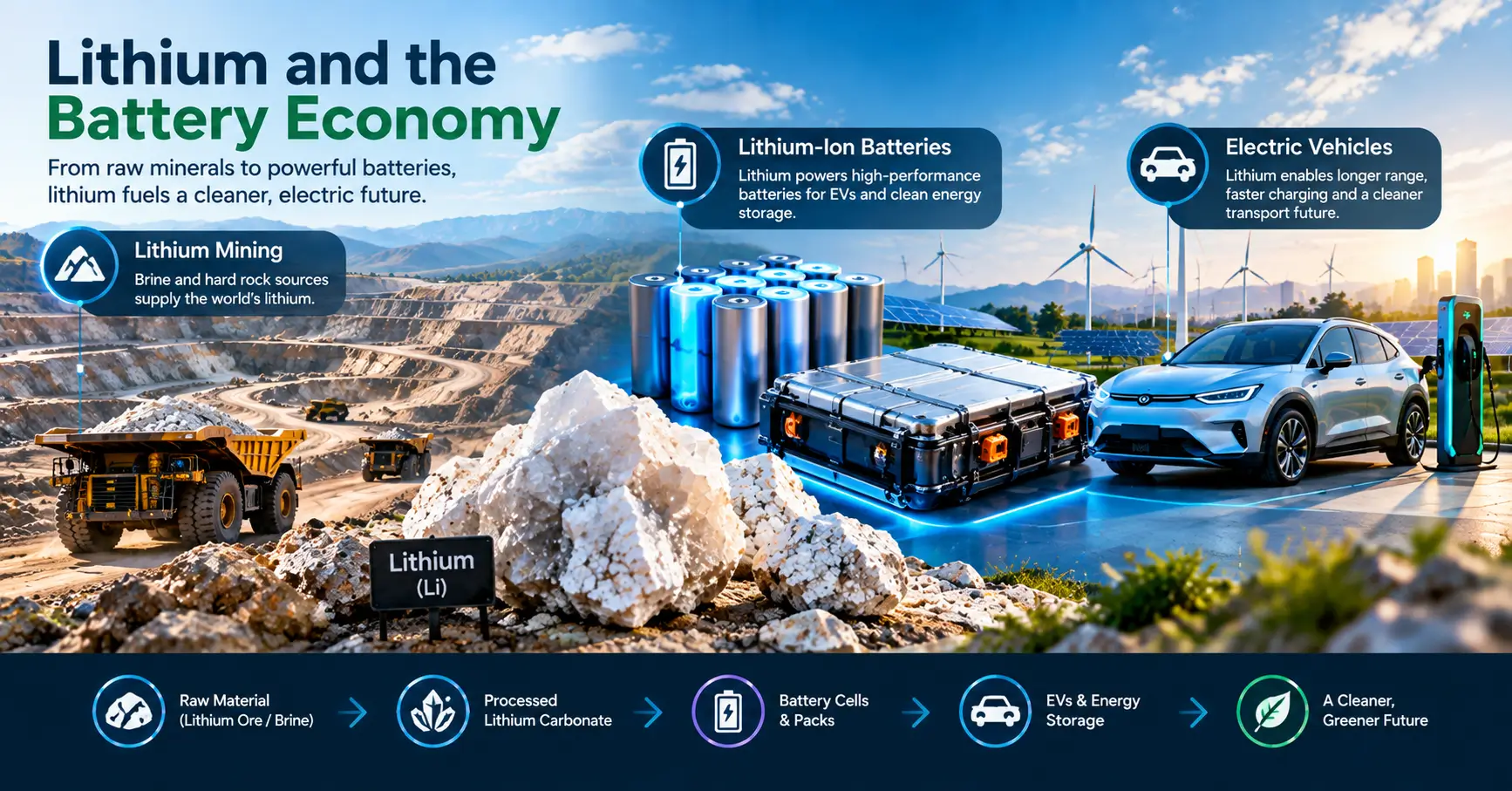
The rise of electric vehicles has made battery supply chains a major economic issue. Vehicle manufacturers need predictable access to battery materials, but mining and processing capacity must grow alongside vehicle production. A shortage at any stage can affect costs, delivery schedules and investment decisions.
Lithium supply also illustrates why mining is only the beginning. Raw material may be extracted from hard-rock deposits or brines, then converted into battery-grade chemical products. Those products must meet strict specifications before they can enter a battery manufacturing process. A country may therefore produce lithium-bearing material while importing refined chemicals or battery components.
The battery industry is also changing. Researchers and manufacturers are exploring different chemistries that can reduce dependence on particular materials or improve cost, safety, energy density and durability. Sodium-ion batteries, for example, use sodium rather than lithium for the charge-carrying ion. Other approaches continue to evolve.
That does not make lithium unimportant. Instead, it shows how substitution can influence criticality. If a practical alternative becomes cheaper and scalable, supply risk may fall. If demand for a mineral grows faster than alternatives can develop, its strategic importance can rise.
Recycling is another part of the answer. Recovering useful materials from retired batteries can reduce pressure on new extraction, although recycling cannot immediately replace mining because the stock of old batteries is still much smaller than the growing demand for new ones.
Copper: The Quiet Foundation of Electrification
Copper is less glamorous than rare earth elements, but it may be one of the clearest examples of how ordinary-looking materials can become strategically important. Copper is an excellent electrical conductor, which makes it essential to cables, motors, transformers, electronics and power networks.
Electrification increases the importance of electrical infrastructure. Adding electric vehicles requires charging equipment and stronger distribution systems. Renewable generation requires electrical connections. Data centers need large power supplies. Buildings increasingly contain electronics, sensors, communications systems and efficient electrical equipment.
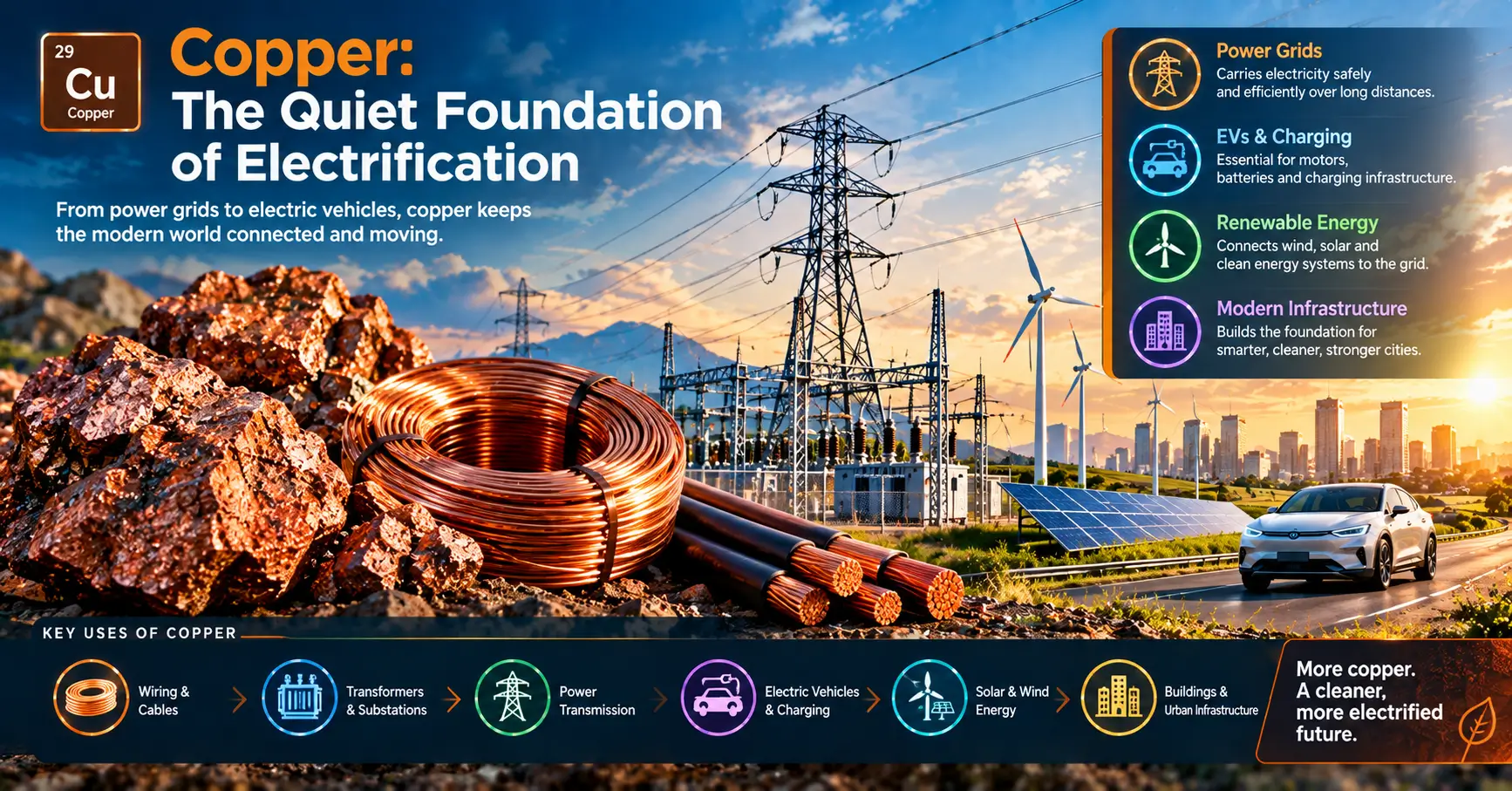
The challenge with copper is scale. Even when the technology is mature, enormous quantities of metal are required to build physical infrastructure. Mines need to replace declining production, and new projects can take many years to develop. Ore grades can also vary, meaning that producing a given quantity of refined copper may require processing more rock.
Copper also shows why recycling matters. Unlike materials that degrade significantly during repeated use, copper can be recycled and returned to industrial applications. A stronger circular economy can therefore supplement primary mining.
However, recycling has limits. New infrastructure adds to the total amount of material in use, and much of that material remains locked in buildings, cables, vehicles and equipment for years or decades. As a result, both mining and recycling are likely to remain important.
For everyday life, the lesson is simple: the energy transition is not only about generating clean electricity. It is also about building wires, transformers, motors, substations and equipment capable of moving that electricity. Copper sits near the center of that physical network.
Cobalt, Nickel and Graphite in Modern Batteries
Cobalt, nickel and graphite demonstrate how one technology can create demand for several different mineral supply chains. Their roles vary by battery chemistry, but each has been important to the development of rechargeable energy storage.
Cobalt has been used in several lithium-ion battery cathode chemistries because it can contribute to structural stability and performance. At the same time, manufacturers have worked to reduce cobalt intensity because of cost, supply concentration and responsible-sourcing concerns. Some newer battery chemistries use little or no cobalt.
Nickel can support higher-energy-density battery cathodes. It is also a major industrial metal with applications outside batteries, including stainless steel and specialized alloys. Battery demand therefore competes with other uses for a material that already has a large industrial market.
Graphite is particularly interesting because natural graphite and synthetic graphite can be used in battery anodes. The anode is where lithium is stored during charging in many common lithium-ion designs. The material must meet demanding physical and chemical specifications.
These examples show that criticality is dynamic. If battery manufacturers redesign cells to use less of a vulnerable mineral, demand patterns can change. If a new technology increases the use of another material, that material can become more important.
Supply chains also have multiple stages. Mining is followed by processing, refining, precursor production and component manufacturing. A disruption in any stage can affect the final battery even if mines themselves continue operating.
The long-term goal is not necessarily to eliminate every supply risk. That would be unrealistic. The practical objective is to build diversified, transparent and resilient supply chains with multiple sources, responsible production, recycling, substitution where practical and enough inventory or flexibility to handle disruptions.
How Critical Mineral Supply Chains Work
A mineral supply chain begins long before a finished product reaches a consumer. Exploration companies search for deposits, geological surveys estimate resources, investors evaluate projects, regulators review environmental and social impacts, and mining companies develop extraction plans.
After extraction, ore usually has to be processed to increase the concentration of the desired material. Concentrates may then move to refineries where chemical or metallurgical processes produce a purer product. Some materials require additional conversion into specialized chemicals, powders, alloys or components.
This means that supply concentration can occur at several points. A country might have large mineral reserves but limited refining capacity. Another country might import ore and dominate chemical processing. A third region might manufacture the final components. Global trade connects these stages.
The International Energy Agency has highlighted the importance of concentration in both mining and refining. Concentration creates efficiency but also creates vulnerability. If a small number of suppliers dominate a material, a disruption caused by an accident, policy decision, trade restriction, natural disaster or infrastructure failure can have effects far beyond the original location.
Transportation is another hidden part of the system. Bulk materials must move by road, rail, ship or pipeline, while processed products may cross borders multiple times before becoming components. Ports, electricity supplies, water availability and industrial infrastructure can therefore affect mineral security.
Financial markets matter too. Mining projects require large amounts of capital and face commodity-price cycles. When prices fall, investment can slow. Years later, that lower investment can contribute to tighter supply. When prices rise, new projects may accelerate, but the physical response is rarely immediate.
Understanding this chain explains why governments increasingly discuss not just mining, but refining, processing, recycling, stockpiling, trade policy, research and manufacturing capacity. Resource security is a system problem.
Why Supply Concentration Creates Risk
A concentrated supply chain is not automatically fragile. Specialization can lower costs and create technical expertise. Problems arise when there are too few alternatives and the material is difficult to replace.
Imagine a factory that buys an essential component from ten suppliers spread across several regions. Losing one supplier would be inconvenient but manageable. Now imagine the same factory depends on one supplier for a material that takes years to replace. A disruption could stop production.
Mineral supply chains can have this second structure. A particular country may dominate mining, refining or both. Even if another country has geological resources, it may not have the processing plants, environmental permits, skilled workforce, financing or infrastructure required to scale quickly.
Geopolitical tensions can add another layer of uncertainty. Export policies, tariffs, sanctions, strategic stockpiling and industrial subsidies can influence the movement and price of materials. Governments may prioritize domestic supply for industries they consider strategically important.
This is why diversification has become a major policy theme. Diversification can mean opening mines in different countries, building refineries in additional regions, expanding recycling, developing substitute technologies or improving efficiency.
The European Union’s Critical Raw Materials Act is one example of a policy response. The framework identifies critical and strategic raw materials and sets goals for increasing European extraction, processing and recycling while reducing excessive dependence on a single third country.
Diversification does not mean every country must produce every mineral. Complete self-sufficiency would often be expensive and inefficient. A more realistic approach is a network of trusted suppliers, domestic capabilities for particularly strategic stages, emergency planning and international cooperation.
In practical terms, resilient supply is about having options before a crisis happens rather than searching for options after a disruption has already begun.
Mining, the Environment and Responsible Production
The growing demand for minerals creates a difficult but necessary conversation about environmental responsibility. Clean-energy technologies can reduce emissions during use, but the materials used to manufacture them still have physical footprints.
Mining can disturb land, consume water, generate waste and affect ecosystems. Processing can require significant energy and chemicals. Communities near projects may face changes in employment, infrastructure, land use and local environmental conditions.
That does not mean mining is inherently unacceptable. Modern society depends on mineral extraction for buildings, transportation, communications, healthcare and energy systems. The real question is how resources are extracted and whether environmental and social impacts are properly managed.
The International Energy Agency has emphasized issues including water, greenhouse-gas emissions, biodiversity, human rights, communities and corruption when discussing sustainable critical mineral supply chains. These issues matter because supply security that creates unacceptable environmental or social damage is not a durable solution.
Responsible production can include stronger environmental assessments, water management, worker protections, community consultation, transparent reporting and rehabilitation planning. Technology can also improve efficiency through better geological modelling, automation, sensor systems and improved processing.
Recycling is another important tool because it can recover materials without repeating the full extraction process. Urban mining, for example, treats discarded electronics, vehicles and batteries as sources of valuable materials. The economics of recycling depend on collection systems, material concentrations, processing costs and product design.
Consumers can contribute indirectly by keeping devices in use longer, repairing products when practical, recycling electronics through legitimate channels and supporting companies that provide transparent supply-chain information.
The broader lesson is that the energy transition is not a choice between technology and nature. It is a challenge to build technologies while reducing the environmental cost of obtaining the materials they require.
Critical Minerals and the Digital World
People often connect mineral security with electric vehicles and solar panels, but the digital economy is equally dependent on physical materials. Smartphones, computers, telecommunications equipment, satellites, sensors, servers and semiconductor systems all require carefully engineered materials.
Semiconductor manufacturing is a particularly demanding example. Modern chips require highly pure materials and specialized manufacturing processes. Gallium and germanium, for instance, have applications in semiconductor and optical technologies. Other elements are used in displays, sensors, communications equipment and specialized components.
Data centers add another dimension. The software world may appear weightless, but cloud computing depends on buildings, servers, cooling equipment, electrical distribution and backup systems. Every physical layer requires metals and other materials.
The growth of artificial intelligence is making this more visible because advanced computing requires large clusters of high-performance processors and supporting infrastructure. As computing capacity expands, demand rises for electricity, data-center construction, cooling systems and networking equipment. That creates indirect demand for a wide range of industrial materials.
This is why resource security is not only an energy policy issue. It is also an industrial, technology and economic policy issue. A disruption in a specialized material can affect products that seem unrelated to mining.
Digital products can also contribute to circularity. Recovering metals from discarded electronics is technically possible, although collection and processing systems must be economically viable. Better product design can make repair, disassembly and recycling easier.
The future digital economy will therefore depend on two parallel forms of innovation: better digital technology and better ways of producing, using, recovering and replacing the materials that technology needs.
Critical Minerals and Electric Vehicles
Electric vehicles provide a clear example of the connection between minerals and modern technology. An EV combines a battery, electric motor, power electronics, charging equipment, software, sensors and a conventional vehicle structure. Each system has its own material requirements.
Battery chemistry determines which materials are most important. Some batteries use nickel-rich cathodes, while others use lithium-iron-phosphate chemistry. Manufacturers choose among chemistries based on cost, energy density, safety, durability and availability of materials.
The electric motor can also require specialized magnetic materials, particularly in designs that use permanent magnets. Copper is needed for electrical conductors, while aluminium and steel are used throughout the vehicle.
The result is not that every EV contains the same quantity of every mineral. Instead, EV manufacturing creates a broader and more complex material system than simply asking whether a vehicle contains lithium.
The industry is responding through chemistry changes, manufacturing improvements, battery recycling and efforts to diversify supply. Automakers and battery companies are also developing supply agreements and investing in upstream projects.
For consumers, mineral supply can eventually affect vehicle prices and availability. When material costs rise sharply, manufacturers face pressure on battery costs. When supply is stable and technology improves, prices can become more competitive.
EVs therefore demonstrate an important principle: technological change can shift resource demand rather than eliminate it. Moving from an internal-combustion vehicle to an electric vehicle changes which materials matter.
The same principle applies to energy storage, renewable generation and digital infrastructure. Every technological pathway has a physical foundation, and understanding that foundation helps explain why mineral policy has become part of mainstream economic planning.
What Governments Are Doing
Governments are responding to mineral risks through a combination of domestic production policies, international partnerships, research funding, trade measures, recycling programs and strategic planning.
The United States maintains a formal list of critical minerals through the U.S. Geological Survey and related federal processes. Its 2025 list contains 60 minerals, reflecting an assessment of economic importance and supply-chain risk.
The European Union has created the Critical Raw Materials Act to strengthen supply chains and support the green and digital transition. The framework includes benchmarks for extraction, processing and recycling within the EU and seeks to avoid excessive reliance on a single third-country supplier.
Other countries are pursuing their own strategies because resource security affects manufacturing, energy, defense, technology and trade. Producer countries want investment and value addition, while consuming countries want reliable access and diversified suppliers.
International cooperation can be valuable because no country has every resource and every stage of the supply chain. Trade remains essential. Partnerships can support responsible mining, shared standards, investment and transparent markets.
At the same time, governments must avoid policies that simply move environmental harm or create inefficient duplication. Building expensive processing capacity without a viable long-term market can waste capital. Good policy balances resilience with economic reality.
Research is another important area. Better exploration can identify new deposits. Improved extraction can reduce waste. Processing innovation can recover more material. Recycling technology can increase recovery rates. Alternative chemistries can reduce dependence on vulnerable inputs.
The most effective strategy is therefore not a single mine or a single law. It is a portfolio of measures that creates more choices across the entire material system.
Recycling and the Circular Economy
Mining supplies the primary materials of the economy, but recycling can become increasingly important as the stock of products in use grows. A circular economy tries to keep materials circulating through repair, reuse, remanufacturing and recycling rather than treating products as disposable.
Batteries are an important example. Retired batteries can contain valuable metals that may be recovered and returned to manufacturing. Recycling methods vary depending on battery chemistry and the material being recovered. Economic performance depends on collection volumes, transport, processing costs and the value of recovered material.
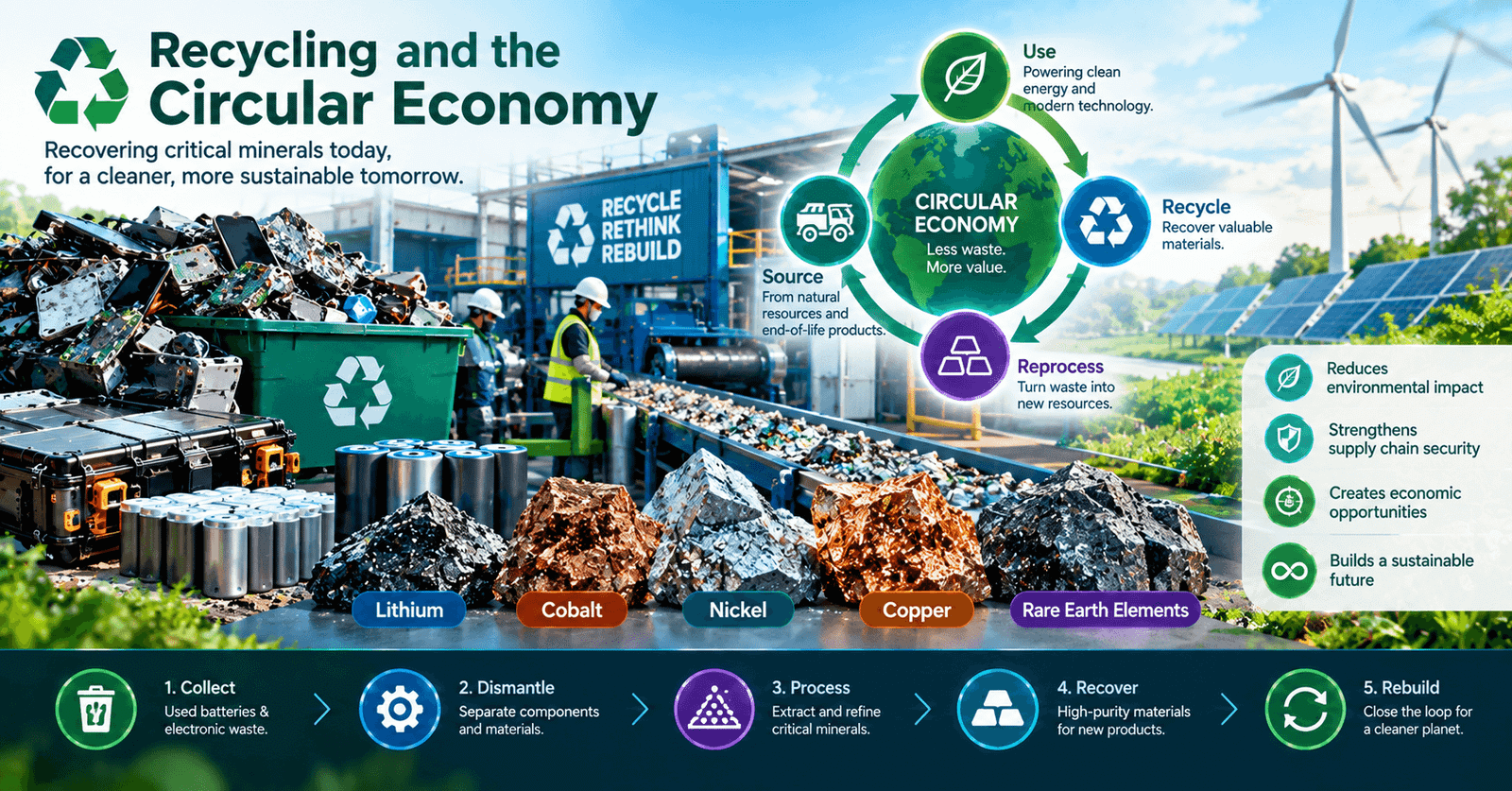
Electronics are another opportunity. Phones, computers, circuit boards and other devices contain small amounts of valuable metals. The challenge is that those materials can be dispersed across millions of products, making collection and processing essential.
Product design can improve the economics of recovery. Devices that are easier to disassemble can reduce labour and processing costs. Standardized components, clear material identification and responsible take-back systems can also help.
However, recycling cannot immediately replace primary mining. A growing economy needs new material to build new infrastructure, and many products remain in service for long periods. If a country is rapidly adding vehicles, power lines and renewable equipment, there may not yet be enough old material available for recycling to satisfy new demand.
Recycling should therefore be seen as a complement rather than a magic substitute. Over time, as larger volumes of batteries, vehicles and electronic equipment reach the end of their useful lives, secondary supply can become more significant.
A resilient material system combines new production with efficient use, longer product lifetimes, reuse, repair and high-quality recycling. That approach can reduce waste while improving resource security.
Can Technology Reduce the Need for Critical Minerals?
Technology can change mineral demand in several ways. It can make a device more material-efficient, replace one material with another, improve recycling or create an entirely different technology.
Battery chemistry is a clear example. Different battery designs can change the need for nickel, cobalt, manganese, graphite and other materials. Electric motors can also be designed with different magnet technologies. Power systems can use different equipment configurations.
Substitution is rarely free. A replacement material may be more expensive, heavier, less efficient or harder to process. A technology may work in a laboratory but require years of engineering before it can be manufactured at scale.
Efficiency is often more achievable. If manufacturers can produce the same performance with less material, total demand can fall even while the number of products increases. Improvements in battery energy density, manufacturing yield and material recovery can therefore have meaningful effects.
Exploration technology can also reduce supply risk by finding deposits more efficiently. Remote sensing, geophysical surveys, geochemical analysis and improved geological modelling can help identify promising areas before expensive drilling programs.
Processing innovation may be just as important as mining innovation. Better separation techniques can improve recovery from existing ores or industrial waste. In some cases, a material previously considered uneconomic can become valuable if processing costs fall.
The key point is that criticality is not fixed. It evolves with technology and economics. A mineral that appears highly vulnerable today may become less important if a substitute becomes commercially successful. Conversely, a previously overlooked material can become strategically important when a new technology creates rapid demand.
This constant change is why mineral lists and supply strategies need regular review rather than being treated as permanent rankings.
What This Means for India and the Wider Global Economy
For India and other fast-growing economies, mineral security has a direct connection to industrial development. Manufacturing electric vehicles, batteries, electronics, renewable-energy equipment and advanced machinery requires reliable access to materials and processed inputs.
India has substantial demand for energy, transportation and digital infrastructure, which means material supply chains can influence long-term industrial competitiveness. Domestic exploration, recycling, processing capacity and international partnerships can all contribute to resilience.
The issue is not simply about owning mineral deposits. Building refining, component manufacturing and recycling capabilities can allow more value to remain within an economy. Skills, infrastructure, research institutions and reliable electricity are also important.
For businesses, mineral security can influence procurement strategy. Companies may seek multiple suppliers, longer-term contracts, recycled inputs or alternative materials. Large manufacturers can also invest directly in upstream projects or processing capacity.
For consumers, the connection is indirect but real. Material costs influence the price of batteries, vehicles, electronics and infrastructure. Supply disruptions can affect product availability and delivery times.
For investors and policymakers, the most important lesson is to look beyond headline mineral prices. A material may be inexpensive today but strategically important because demand is expected to rise, supply is concentrated or new production takes many years.
Global cooperation remains essential. Modern supply chains cross borders, and resource security cannot be achieved by isolation alone. Producer countries need investment and fair value creation, while consuming countries need reliable supplies. Stronger standards can help ensure that growth does not come at the expense of workers, communities or ecosystems.
India’s opportunity is therefore broader than mining. It includes exploration, processing, manufacturing, recycling, research and international cooperation.
The Future of Critical Mineral Security
The future of mineral security will probably be defined by diversification. Instead of relying heavily on one mine, one country or one processing route, industries are likely to build networks with more suppliers and more flexible technologies.
Recycling will become more important as the global stock of batteries, vehicles and electronic equipment grows. Improvements in collection and processing can turn waste into a secondary source of useful material.
Substitution will continue as engineers search for cheaper, safer and more abundant materials. Some alternatives will succeed while others will remain niche technologies. The outcome will depend on cost, performance, manufacturing scale and consumer demand.
Governments are also likely to pay closer attention to processing capacity. A country with ore but no refining capability can still be vulnerable. Building technical expertise and industrial infrastructure can therefore be as important as discovering new deposits.
Environmental standards will become more significant as new mines are developed. Communities and regulators are increasingly focused on water, biodiversity, emissions, land use and local economic benefits. Projects that ignore these concerns can face delays, opposition and reputational risk.
Data will improve decision-making. Better information about production, trade flows, inventories, project pipelines and recycling can help governments and companies identify bottlenecks earlier.
The long-term objective should not be a world in which every country mines everything. That would be unrealistic. The better goal is a global system with enough diversity and cooperation to absorb shocks.
Critical minerals matter because they connect geology to everyday life. The phone in a pocket, the battery in a vehicle, the electricity moving through a grid and the servers supporting online services all depend on physical materials. Understanding those materials makes the modern economy easier to understand—and makes it clear why resource security will remain an important issue for years to come.
Frequently Asked Questions About Critical Minerals
What makes a mineral critical?
A mineral is generally described as critical when it has high economic or strategic importance and faces meaningful supply risk. Different governments use different methods and lists, so the definition can vary by country.
Are critical minerals the same as rare earth elements?
No. Rare earth elements are a specific group of elements. Critical minerals are a broader category that can include rare earths as well as lithium, copper, graphite, cobalt, nickel, gallium and many other materials.
Why are lithium and copper important?
Lithium is widely used in rechargeable battery technologies, while copper is a major electrical conductor used in wiring, motors, grids and electronics. Their importance is linked to the expansion of electrification and technology.
Why is mining not enough?
A mined material often needs concentration, refining, chemical conversion and component manufacturing before it can be used. Supply risk can therefore exist at any stage of the value chain.
Can recycling solve the mineral problem?
Recycling can reduce pressure on new extraction and create a valuable secondary supply, but it cannot immediately meet all new demand because many materials are still locked inside products that are in use.
Why do governments care about mineral supply?
Minerals affect energy systems, manufacturing, electronics, defense, transportation and infrastructure. A major disruption can therefore affect national economies and strategic industries.
Are critical minerals always rare?
No. Criticality is about the combination of importance and supply risk. A mineral can be relatively abundant but still be vulnerable because production or refining is concentrated.
Will technology eliminate the need for critical minerals?
Technology can reduce dependence through efficiency, substitution, recycling and new designs, but most technologies still require physical materials. Demand is likely to change rather than disappear.
What can ordinary people do?
People can extend the life of electronics, repair products when practical, recycle batteries and electronics through appropriate programs, and consider the durability and repairability of products when making purchases.
Final Takeaway
The story of critical minerals is ultimately a story about how the modern world is built. Digital services, electric transportation, renewable power, communications, advanced manufacturing and everyday consumer products all depend on materials that begin in mines, quarries, brines and industrial processing facilities.
The biggest misunderstanding is that critical minerals are simply rare rocks. In reality, criticality is a relationship between importance and supply risk. A material becomes strategically significant when industries need it, alternatives are limited, production is concentrated, processing is difficult or supply cannot expand quickly enough.
That is why the future will depend on more than discovering new deposits. The world needs better exploration, responsible mining, efficient processing, diversified trade, stronger recycling systems, material substitution and smarter product design.
The United States and European Union already use formal frameworks to identify vulnerable materials, while the International Energy Agency tracks mineral demand and supply developments connected to energy technologies. These efforts show that mineral security has moved from a specialized mining topic into a major economic and technology issue.
For consumers, the subject may seem distant. It is not. The minerals inside a phone, car, battery, computer or electrical system connect ordinary life to global geology and international trade.
Understanding that connection helps explain both the opportunities and the challenges of the next technological era. The modern world will need more energy, more computing, more electrification and more infrastructure. Meeting those needs responsibly will require not only innovation at the software and engineering level, but also innovation in how society finds, produces, uses and recycles the materials underneath it all.
Research Sources
- International Energy Agency — Global Critical Minerals Outlook 2025
- U.S. Geological Survey — About the 2025 List of Critical Minerals
- U.S. Geological Survey — Mineral Commodity Summaries 2025
- European Commission — European Critical Raw Materials Act
- EUR-Lex — Regulation on Critical and Strategic Raw Materials
Related Articles
Disclaimer
This article is for general educational and informational purposes. Mineral lists, policies, technologies, prices and supply-chain conditions can change. For investment, business, legal or policy decisions, consult current primary sources and qualified professionals.
Questions & Answers
Have a question about this article? Ask it below. Other GrayGaps readers can share their experience and help answer it.