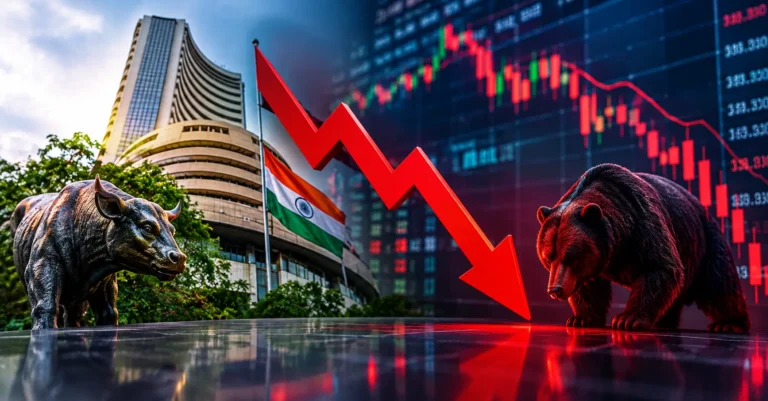
Oil Prices Near $100: What It Means for India’s Economy, Inflation, Rupee and Stock Market
If crude oil remains near $100 for a prolonged period, India could face a higher oil-import bill, pressure on the rupee, renewed inflation risks and higher costs for fuel-sensitive industries.
Oil prices near $100 are therefore an important economic warning signal for an oil-importing country such as India.
The biggest risk is not necessarily one day of expensive crude. The bigger concern is whether elevated prices continue for weeks or months.
Oil Shock at a Glance
Psychologically important crude-price level
Approx. rupee per U.S. dollar reported on Sept. 8
India’s approximate crude-import dependence
- Why Are Oil Prices Near $100?
- Why Expensive Oil Matters for India
- Impact on the Indian Rupee
- Will Oil Push Up Inflation?
- What Happens to Petrol and Diesel Prices?
- Impact on India’s Economic Growth
- Impact on Indian Stock Markets
- Which Sectors Could Be Hit?
- Which Businesses Could Benefit?
- What Can the RBI Do?
- What Can the Government Do?
- Impact on Indian Households
- Three Possible Oil Scenarios
- What Investors Should Watch
- Related Articles
- Frequently Asked Questions
- Official Sources & Research
1. Why Are Oil Prices Near $100?
International crude prices have moved sharply higher as geopolitical tensions in the Middle East raise concerns about supply disruptions.
The latest rally is particularly important because global oil markets are extremely sensitive to disruptions involving major producing countries, refineries and shipping routes.
On September 8, Brent crude was reported near the $100 level, while market participants continued to assess the risk of further supply disruption.
Breaking-market takeaway:
The key question for India is no longer simply whether crude touches $100. The more important question is how long prices remain elevated.
<p>
That makes international crude prices an important factor for India’s trade balance, currency market and inflation outlook.
</p>
<p>
For India, <strong>oil prices near $100</strong> could increase pressure on the country’s energy import bill and the wider economy.
</p>
2. Why Expensive Oil Matters for India
India is one of the world’s major oil-consuming economies and imports a large share of the crude it processes.
That makes international crude prices an important factor for India’s trade balance, currency market and inflation outlook.
When crude becomes more expensive, Indian importers generally need more dollars to purchase energy supplies.
Oil prices near $100 can increase the value of India’s energy imports, particularly if the higher prices persist for an extended period.
The basic chain reaction:
Higher crude → higher import cost → greater dollar demand → rupee pressure → higher rupee cost of imports.
India’s Petroleum Planning & Analysis Cell publishes official data on crude imports, petroleum products and the Indian oil sector.
3. Impact on the Indian Rupee
Oil prices and the rupee are closely watched together because international crude is predominantly priced in U.S. dollars.
When Indian oil importers need more dollars, demand for the U.S. currency can increase.
On September 8, the rupee weakened to around ₹94.8175 per dollar as the market assessed the impact of higher crude prices and broader currency pressures.
Investors are closely watching oil prices near $100 because a sustained rise can increase India’s dollar demand and add pressure to the country’s external balance.
| Oil Environment | Potential Effect on India |
|---|---|
| Lower crude prices | Generally reduces the energy import burden. |
| Stable crude prices | Makes India’s external-sector planning easier. |
| Crude near $100 for an extended period | Can increase import costs and pressure the rupee. |
4. Will Oil Push Up Inflation?
Potentially, yes.
The impact can happen directly through fuel and indirectly through transportation, logistics, manufacturing and petroleum-based inputs.
For example, a truck transporting food uses fuel. A factory may use petroleum-derived chemicals. Airlines need aviation fuel. Packaging materials can also have links to petrochemical inputs.
If oil prices near $100 remain elevated for several weeks or months, the pressure can spread through transportation and production costs, although the final effect depends on fuel pricing, taxes, exchange rates and other economic conditions.
Why inflation matters:
A sustained oil shock can make it more difficult for the central bank to balance inflation control with economic growth.
Higher crude prices can therefore become an important variable for India’s inflation outlook, especially when energy costs remain elevated for a prolonged period.
5. What Happens to Petrol and Diesel Prices?
A rise in international crude does not automatically translate into an identical rise in petrol or diesel prices in India.
Retail fuel prices are influenced by crude costs, refining margins, freight, exchange rates, taxes and pricing decisions.
Important:
Consumers should therefore watch the trend and duration of the crude-price increase rather than assuming that every daily oil-market move will immediately appear at the petrol pump.
For households, the duration of the increase is especially important. A temporary spike can have a different economic effect from a prolonged period of elevated crude prices.
6. Impact on India’s Economic Growth
Higher oil prices can act like an external cost shock for an oil-importing economy.
Households may spend more on transportation. Companies may face higher logistics and energy costs. Airlines can face higher fuel bills, while manufacturers may see input costs rise.
If companies cannot pass those costs to customers, profit margins may come under pressure.
The good news:
India has several buffers, including substantial refining capacity, diversified crude sourcing and policy tools that can help reduce the impact of temporary supply shocks.
The overall economic impact will depend on the level of crude prices, the duration of the shock, currency movements, domestic fuel pricing and the ability of businesses and households to absorb higher costs.
7. Impact on Indian Stock Markets
The stock market reaction to expensive crude is usually uneven.
Oil-sensitive sectors can come under pressure, while upstream energy producers can sometimes benefit from higher crude realizations.
| Sector | Possible Impact |
|---|---|
| Airlines | Negative pressure from higher aviation fuel costs. |
| Logistics | Higher diesel and transportation costs. |
| Tyres | Potential pressure from petroleum-linked raw materials. |
| Paints | Possible increase in petroleum-derived input costs. |
| Chemicals | Higher feedstock and energy costs. |
| Upstream oil producers | Potential benefit from higher crude realizations. |
Crude-sensitive stocks can react quickly when investors reassess earnings expectations. However, individual companies may respond differently depending on their pricing power, hedging, debt and operating structure.
8. Which Sectors Could Be Hit?
The effects of higher crude can spread across the economy.
- Airlines: fuel is a major operating expense.
- Logistics: transportation costs can increase.
- Tyres: synthetic rubber and petrochemical inputs can become more expensive.
- Paints: several raw materials are linked to petroleum.
- Chemicals: feedstock costs can rise.
- Consumer businesses: logistics and packaging costs can increase.
Businesses with thin margins and limited ability to pass higher costs to customers may face greater pressure if the crude shock persists.
9. Which Businesses Could Benefit?
Not every energy-related company loses when crude prices rise.
Upstream oil and gas producers may benefit from stronger crude realizations. However, the actual benefit depends on production volumes, costs, taxation, hedging and government policy.
Investor warning:
Higher oil prices do not automatically mean every oil stock will rise. Investors should examine company-specific earnings, valuation, debt, production and refining exposure.
10. What Can the RBI Do?
The RBI cannot control international crude prices, but it can respond to their economic consequences.
The central bank can monitor inflation expectations, currency-market conditions, liquidity and financial stability.
The challenge is that an oil shock can create both inflation pressure and growth pressure at the same time.
The policy dilemma:
Higher oil → inflation risk.
Higher oil → weaker household and business purchasing power.
Therefore, policymakers must balance price stability with economic growth.
11. What Can the Government Do?
The government has several possible tools to reduce the economic impact of an oil shock.
12. Impact on Indian Households
For households, the impact may appear gradually.
Fuel costs can affect personal transportation, delivery charges, travel expenses and the cost of transporting everyday products.
Simple example:
If logistics companies face higher diesel costs, some of that additional expense can eventually be reflected in freight rates and the prices of transported goods.
This does not mean every product will become more expensive immediately. The actual effect depends on competition, demand, transportation costs and how businesses manage their margins.
13. Three Possible Oil Scenarios
| Scenario | Potential India Impact |
|---|---|
| Oil falls below $90 | Lower import pressure and potentially better inflation and rupee conditions. |
| Oil stays around $95–$105 | Manageable but persistent pressure on imports, currency and inflation. |
| Oil stays above $110 | Greater risk to inflation, growth, currency and corporate margins. |
Note:
These are scenario illustrations, not investment forecasts or guaranteed price targets.
14. What Investors Should Watch
Investors should monitor several indicators together instead of looking at crude prices alone.
| Indicator | Why It Matters |
|---|---|
| Brent crude | Shows the global oil-price trend. |
| USD/INR | Shows currency pressure. |
| CPI inflation | Shows consumer-price developments. |
| India’s trade balance | Shows external-sector pressure. |
| RBI policy | Important for rates, liquidity and market sentiment. |
| Corporate margins | Shows which businesses are absorbing higher costs. |
Bottom Line
Oil prices near $100 are an important warning signal for India, but they do not automatically mean an economic crisis.
The duration of the oil shock will matter enormously. If prices remain elevated, India could face pressure through the import bill, rupee, inflation and corporate costs. If the spike proves temporary, the economic impact could be considerably more manageable.
16. Frequently Asked Questions
Q1. Why is $100 oil important for India?
India imports a large amount of crude oil, so higher global prices can increase the country’s import bill and put pressure on the rupee and inflation.
Q2. Will petrol prices immediately increase?
Not necessarily. Retail fuel prices depend on several factors beyond international crude prices.
Q3. Does expensive oil weaken the rupee?
It can because oil importers generally require more U.S. dollars when crude prices rise.
Q4. Which sectors are most vulnerable?
Airlines, logistics, tyres, paints and some chemical and consumer businesses can be particularly sensitive to higher energy and petroleum-linked costs.
Q5. Can the RBI control crude oil prices?
No. Global crude prices are determined by international supply, demand, inventories and geopolitical conditions. The RBI can respond to the economic effects.
Q6. Is $100 crude automatically bad for India’s economy?
No. A short-lived spike is different from crude remaining above $100 for several months. Duration is one of the most important variables.
17. Official Sources & Research
1. Petroleum Planning & Analysis Cell (PPAC)
Official Government of India data on crude imports, petroleum products and oil-sector statistics.
2. PPAC — Crude Oil Import & Export Data
Official monthly import/export information for crude oil and petroleum products.
3. Reserve Bank of India
Official RBI information on monetary policy, inflation, currency and financial conditions.
4. RBI — Inflation & Crude Oil Research
RBI publications and research discussing inflation risks associated with global commodity and crude-oil prices.
5. Ministry of Statistics & Programme Implementation
Official Indian statistics, including Consumer Price Index information.
6. Reuters — India Rupee & Oil Market Update
Reporting on the September 8, 2026 crude-price and rupee movement.
Related Articles
Loan Closed but Still Showing on CIBIL? What It Means
AI and Personal Finance: Can You Trust AI With Your Money?
AI Agents Explained: How They Work, Uses, Benefits and Risks
Why Your Salary Disappears Before Month-End: Common Money Mistakes
Disclaimer
This article is for general informational and educational purposes only. It is not investment, financial, tax or trading advice. Crude oil, currency and stock-market prices can change rapidly. Readers should verify the latest market data from official or reliable sources and conduct their own research or consult a qualified financial professional before making investment decisions.
Questions & Answers
Have a question about this article? Ask it below. Other GrayGaps readers can share their experience and help answer it.