AI Safety in 2026: 10 Biggest Risks, Powerful Benefits and the Future of Artificial Intelligence

AI Safety in 2026 has become one of the most important conversations surrounding artificial intelligence. AI is no longer a technology used only by researchers and large technology companies. It is now part of education, business, software development, customer service, content creation, cybersecurity, scientific research and everyday digital life.
Artificial intelligence can help people work faster, understand complicated information, automate repetitive tasks and discover new possibilities. At the same time, increasingly capable AI systems can create serious challenges when they produce incorrect information, expose private data, amplify bias, enable fraud or receive more authority than they can safely handle.
This creates an important question: How can society enjoy the benefits of artificial intelligence while reducing its risks?
This article provides a detailed look at AI Safety in 2026, including the biggest risks, major benefits, privacy concerns, cybersecurity threats, AI hallucinations, misinformation, employment changes, autonomous AI agents, governance and the long-term future of artificial intelligence.
For more technology and knowledge articles, visit the GrayGaps homepage.
Table of Contents
- Why AI Safety Matters in 2026
- What Is AI Safety?
- The Biggest AI Risks in 2026
- 1. Misinformation, Deepfakes and Digital Manipulation
- 2. Privacy and Personal Data
- 3. AI Bias and Unfair Decisions
- 4. AI Hallucinations and Incorrect Information
- 5. Cybersecurity and AI-Powered Attacks
- 6. Job Disruption and the Future of Work
- 7. Autonomous and Agentic AI
- 8. AI in Healthcare, Finance and Critical Systems
- 9. Concentration of AI Power
- 10. Environmental and Infrastructure Challenges
- Major Benefits of Artificial Intelligence
- AI Safety and Responsible AI
- AI Governance in 2026
- How Individuals Can Use AI Safely
- AI Safety Checklist for Businesses
- The Future of AI Safety
- Why Human Oversight Still Matters
- AI Safety in Education
- Balancing AI Innovation and Safety
- The Long-Term Future of AI
- Final Verdict
- Frequently Asked Questions
- References
- Disclaimer
Why AI Safety Matters in 2026
Artificial intelligence has developed rapidly over the last few years. Earlier AI systems were often designed for specific tasks such as recognizing images, recommending products or translating text. Modern generative AI systems can perform a much wider range of activities, including writing, coding, summarizing, reasoning, creating images and interacting with software.
The growing capabilities of AI make safety increasingly important because the consequences of an error can become larger as systems are given more responsibilities.
For example, an incorrect answer from a simple chatbot may only waste a few minutes. But if an AI system is connected to a business database, financial workflow or critical operational system, an incorrect decision could have much greater consequences.
AI Safety in 2026 therefore is not only about extreme future scenarios. It also concerns practical problems happening today.
These include:
- Incorrect AI-generated information
- Privacy and data protection
- Cybersecurity vulnerabilities
- Deepfakes and misinformation
- Algorithmic bias
- Fraud and impersonation
- Workplace disruption
- Unsafe automation
- Uncontrolled AI agents
- Concentration of technological power
The goal of AI safety is not to stop technological progress. Instead, it is to make sure that progress happens in a way that reduces avoidable harm.
What Is AI Safety?
AI safety is the practice of identifying, preventing, reducing and managing risks associated with artificial intelligence systems.
It includes technical reliability, cybersecurity, privacy, fairness, transparency, human oversight, responsible deployment and governance.
The concept is much broader than simply preventing an AI system from behaving badly. It also includes making sure that the system is used in the right environment and for an appropriate purpose.
For example, an AI writing assistant might be perfectly acceptable for creating a first draft of an article. The same system should not automatically make an important medical diagnosis without appropriate validation and professional oversight.
The National Institute of Standards and Technology’s AI Risk Management Framework focuses on trustworthy characteristics such as validity and reliability, safety, security and resilience, accountability and transparency, explainability and interpretability, privacy enhancement and fairness.
This demonstrates why AI safety should be viewed as a complete system rather than a single technical feature.
The Biggest AI Risks in 2026
There is no single AI risk that affects every person and organization equally. The most important risk depends on the technology, its purpose, the information it receives and the amount of authority it has.
However, several risks are becoming particularly important as artificial intelligence becomes more capable and widely used.
1. Misinformation, Deepfakes and Digital Manipulation
One of the most visible AI risks in 2026 is the rapid production of synthetic content.

AI can create realistic text, images, voices and videos. These technologies have many positive uses. Creators can produce visual concepts more quickly, businesses can create marketing material and educators can develop learning resources.
However, the same capabilities can be abused.
Someone can create a fake image of a real person, imitate someone’s voice or generate a video that appears authentic. Fraudsters can use synthetic media to make social engineering attacks more convincing.
The problem is not simply that fake content exists. Manipulated content has existed for many years. The major difference is that AI makes production faster, cheaper and more accessible.
This can make it harder for ordinary users to determine what is real.
A responsible digital environment therefore requires better verification habits.
People should avoid immediately believing or sharing surprising information. Important claims should be checked against reliable sources. Financial requests and urgent messages should be verified through another trusted communication channel.
Technology companies can also work on content provenance and detection systems, although no detection technology should be treated as perfect.
The strongest defense against misinformation is likely to combine technology, media literacy, secure identity systems and responsible platform practices.
2. Privacy and Personal Data
Privacy is another major part of AI Safety in 2026.
AI systems can process enormous amounts of information. Depending on the application, that information may include documents, messages, images, customer records, business information or other personal data.
The more information an AI system receives, the more important it becomes to understand how that information is stored, processed and protected.
Organizations should follow data minimization principles. An AI system should receive only the information required to complete its task.
For example, if an AI assistant only needs a short document to summarize, there may be no reason to provide an entire private database.
Access controls are also important. AI systems should not automatically receive access to every file, account or application available to a user.
Businesses should establish clear rules for:
- Data collection
- Data retention
- Access permissions
- Encryption
- Employee use of AI tools
- Third-party AI services
- Sensitive information
- Incident response
Individuals should also be careful. Users should avoid entering passwords, confidential documents, private financial information or other sensitive information into AI services unless they understand the service’s privacy practices and have a legitimate reason to do so.
3. AI Bias and Unfair Decisions
Artificial intelligence learns patterns from data and from the objectives designed by humans. If the training data contains historical inequalities or incomplete representation, an AI system can reproduce those patterns.
Bias can become particularly serious when AI is used for high-impact decisions.
Examples include:
- Hiring
- Lending
- Insurance
- Education
- Healthcare
- Employment evaluation
- Public services
An automated decision can appear objective simply because a computer produced it. But the underlying data, design choices and evaluation methods can still contain problems.
Responsible AI development therefore requires testing across relevant populations.
Organizations should monitor outcomes after deployment instead of assuming that a system will remain fair forever.
People affected by important automated decisions should also have a meaningful way to challenge or appeal those decisions.
AI cannot automatically eliminate human bias. In some circumstances, it can reproduce or amplify existing patterns.
AI safety therefore requires transparency and continuous evaluation.
4. AI Hallucinations and Incorrect Information
AI hallucinations are one of the most common practical problems with generative AI.
An AI system can produce information that sounds confident and professional while being factually incorrect.
It may invent a source, produce an incorrect date, misunderstand a question or combine unrelated information.
This is especially important because people naturally associate fluent communication with knowledge.
However, a well-written answer is not automatically a verified answer.
The consequences depend on the situation.
A wrong answer during brainstorming may not matter. A wrong answer involving a financial decision, legal issue, medical question or safety procedure can be much more serious.
Users should therefore verify important information with reliable sources.
Organizations can reduce hallucination risks by connecting AI systems to trusted databases, retrieval systems, structured information and verification processes.
Developers should also evaluate AI systems using realistic examples instead of relying only on general benchmark scores.
One of the most important principles of AI Safety in 2026 is simple: AI output should be judged according to the consequences of being wrong.
5. Cybersecurity and AI-Powered Attacks
AI is becoming increasingly important in cybersecurity.
Security teams can use AI to summarize alerts, identify suspicious patterns, classify threats and help investigate incidents.
However, AI is also a dual-use technology.
The same capabilities can potentially help attackers create convincing phishing messages, automate certain tasks and scale social engineering operations.

AI agents introduce another layer of risk because they may have access to tools.
An AI system that can only answer questions has a different risk profile from an agent that can access files, send messages or interact with external applications.
Organizations should therefore apply strong security controls around AI systems.
Important measures include:
- Least-privilege access
- Strong authentication
- Permission management
- Activity logging
- Security testing
- Adversarial testing
- Human approval for sensitive actions
- Incident response procedures
AI security should be treated as part of the organization’s overall cybersecurity architecture.
6. Job Disruption and the Future of Work
One of the biggest questions surrounding artificial intelligence is its impact on employment.
AI can automate tasks, but task automation does not always mean complete job replacement.
Most occupations contain multiple activities. Some activities may be automated while others still require human communication, judgment, creativity, physical work or responsibility.
AI may therefore change jobs rather than simply eliminate them.
Some workers may become more productive because AI handles repetitive activities. Other workers may face reduced demand for certain skills.
New jobs can also emerge around AI development, implementation, evaluation, security, governance and oversight.
The challenge is managing the transition.
Businesses can support workers by providing training and redesigning roles rather than treating automation as a simple replacement strategy.
Workers can benefit from developing skills that complement AI, including:
- Critical thinking
- Communication
- Problem solving
- Domain expertise
- Verification
- Leadership
- Creativity
- Human interaction
The future workplace may not be about humans competing directly against AI. It may increasingly involve humans working with AI tools.
7. Autonomous and Agentic AI
A major development in artificial intelligence is the movement from simple question-and-answer systems toward AI agents capable of performing multiple steps.
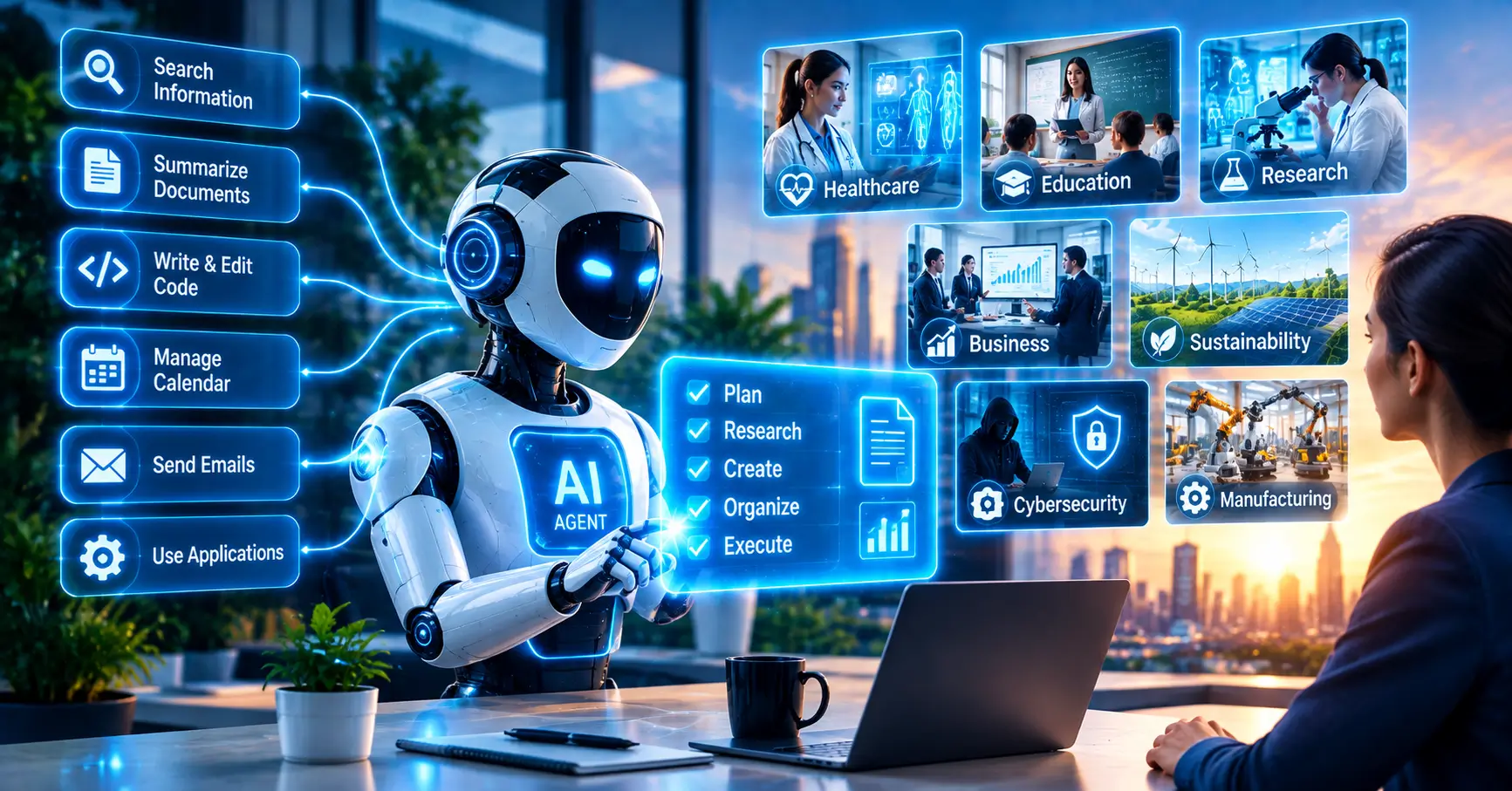
An AI agent may search for information, organize files, interact with applications, prepare documents or complete a workflow.
This creates significant opportunities for productivity.
But greater autonomy also creates greater responsibility.
If an AI system generates an incorrect answer, a human can potentially correct it before taking action.
If an autonomous agent performs the action itself, the same error can become an actual event.
For this reason, AI agents should operate within clearly defined boundaries.
High-impact actions should often require confirmation. Permissions should be limited. The system should have access only to necessary information and tools.
Organizations should also maintain logs so that important actions can be reviewed later.
The principle is not that AI agents must never be autonomous. Instead, autonomy should match the potential consequences of failure.
8. AI in Healthcare, Finance and Critical Systems
Artificial intelligence can provide valuable assistance in healthcare, finance, infrastructure and other important industries.
AI can help analyze large amounts of information, detect patterns, support research and automate administrative processes.
However, high-impact applications require stronger safety standards.
An incorrect recommendation in a casual writing application is very different from an incorrect recommendation in a medical or financial environment.
Organizations should therefore conduct domain-specific testing.
General AI benchmark performance does not automatically demonstrate that a system is safe for a particular real-world application.
Human review is particularly important when AI recommendations can significantly affect people’s lives.
Monitoring is also essential because real-world conditions can change.
A model that performs well during testing may behave differently when exposed to new populations, new information or unusual circumstances.
9. Concentration of AI Power
Advanced AI development requires significant computing resources, specialized expertise, infrastructure and financial investment.
This can result in a relatively small number of organizations controlling powerful AI models or infrastructure.
Large-scale development can provide advantages. Major organizations may have resources to invest in security research, testing and infrastructure.
However, excessive concentration can create other problems.
Businesses may become dependent on a small number of providers. Researchers may have limited access to important technologies. Users may have fewer alternatives.
A healthy AI ecosystem needs innovation, competition, research and accountability.
Organizations should also consider resilience. If an important business process depends completely on one AI provider, the organization should have contingency plans for outages or changes in service.
AI safety is therefore not only a technical issue. It also involves economic structures, institutions and governance.
10. Environmental and Infrastructure Challenges
AI systems require computing infrastructure, and computing requires electricity, cooling, networking equipment and physical data centers.
As AI adoption increases, efficiency becomes increasingly important.
The environmental impact of an AI system depends on several factors, including model size, hardware efficiency, data-center design, utilization and energy sources.
Organizations can reduce unnecessary resource use by choosing models appropriate for the task rather than automatically using the largest system available.
AI infrastructure also needs resilience.
If companies become heavily dependent on AI services, outages can disrupt important operations.
Businesses should maintain fallback procedures for critical workflows.
Environmental responsibility and reliability should therefore be considered part of long-term AI planning.
Major Benefits of Artificial Intelligence
AI safety discussions should not focus only on risks.
The reason artificial intelligence is being adopted so quickly is that it can provide significant benefits.
AI can help people process information, automate repetitive tasks and explore ideas more quickly.
It can support:
- Education
- Scientific research
- Healthcare research
- Accessibility
- Cybersecurity
- Software development
- Business analysis
- Translation
- Creative work
- Customer service
For small businesses, AI can reduce the cost of tasks such as writing, research, data organization and customer communication.
For students, AI can provide explanations, practice questions and alternative ways of understanding difficult topics.
For researchers, AI can help organize large amounts of information and identify patterns.
For people with disabilities, AI-powered speech, vision and communication tools can improve accessibility.
AI can also support cybersecurity teams by helping them analyze large volumes of security information.
However, benefits are strongest when AI is used responsibly.
A powerful system can multiply productivity, but it can also multiply mistakes.
Safety helps determine which outcome becomes dominant.
AI Safety and Responsible AI
AI safety and responsible AI are closely connected but are not exactly the same.
AI safety often focuses on preventing harmful behavior, failures and loss of control.
Responsible AI is broader and includes fairness, accountability, transparency, privacy and social impact.
A system can be technically reliable while still creating unfair outcomes.
It can be secure while collecting unnecessary personal information.
It can be accurate while being used for an inappropriate purpose.
This is why organizations should consider multiple dimensions of trustworthiness.
Safety should not be reduced to one score.
High accuracy does not automatically mean an AI system is safe.
A written policy does not automatically make a system responsible.
Effective responsible AI requires practical processes such as testing, documentation, monitoring, access controls and accountability.
AI Governance in 2026
AI governance is becoming increasingly important as organizations integrate artificial intelligence into everyday operations.
Governance defines who is responsible for AI systems, how risks are assessed, what uses are permitted and how incidents are handled.
A practical AI governance program should begin with an inventory.
Organizations should know which AI systems they are using and what those systems can access.
They should classify applications according to risk.
A system used for brainstorming internal ideas does not require exactly the same controls as a system influencing financial or employment decisions.
Organizations should also establish clear rules for sensitive information and high-impact decisions.
Monitoring should continue after deployment because AI systems operate in changing environments.
When an incident occurs, there should be a clear process for investigation, communication and corrective action.
AI governance works best when it becomes part of normal business operations rather than remaining a document that employees rarely use.
How Individuals Can Use AI Safely
People do not need to be AI researchers to use artificial intelligence safely.
A few practical habits can significantly reduce common risks.
Protect Sensitive Information
Do not casually provide passwords, confidential documents, private financial information or other sensitive data to AI services.
Verify Important Information
Important claims involving health, money, law, employment or safety should be checked against reliable sources.
Be Careful With AI-Generated Media
Do not assume that a realistic image, video or voice recording is genuine.
Review Permissions
If an AI application can access files, email, calendars or other services, understand what permissions it has.
Keep Human Judgment Involved
AI can provide recommendations and possibilities, but people remain responsible for important decisions.
Learn Basic AI Literacy
Understanding hallucinations, bias, privacy and synthetic media will become increasingly important as AI becomes part of everyday life.
AI Safety Checklist for Businesses
Businesses should establish a practical AI safety program.
- Create an inventory of AI systems.
- Identify what information each system receives.
- Classify systems according to risk.
- Define acceptable and prohibited uses.
- Test systems before deployment.
- Limit permissions and access.
- Require human approval for sensitive actions.
- Monitor performance after deployment.
- Record incidents and unexpected behavior.
- Maintain an AI incident response plan.
- Train employees on safe AI use.
- Review systems regularly as technology changes.
Good AI governance should make safer decisions easier for employees rather than creating unnecessary complexity.
The Future of AI Safety
The future of AI safety will likely involve continuous testing and monitoring.
Instead of evaluating an AI model only before launch, organizations may increasingly evaluate complete AI systems throughout their lifecycle.
Automated monitoring can help detect unusual behavior.
Independent evaluations can test systems against standardized scenarios.
Security tools can monitor access to external applications.
Provenance systems may help users determine where digital content originated.
AI safety may also become more specialized.
Rather than using one general-purpose system for every task, organizations may combine general models with specialized databases, rules and verification systems.
This can make certain applications easier to control and evaluate.
Human oversight will also evolve.
The objective should not necessarily be for a human to approve every action. Instead, human attention should be concentrated on decisions where mistakes could have significant consequences.
Why Human Oversight Still Matters
Human oversight remains one of the most important parts of AI safety.
Humans provide context and accountability.
An AI system may identify a technically reasonable recommendation, but a human may recognize an unusual circumstance that changes the appropriate decision.
However, human oversight must be designed correctly.
If a worker is expected to approve hundreds of AI decisions in seconds, meaningful oversight becomes difficult.
Effective oversight requires enough time, information and authority to challenge an AI recommendation.
Users should understand what the system is doing and what information it used.
They should also have a clear way to stop or correct the system.
Human oversight should therefore be treated as an organizational design principle rather than simply an approval button.
AI Safety in Education
Education is one of the areas where AI can provide major benefits.
Students can use AI to receive explanations, practice languages, explore ideas and get feedback.
However, excessive dependence on AI can reduce genuine learning.
If a student asks AI to complete every assignment, they may receive a finished answer without developing the underlying skill.
A better approach is to use AI as a learning partner.
Students can compare AI explanations with textbooks, identify mistakes, ask follow-up questions and explain concepts in their own words.
Teachers can create assignments that emphasize reasoning, experiments, discussion and personal understanding.
AI literacy should become part of digital literacy.
Students should learn about:
- AI limitations
- Information verification
- Privacy
- Bias
- Copyright
- Responsible use
- Source evaluation
The strongest educational use of AI is not replacing thinking. It is helping people think more effectively.
Balancing AI Innovation and Safety
Innovation and safety do not have to be enemies.
A safe and reliable AI product can actually be easier for businesses and consumers to trust.
The key is proportionality.
A low-risk creative application can tolerate more experimentation than an AI system controlling critical infrastructure.
Safety requirements should increase as potential harm increases.
Developers can also integrate safety into product architecture.
Permission controls, confirmation steps, logging, evaluation and user controls can be designed directly into AI applications.
Companies should measure more than speed of deployment.
Long-term reliability, security incidents, user trust and quality should also matter.
A balanced approach allows innovation while creating strong protections around high-impact activities.
The Long-Term Future of AI
The long-term future of artificial intelligence remains uncertain.
Researchers have different views about how quickly AI capabilities will develop and which risks will become most important.
Some future systems may become significantly more capable at planning, coding, research and interacting with tools.
Greater capability could provide enormous benefits.
It could also increase the consequences of certain failures or misuse.
This is why long-term AI safety research examines questions involving evaluation, robustness, alignment, interpretability, cybersecurity and human control.
Preparing for advanced AI does not require predicting exactly what will happen.
Instead, society can build flexible safety systems that work across multiple possible futures.
Strong cybersecurity, privacy protection, reliable evaluation, responsible governance and clear accountability are useful regardless of exactly how AI capabilities evolve.
Final Verdict: Is AI Safe in 2026?
AI Safety in 2026 cannot be reduced to a simple answer of yes or no.
Artificial intelligence is neither automatically safe nor automatically dangerous.
Its impact depends heavily on how it is designed, trained, deployed, connected to other systems and used by people.
AI can improve productivity, education, research, accessibility, cybersecurity and communication.
At the same time, it can contribute to misinformation, privacy problems, fraud, bias, cybersecurity threats, incorrect information and unsafe automation.
The most responsible approach is therefore not to reject AI or blindly trust it.
Instead, people and organizations should learn how AI works, understand its limitations and establish appropriate safeguards.
Individuals can protect sensitive information and verify important claims.
Businesses can establish governance, restrict permissions and monitor systems.
Governments and standards organizations can create practical frameworks that encourage innovation while reducing high-impact risks.
Developers can build stronger evaluation, security and transparency mechanisms.
The future of artificial intelligence will depend not only on how powerful AI becomes but also on whether humans build the systems and institutions needed to use that power responsibly.
AI safety is not an obstacle to progress. It is an essential part of sustainable progress.
Frequently Asked Questions About AI Safety in 2026
What is AI Safety in 2026?
AI Safety in 2026 refers to the technical, organizational and social practices used to reduce harmful failures, misuse and unintended consequences from artificial intelligence systems. It includes reliability, privacy, cybersecurity, fairness, human oversight and governance.
What is the biggest AI risk in 2026?
There is no single biggest risk for every situation. Major concerns include misinformation, privacy loss, cybersecurity threats, AI hallucinations, bias, fraud, job disruption and unsafe autonomous actions.
Can AI be completely safe?
No complex technology can realistically be guaranteed to have zero risk. The practical objective is to identify foreseeable risks, reduce them, monitor systems and respond effectively when failures occur.
Will AI replace human jobs?
AI is likely to automate many tasks and change the way people work. Some jobs may decline while new roles emerge. The impact will vary significantly between industries and occupations.
Why does AI sometimes give wrong answers?
Generative AI systems can produce fluent text without guaranteeing factual accuracy. They may generate plausible but incorrect information, which is why important claims should be independently verified.
How can I use AI safely?
Protect sensitive information, verify important answers, review application permissions, be cautious with AI-generated media and keep human judgment involved in high-impact decisions.
What is responsible AI?
Responsible AI is the broader practice of developing and using artificial intelligence with attention to safety, fairness, privacy, transparency, accountability and social impact.
Why is AI governance important?
AI governance establishes responsibility, acceptable use, risk management, monitoring and incident response. It helps organizations use AI consistently and responsibly.
Is AI dangerous for the future?
AI creates both opportunities and risks. Future risks depend on how capable systems become, how they are deployed and how effectively society manages them. Preparing for potential risks while continuing beneficial research is an important part of responsible AI development.
What does NIST say about trustworthy AI?
NIST’s AI Risk Management Framework identifies characteristics such as validity and reliability, safety, security and resilience, accountability and transparency, explainability and interpretability, privacy enhancement and fairness with harmful bias managed.
References and Further Reading
Readers who want to explore AI safety and governance in greater depth can consult these authoritative resources:
-
NIST AI Risk Management Framework
-
NIST AI Security and Resilience
-
NIST Artificial Intelligence Standards
-
OECD AI Risks and Incidents
-
OECD AI Risks, Benefits and Policy Imperatives
-
World Economic Forum Global Risks Report 2026
Related Articles
Disclaimer
Disclaimer: This article is provided for general educational and informational purposes only. It should not be considered legal, financial, medical, cybersecurity or professional advice. Artificial intelligence technology, regulations, standards and best practices continue to change rapidly. Always verify important information using authoritative sources and consult an appropriately qualified professional when making high-impact decisions.
Questions & Answers
Have a question about this article? Ask it below. Other GrayGaps readers can share their experience and help answer it.