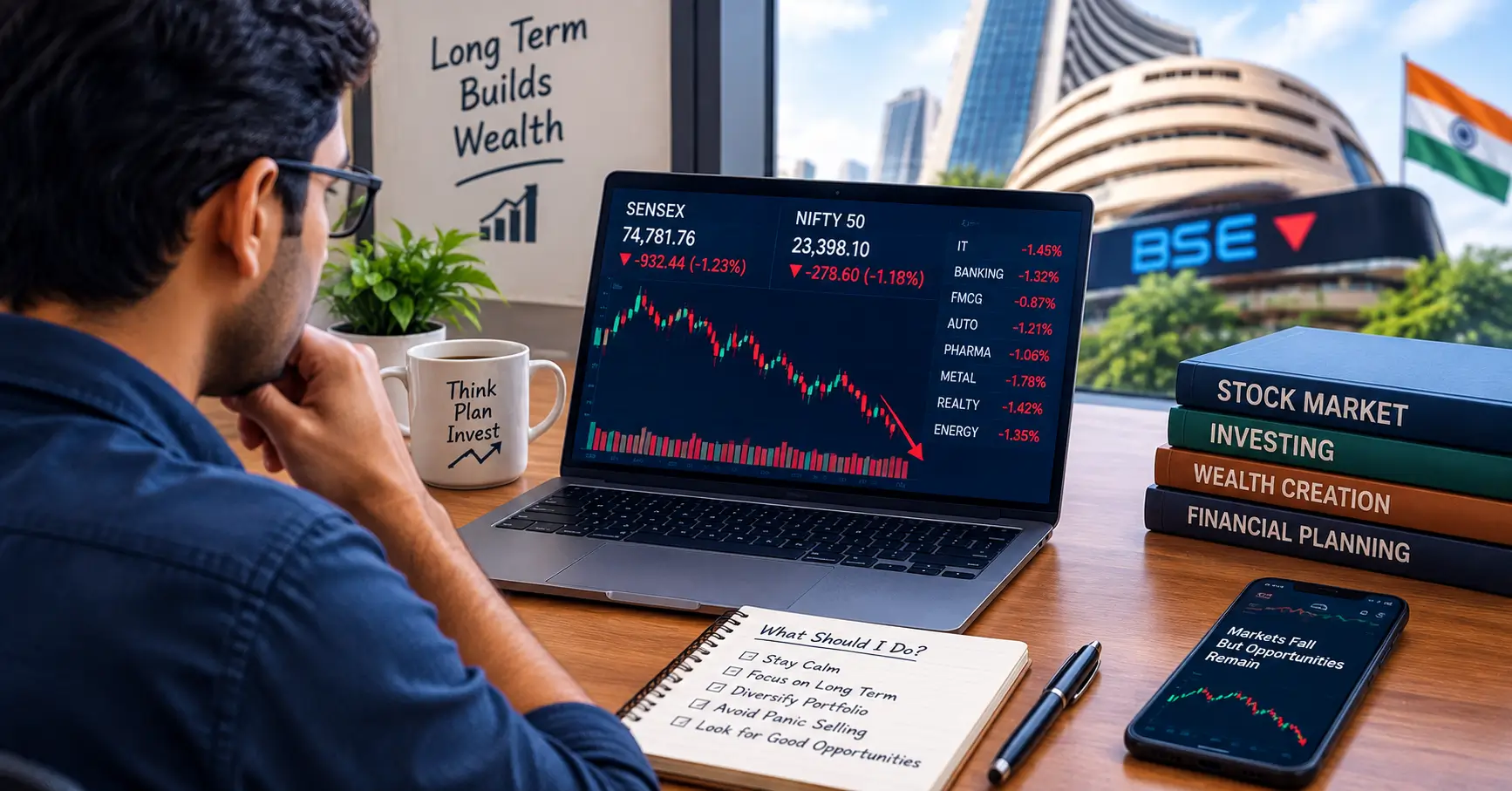
Sensex Nifty Today: Why Is the Indian Stock Market Falling?
Sensex and Nifty today amid falling Indian stock market trends.
A practical market explainer covering crude oil, geopolitical risk, interest rates, the rupee, foreign flows, sectors and what investors should watch next.
Quick Answer
Why is the Indian stock market falling today? The main pressure comes from renewed geopolitical tension in West Asia, higher crude oil prices, concerns about inflation and global interest rates, weak international cues, rupee pressure and continued foreign selling. These factors are interacting rather than acting independently.
Introduction: Why Are Sensex and Nifty Falling Today?
Indian equities ended a difficult week on September 11, 2026, with the Sensex and Nifty 50 under pressure from a combination of geopolitical risk, a sharp rise in crude oil prices, weaker global sentiment and concern about higher interest rates. The market had started the session with a much steeper fall, but buyers returned in parts of the market and helped the benchmark indices recover a portion of their early losses by the close.
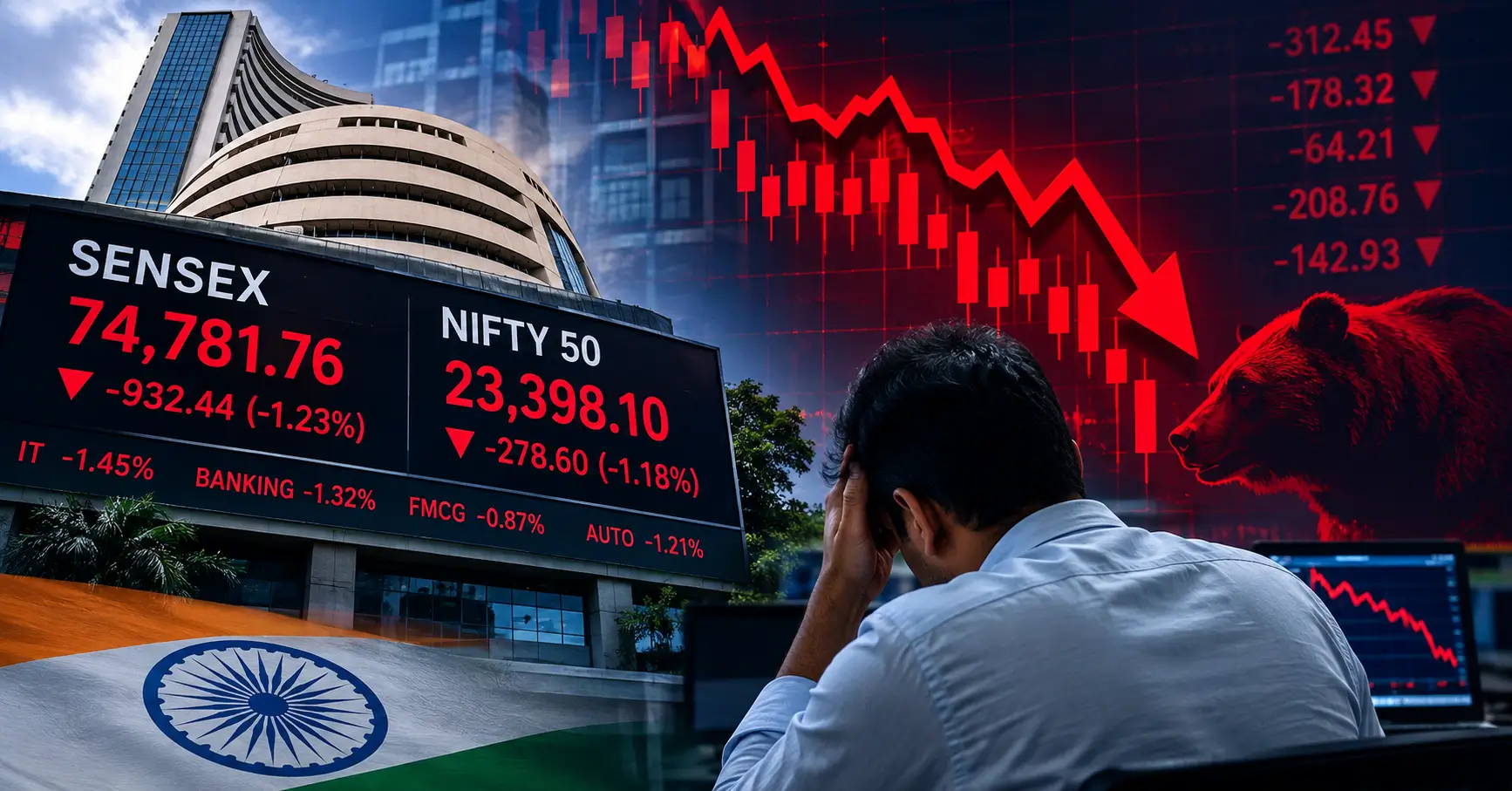
Sensex and Nifty today amid the Indian stock market fall.
The Sensex finished at 74,781.76, down 120.83 points, or 0.16%, while the Nifty 50 ended at 23,398.10, lower by 79.70 points, or 0.34%. The numbers tell part of the story. During the session, the indices traded substantially lower as investors reacted to renewed tension in West Asia and the resulting jump in crude prices. By the end of the week, both benchmarks had recorded a fifth straight weekly decline, showing that the pressure is broader than a single bad trading session.
This article explains the main reasons behind the fall, how crude oil affects India, why bond yields and the rupee matter, what foreign investors are doing, which sectors are more exposed, and what ordinary investors should watch next. The goal is not to predict the next market move, but to put today's headline into context.
Quick Answer: Why Is the Indian Stock Market Falling?
The simplest answer to the question, “Why is the Indian stock market falling today?” is that several risks are arriving at the same time. The immediate trigger is the escalation of geopolitical tensions in West Asia, which has pushed crude oil sharply higher and revived fears about inflation, shipping disruptions and global interest rates. India imports a large share of the crude it consumes, so a sustained oil shock can increase the cost of energy, transport and many manufactured goods.
The second pressure point is the global bond market. Higher US and other sovereign yields can make riskier assets less attractive, particularly when investors already feel uncertain about growth and inflation. A stronger dollar can also put pressure on the rupee, making imported commodities more expensive in local currency.
The third factor is positioning. When investors have experienced several weak sessions in a row, they often reduce exposure, lock in gains or wait for clearer signals. Foreign institutional selling can add to the pressure because large orders influence liquidity and sentiment. Today's decline therefore should not be treated as the result of one headline alone.
For long-term investors, the useful question is not simply whether the market is down. It is whether the underlying earnings outlook, valuations, personal financial goals and risk tolerance have changed enough to justify a different investment decision.
What Happened in the Market Today?
The trading session on September 11 was volatile. Early reports showed the benchmark indices falling much more sharply, with the Nifty moving toward the 23,200 area and the Sensex losing several hundred points at one stage. The weakness was broad, rather than limited to a handful of index heavyweights. Small- and mid-cap shares were also under pressure, indicating that investors were reducing risk across the market.
By the close, the decline had moderated. The Sensex settled at 74,781.76 and the Nifty 50 at 23,398.10. That recovery from the day's worst levels matters because it shows that buyers were willing to step in when valuations became more attractive. It does not, however, prove that the downtrend has ended.
Market breadth remained weak. Reuters reported that 14 of 16 major sectors posted losses for the week, while another intraday report noted that 15 of 16 major sectors were lower during the morning sell-off. Small-cap and mid-cap indices also recorded larger declines than the main benchmarks during the session. Such breadth usually tells investors more about risk appetite than the headline index alone.
The market was also coming off a long stretch of weakness. Both the Sensex and Nifty recorded their fifth consecutive weekly decline, according to Reuters. That means today's movement is part of a developing trend rather than an isolated event.
Index / Indicator
September 11, 2026 close or reported level
What it indicates
Sensex
74,781.76
Closed 120.83 points lower, or 0.16%.
Nifty 50
23,398.10
Closed 79.70 points lower, or 0.34%.
Brent crude
Above $108 during the session
Higher energy prices increased inflation and margin concerns.
Weekly trend
Fifth consecutive weekly decline
Shows that the weakness extends beyond one trading session.
Important: Intraday market levels can differ from closing figures. The table uses the reported September 11 closing figures where available and describes crude oil as an intraday level.
1. Geopolitical Tensions Are Driving Risk Aversion
The most visible catalyst is geopolitical uncertainty. Renewed conflict and instability in West Asia have raised concern about energy supplies and shipping routes. Investors do not need a disruption to actually occur before markets react. Prices often move when traders begin assigning a higher probability to a disruption.
The Red Sea and Strait of Hormuz are especially important because they are linked to global energy and shipping flows. Any threat to tanker traffic can increase the risk premium embedded in crude oil prices. That risk premium can remain elevated even if physical supplies have not yet been materially reduced.
For India, this matters because oil is closely connected to the country's external balance, inflation expectations and corporate costs. When crude rises quickly, markets start asking whether transport expenses, fuel costs, chemicals, aviation expenses and other inputs will increase. They also consider whether the government, oil marketing companies and consumers will absorb the shock.
Geopolitical headlines can also change investor behavior before the economic data catches up. Portfolio managers may reduce cyclical exposure, move toward defensive assets or hold more cash until visibility improves. This can create a feedback loop in which falling prices themselves encourage additional caution.
That is why a geopolitical event can influence the Sensex and Nifty even when most listed Indian companies have no direct business connection to the conflict.
2. Crude Oil Is the Biggest Economic Link
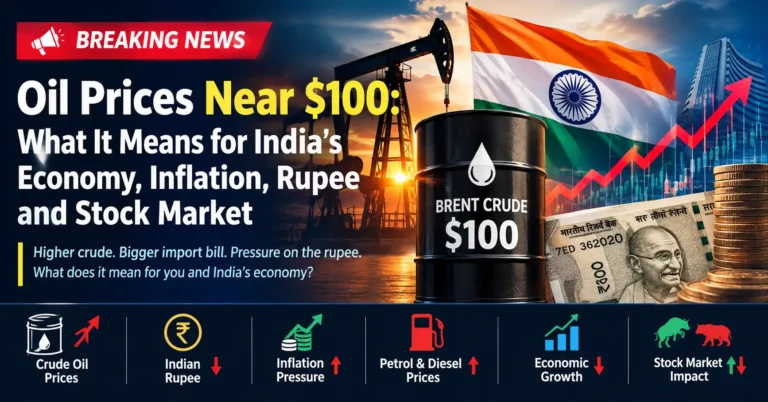
Crude oil is one of the most important links between the global crisis and the Indian stock market. Brent crude moved above $108 a barrel during Friday's trading, according to Reuters and market reports, after the latest escalation increased concern about supply routes. The exact intraday price can change quickly, so investors should treat the quoted level as a snapshot rather than a permanent forecast.
India's vulnerability comes from its dependence on imported energy. When international crude becomes more expensive, the country needs more dollars to pay for the same physical quantity of oil. That can widen the trade deficit and put pressure on the rupee if the increase is large or prolonged.
Higher crude also affects company margins. Airlines face fuel-cost pressure. Logistics companies pay more for transportation. Paint and chemical manufacturers can face higher input costs. Tyre producers, packaging businesses and many industrial companies can also experience indirect cost pressure. Some companies can pass the increase to customers; others cannot do so without losing demand.
There are winners as well. Upstream oil producers can benefit from higher realizations, although the final effect depends on taxes, domestic pricing rules and company-specific factors. The market therefore does not treat every sector in the same way.
The key issue is duration. A short oil spike can be absorbed. A prolonged period above normal levels can feed into inflation, margins and interest-rate expectations, making the market impact much more serious.
Key takeaway: For India, the duration of an oil shock matters more than one volatile trading day. A temporary spike can be absorbed; a prolonged rise can affect inflation, margins, the rupee and interest-rate expectations at the same time.
3. Why Higher Oil Raises Inflation Concerns
Oil matters to the stock market because inflation matters to the stock market. If fuel and transport costs rise, businesses may eventually increase prices. If prices rise across the economy, households may have less money available for discretionary spending. At the same time, companies may see their input costs rise faster than their ability to raise selling prices.
This is especially important for sectors with thin margins. A business that earns a small operating margin has less room to absorb a sudden increase in freight, energy or raw-material costs. Larger companies with strong brands may have more pricing power, but even they can experience a lag between higher costs and higher selling prices.
Investors therefore watch inflation not only as a consumer issue but as an earnings issue. If inflation becomes persistent, central banks may have less freedom to keep monetary policy easy. Higher interest rates can increase borrowing costs and reduce the present value investors place on future earnings.
The market can react before official inflation data changes. Bond yields, commodity prices and currency markets provide continuous signals, so equity investors begin adjusting expectations in advance.
This is one reason the current decline can feel disproportionate to the day's headline. A geopolitical shock may begin with oil, but the market then calculates possible effects on inflation, interest rates, consumption, investment and corporate earnings. Each step adds another layer of uncertainty.
4. Higher Interest Rates and Bond Yields Add Pressure
Interest rates are another important part of the story. Global investors compare expected returns across government bonds, equities and other assets. When sovereign bond yields rise, safer fixed-income assets can become relatively more attractive. Higher yields can also increase the discount rate used to value future corporate cash flows.
The US Treasury market is particularly influential. Recent market reports have pointed to the US 10-year yield moving close to 5%, a level that has attracted attention because it can tighten global financial conditions. A higher US yield can support the dollar and make emerging-market assets less attractive at the margin.
For Indian companies, higher global rates can matter through several channels. Foreign borrowing can become more expensive. The rupee may face pressure. Foreign portfolio investors may rebalance toward developed-market bonds. Domestic interest-rate expectations can also change if imported inflation becomes a concern.
This does not mean every rate increase automatically causes an equity crash. Markets often rise during periods of higher yields when economic growth and corporate earnings are strong enough. The problem becomes more serious when yields rise because investors fear inflation while growth expectations weaken.
That combination is harder for equity markets to digest. Today's decline reflects that concern: investors are trying to assess whether the oil shock will remain temporary or become a broader inflation and policy problem.
5. A Weaker Rupee Makes the Oil Shock More Important
The rupee is another piece of the puzzle. When the rupee weakens against the US dollar, imported commodities priced in dollars become more expensive in local currency. Crude oil is the clearest example, so an oil shock and a currency shock can reinforce each other.
Recent market reports showed the rupee around the mid-90s per dollar, with the currency under pressure as global risk aversion increased. A weaker rupee is not automatically negative for India. Export-oriented companies can benefit from better rupee revenues, depending on their cost structure and hedging. Information technology companies, pharmaceutical exporters and other overseas earners may therefore respond differently from import-heavy businesses.
For the broader market, however, a rapid currency decline can increase uncertainty. Investors may worry about imported inflation, external financing costs and the attractiveness of Indian assets for foreign capital.
Currency moves also affect investor psychology. When traders see oil rising, the dollar strengthening and the rupee weakening at the same time, they may assume that the pressure could persist. That can encourage defensive positioning even before company results show any deterioration.
The right way to read the rupee is therefore not as a standalone signal. It is part of a chain connecting commodities, inflation, interest rates and capital flows. The stronger that chain becomes, the greater the potential pressure on the Sensex and Nifty.
6. Foreign Investor Selling Can Amplify the Decline
Foreign institutional investors are another factor behind market weakness. Large global funds can move substantial amounts of money in and out of Indian equities. When risk appetite falls, foreign selling can amplify a decline that may have started for another reason.
Friday's market reports showed continued foreign selling, while domestic institutional investors provided some support. This difference is important. Domestic funds, including mutual funds and other institutions, can act as a stabilizing force when overseas investors reduce exposure. But domestic buying does not always fully offset foreign selling.
Foreign investors are influenced by relative valuations, currency expectations, global bond yields, commodity prices and the outlook for Indian corporate earnings. They also consider opportunities in other markets. If the risk-adjusted return from US bonds or another equity market becomes more attractive, capital can be reallocated.
Investors should not interpret every FII selling figure as a prediction of a crash. Flows can change from one session to another, and large funds may sell for portfolio-rebalancing reasons that have little to do with India's long-term outlook.
The more useful signal is persistence. If foreign selling continues alongside rising oil prices, a weaker rupee and falling earnings expectations, the market can remain under pressure for longer. If selling slows while domestic buying remains strong, the market may find a floor even before global conditions fully normalize.
7. Weak Global Cues Are Affecting Indian Equities
Indian stocks do not trade in isolation. Asian markets, US equities, bond yields, commodity prices and currency markets all influence the opening mood on Dalal Street. On September 11, weak global cues added to domestic concerns, with major Asian benchmarks also under pressure.
Global weakness matters because multinational investors allocate capital across countries. A synchronized risk-off move can reduce demand for equities everywhere, including India. It also affects sentiment among domestic traders who use global futures and overnight market movements as signals before the Indian session begins.
The current environment is particularly sensitive because geopolitical tension is interacting with commodity prices. In a normal risk-off episode, investors may move toward government bonds or cash. In an inflationary risk-off episode, the response can be more complicated because higher oil prices can also push bond yields higher.
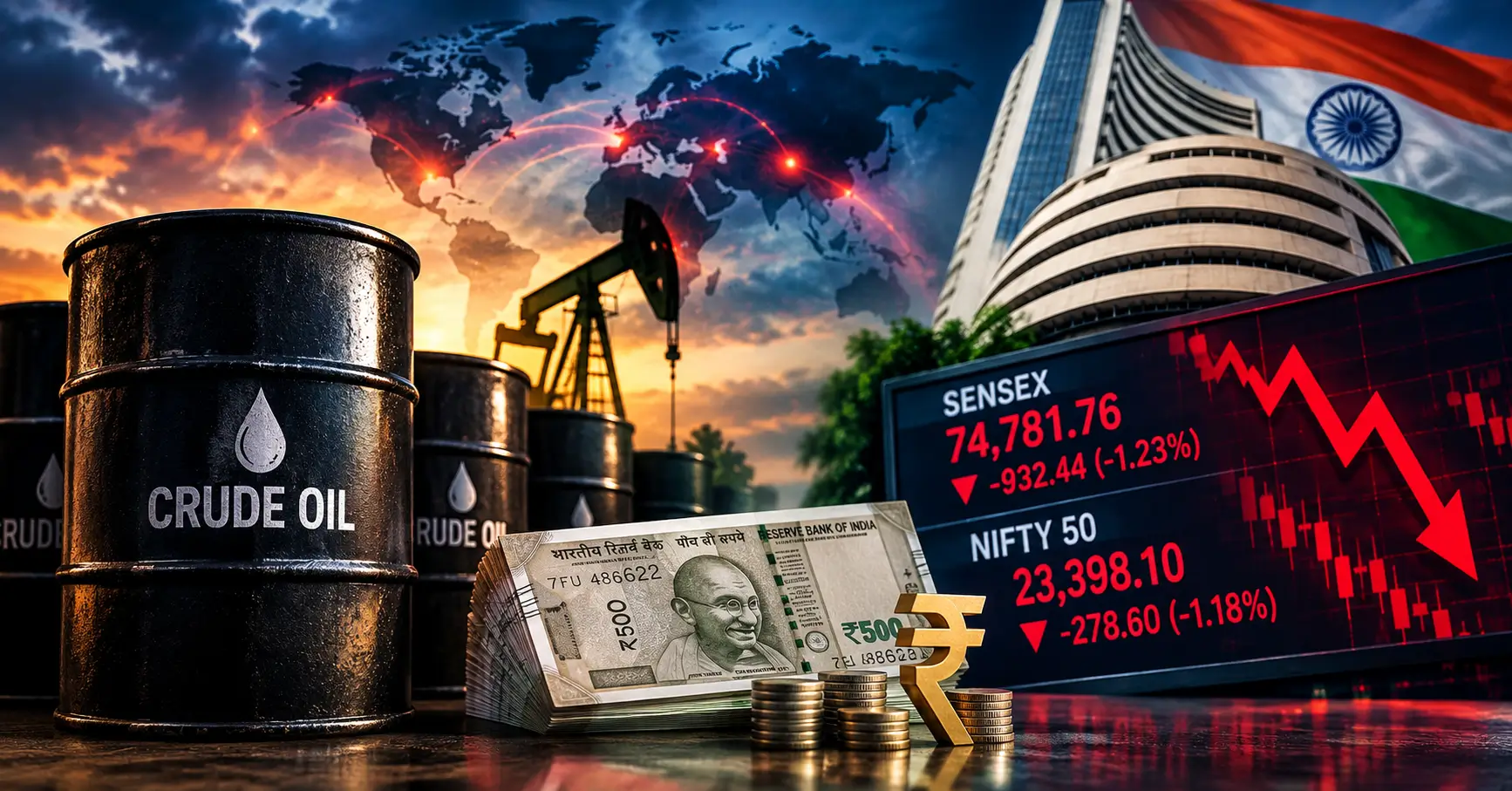
Sensex and Nifty today amid crude oil prices and global market pressure.
Indian companies with significant overseas revenue can also feel the effect through currency movements and foreign demand. Export businesses may benefit from a weaker rupee, but they can still face slower global growth if overseas customers cut spending.
The important lesson is that a market decline can have several layers. The local economy may remain fundamentally resilient while the stock market falls because global investors temporarily demand a higher risk premium. Understanding that difference helps investors avoid treating every index correction as evidence that the domestic economy has suddenly broken down.
8. Which Sectors Are More Vulnerable?
Sector performance provides a more detailed picture than the headline index. Financial stocks are particularly important because banks and financial companies carry large weights in the benchmark indices. When investors become worried about growth, rates or liquidity, financial shares can experience significant selling.
Metals are highly sensitive to global growth expectations and commodity prices. They can fall when investors expect weaker industrial demand, even if some commodity prices are rising for supply-related reasons. That makes the sector particularly volatile during geopolitical shocks.
Automobiles are exposed to consumer demand, financing costs, commodity inputs and fuel prices. A combination of expensive oil and tighter financial conditions can create a more cautious outlook for discretionary purchases.
Information technology has a different set of drivers. IT companies depend heavily on overseas clients, especially in the United States and Europe. Their shares can therefore respond to global technology spending, currency movements and expectations for interest rates. Recent market reports showed IT among the weaker groups during the broader weekly sell-off.
Energy producers can sometimes move against the market when crude rises, because higher oil prices can improve the revenue outlook for upstream companies. But the relationship is not simple for every energy stock, particularly when refining margins, government policy or domestic fuel pricing are involved.
The key point is that a falling Sensex does not mean every stock is equally weak. Investors should look at earnings exposure, debt, pricing power, export revenue and valuation before drawing conclusions about individual companies.
9. Market Breadth Shows the Sell-Off Is Broad
Market breadth is a useful tool for understanding whether a decline is narrow or broad. If the Sensex falls because one or two very large companies decline, the headline number can look worse than the average stock experience. If hundreds of shares decline together, the risk environment is different.
Today's session showed broad pressure. Reuters reported that small-cap and mid-cap stocks fell more sharply during the sell-off. Weekly performance was also weak across most major sectors. This indicates that investors were not simply rotating out of a single company or theme; they were reducing risk more widely.
Broad weakness can create both danger and opportunity. The danger is that indiscriminate selling can push fundamentally sound companies lower alongside weaker businesses. The opportunity is that quality companies can become more reasonably valued if the selling is driven by temporary macro fear rather than a permanent deterioration in their earnings.
However, investors should not assume every sharp fall is a bargain. A falling price can be justified if debt is high, cash flow is weak, valuations were excessive or the business model is deteriorating.
A sensible approach is to separate market risk from company risk. Market risk comes from oil, rates, currency and global sentiment. Company risk comes from balance sheets, management, competition and earnings. The strongest investment decisions consider both instead of buying simply because the index has fallen.
10. Does a Falling Market Mean Stocks Are Cheap?
Valuation becomes more important during a market correction. When prices are high, investors can tolerate bad news because they expect strong future growth. When uncertainty increases, the premium paid for that growth can shrink.
A correction therefore does not automatically make the market cheap. Investors should compare current prices with earnings, cash flow, historical valuation ranges and the growth prospects of individual companies. A company trading at a high multiple may still deserve that valuation if earnings are growing rapidly and sustainably. Another company may look inexpensive because its profits are likely to fall.
The same principle applies to the indices. The Sensex and Nifty represent groups of companies with different business models and weights. Their valuation can provide a broad reference point, but it does not tell an investor whether a particular share is attractive.
During a macro-driven sell-off, valuation changes can happen quickly because both prices and earnings expectations move. Analysts may reduce forecasts if oil remains expensive or global demand weakens. That can make a stock appear no cheaper even after its share price falls.
For long-term investors, the best opportunity often appears when the market becomes selective again. Instead of asking whether the market has fallen enough, investors can ask whether the expected return from a company justifies its risks. That question remains useful whether the Sensex is rising or falling.
11. What Long-Term Investors Should Do
Long-term investors should distinguish between a market correction and a permanent change in the investment case. Markets have always moved through periods of fear, optimism, liquidity expansion and tightening. A geopolitical shock can cause a rapid repricing even when the underlying economy changes more slowly.
That does not mean investors should ignore a falling market. A sustained rise in oil, a weaker currency, higher interest rates and lower earnings expectations can eventually affect corporate fundamentals. The important task is to monitor whether temporary market pressure is becoming a lasting earnings problem.
Portfolio construction matters. An investor who needs money in the next few months should not rely on equity markets to provide stable value. Someone with a long horizon and diversified holdings may have more capacity to tolerate volatility. SEBI's investor education material emphasizes matching investment choices with goals, risk appetite and time horizon.
Diversification can also reduce the impact of a single sector shock. Holding several companies across industries does not eliminate market risk, but it can reduce the damage caused by one company's poor performance.
Most importantly, investors should avoid making decisions solely from a dramatic intraday headline. A 500-point or 700-point move sounds large, but the significance depends on the index level, the reason for the move and what happens afterward. A disciplined process is more useful than trying to guess the exact bottom.
Risk reminder: A market decline is not, by itself, a buy signal. Investors should consider their goals, time horizon, liquidity needs, valuation and risk appetite before changing a portfolio.
12. What Short-Term Traders Should Watch
Short-term traders face a different challenge. Volatility creates opportunities, but it also increases the probability of false signals and sudden reversals. Friday's session demonstrated this clearly: the market opened under heavy pressure and then recovered a significant part of the early decline.
In such conditions, a trader should know the difference between a trend and a temporary bounce. Support and resistance levels, volume, market breadth and price action can help, but none of them guarantees the next move.
Risk management becomes more important when geopolitical headlines can change market direction within minutes. Position size, stop-loss discipline and avoiding excessive leverage can prevent one bad trade from causing disproportionate damage.
Traders should also remember that index movement can hide large differences between individual stocks. A stock may rise even when the Nifty falls, while another may collapse despite a stable sector. News flow and liquidity can create large intraday gaps.
For readers who are not active traders, there is no requirement to respond to every market move. A long-term portfolio can often be managed through scheduled reviews rather than constant monitoring. The best response to volatility depends on the investor's strategy, not on the emotional intensity of the day's headlines.
13. Five Market Signals to Watch Next
What should investors watch next? The first signal is crude oil. If prices remain elevated because geopolitical risk persists, markets will continue to assess the inflation and earnings consequences. A sustained fall in oil would remove one of the most immediate sources of pressure.
The second signal is global bond yields. If US yields continue rising, emerging-market equities can face a more difficult liquidity environment. If yields stabilize or fall, some pressure on growth stocks and foreign capital flows could ease.
The third signal is the rupee. A stable currency would reduce imported inflation concerns, while a rapid decline could make the oil shock more painful. Investors should watch the direction and speed of the move rather than one day's exchange rate.
The fourth signal is foreign institutional flows. Continued selling would indicate that global risk appetite remains weak. A return to sustained buying would be a constructive sign, particularly if supported by improving global markets.
The fifth signal is corporate earnings guidance. Ultimately, stock prices reflect expectations about future profits. If companies maintain guidance despite the macro shock, the market may eventually look through the turbulence. If earnings estimates are repeatedly cut, the correction could become more fundamental.
Finally, watch market breadth. A market that stops falling while more stocks begin participating in the recovery is generally healthier than a rebound led by only a few large companies.
14. A Simple Example of How the Shock Travels Through a Company
Consider a simple example. Imagine an Indian manufacturing company that spends a large amount on fuel, transportation and imported raw materials. Crude oil rises sharply, the rupee weakens and borrowing costs remain high. The company's revenue may not change immediately, but its costs can rise.
If the company has strong pricing power, it may increase selling prices and protect its margins. If customers are price-sensitive, it may absorb some of the cost, reducing profit. If debt is also high, higher interest costs can add another pressure point.
Now consider an export-oriented software company. A weaker rupee may increase the rupee value of overseas revenue, which can provide some support. But if global clients reduce technology spending because interest rates are high, demand may weaken. The same macro event therefore produces both a positive currency effect and a negative demand effect.
This example explains why investors should not use a single market headline to make a blanket decision about every stock. The right question is how each company's revenue, costs, debt, currency exposure and competitive position interact with the macro environment.
The Sensex and Nifty are useful summaries of market sentiment, but they are not substitutes for company-level analysis.
15. Common Mistakes Investors Should Avoid
One common mistake during a falling market is trying to identify the exact bottom. Nobody knows in advance whether today's low will be the lowest point of the correction. Markets can fall further even after a seemingly attractive decline.
Another mistake is averaging down without checking the investment thesis. Lower prices are not automatically better prices. If earnings expectations have deteriorated materially, the fair value of a company may also be lower.
A third mistake is using borrowed money to buy a falling market. Leverage can turn a temporary decline into a permanent financial loss if the investor is forced to sell.
A fourth mistake is relying on social-media predictions. SEBI's investor education resources specifically caution investors against blindly following tips and emphasize independent research and risk assessment.
A fifth mistake is ignoring personal cash flow. An investor who may need the money soon has a different risk capacity from someone investing for a distant goal. Market volatility becomes much harder to tolerate when an unexpected expense arrives at the same time.
Finally, investors should avoid treating every market rally as proof that the problem is solved. A one-day rebound can happen inside a larger downtrend. The stronger signal is a combination of improving breadth, stable commodities, calmer bond markets, healthier earnings expectations and sustained investor participation.
16. Sensex vs Nifty: What the Two Indices Actually Tell You
To understand a headline such as “Sensex Nifty Today,” it helps to know what the two indices measure. The Sensex is a benchmark index of major companies listed on the Bombay Stock Exchange, while the Nifty 50 tracks a basket of leading companies on the National Stock Exchange. Both are designed to provide a quick view of the large-cap equity market.
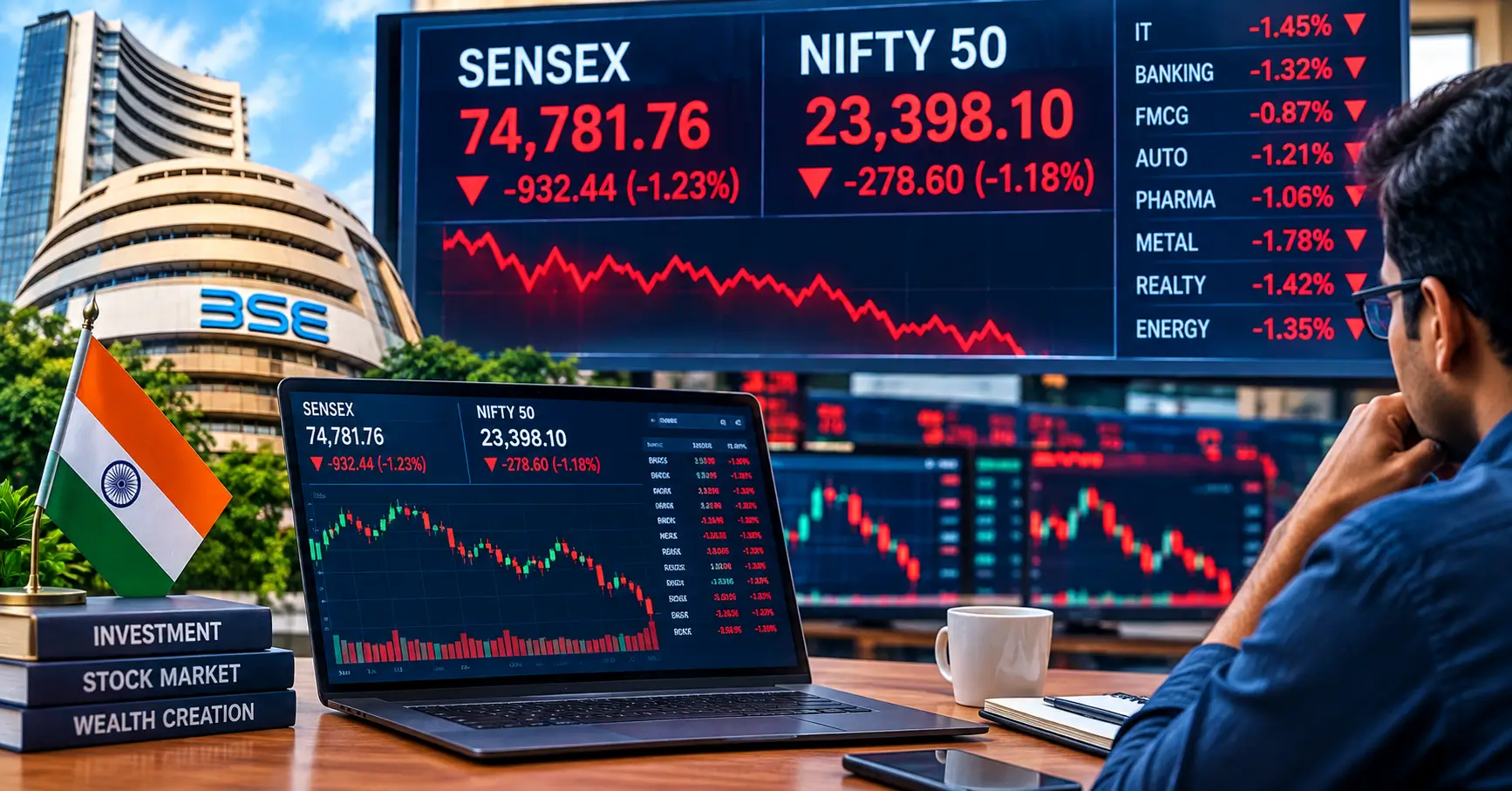
Sensex and Nifty today amid the latest Indian stock market performance.
Neither index is a simple average of share prices. Index construction uses a methodology that gives companies different weights, so movements in large constituents can have a greater effect on the headline number. This is why a market can feel mixed even when an index is clearly lower.
The Nifty 50 and Sensex are also different baskets, so they can move by slightly different percentages on the same day. Their sector weights, constituents and methodologies are not identical.
This distinction matters for readers because the phrase “market is falling” can be too broad. Large-cap benchmarks may fall while selected mid-cap companies rise, or the opposite can happen. Investors should therefore use the indices as a starting point rather than as a complete description of every listed share.
For everyday financial news, however, the benchmarks remain valuable. They summarize changes in investor confidence, liquidity and expectations in a way that is easy to compare from one session to the next. The most useful habit is to combine the headline index with breadth, sector performance, volumes and the fundamental reasons behind the move.
17. A Practical Checklist for a Falling Market
A practical checklist can make a volatile market easier to understand. Start with the cause of the move. Is the decline driven by a company-specific announcement, domestic economic data, global markets, commodities or geopolitical news? The cause often tells you whether the risk is likely to be temporary or persistent.
Next, check whether the decline is broad. Look at large-cap, mid-cap and small-cap performance, along with sector breadth. A broad sell-off suggests risk aversion, while a narrow decline may reflect rotation.
Sensex and Nifty today and the investor strategy amid changing market conditions.
Then examine oil and the rupee. For India, these two indicators provide a useful first view of imported inflation pressure. After that, look at government-bond yields and global rates because they influence financing costs and valuation.
The next step is to review foreign and domestic institutional flows. These figures should not be treated as standalone buy or sell signals, but they help explain liquidity conditions.
Finally, return to your own portfolio. Check whether the companies you own still have healthy balance sheets, sensible valuations, competitive advantages and credible earnings prospects. If the investment case remains intact, market volatility may be manageable. If the original reason for owning a stock has disappeared, a falling market can reveal that problem rather than create it.
This process is slower than reacting to a breaking-news headline, but it is more likely to produce decisions that remain sensible after the headline has disappeared.
Conclusion: What Sensex Nifty Today Really Means
The fall in the Sensex and Nifty on September 11, 2026 is best understood as a combination of pressures rather than a single event. Geopolitical tension has pushed crude oil sharply higher. Higher oil has increased concern about inflation and the rupee. Global bond yields have added to the pressure on risk assets, while foreign selling and weak international markets have amplified the move.
The market's recovery from its early lows also offers an important reminder: prices can change direction quickly even when the broader environment remains uncertain. Investors should therefore avoid assuming that one day's fall or rebound settles the larger trend.
For long-term investors, the focus should remain on fundamentals, valuation, diversification and time horizon. For traders, volatility demands disciplined risk management. For everyone, the most useful response is to separate facts from predictions.
The next phase of the market will depend heavily on whether crude prices remain elevated, whether geopolitical risks ease, how global yields behave, what happens to the rupee and whether corporate earnings expectations hold up. If those pressures begin to fade, market sentiment can improve. If they intensify, volatility may remain high.
The headline “Sensex Nifty Today” captures the day's movement, but it does not capture the entire investment decision. A good investor looks beyond the index, understands the forces behind the move and acts according to a clearly defined financial plan rather than the emotion of the moment.
Frequently Asked Questions About Sensex Nifty Today
What is happening to Sensex and Nifty today? On September 11, 2026, both major Indian benchmarks closed lower after a volatile session. The Sensex ended at 74,781.76 and the Nifty 50 at 23,398.10. Both were also heading into their fifth consecutive weekly decline.
Why is the Indian stock market falling? The main drivers are geopolitical tension in West Asia, higher crude oil prices, concerns about inflation and interest rates, weak global cues, currency pressure and continued foreign selling.
How does crude oil affect Indian stocks? India imports substantial amounts of crude, so higher oil prices can increase the country's import bill and create pressure on inflation, the rupee and corporate costs. The effect differs by sector.
Is today's fall a stock market crash? A single down session should not automatically be described as a crash. Today's decline was volatile and broad, but the closing losses were smaller than the early-session fall. Investors should assess the trend over several sessions and the underlying causes.
Should investors buy stocks after a fall? A lower price can create opportunities, but investors should first evaluate valuation, earnings, balance-sheet strength, time horizon and risk tolerance. There is no guarantee that a falling stock has reached its bottom.
What should investors watch next? Crude oil, global bond yields, the rupee, foreign institutional flows, corporate earnings expectations and market breadth are among the most useful signals.
Where can investors learn about market risk? SEBI Investor provides official educational material covering securities-market risks, investment risk management, risk appetite and investor precautions.
Is the Sensex more important than individual stocks? The Sensex is a broad benchmark, but it does not represent every company or sector equally. Individual investment decisions require company-specific analysis and should match the investor's goals and risk tolerance.
This article is for general information and educational purposes only. It is not investment advice, a recommendation to buy or sell securities, or a guarantee of future market performance. Market prices can change rapidly. Readers should conduct independent research and consider consulting a qualified financial professional where appropriate.
COMMUNITY Q&A
Questions & Answers
Have a question about this article?
Ask it below. Other GrayGaps readers can
share their experience and help answer it.