NSE IPO 2026: Why the National Stock Exchange Is Cutting Its IPO Size

The long-awaited listing of India’s National Stock Exchange is moving closer to the market, but the proposed offering is now expected to be smaller than originally planned. Here is what is changing, why shareholders appear less willing to sell, and what the reduced issue could mean for investors.
Quick Answer: What Is Happening With the NSE IPO?
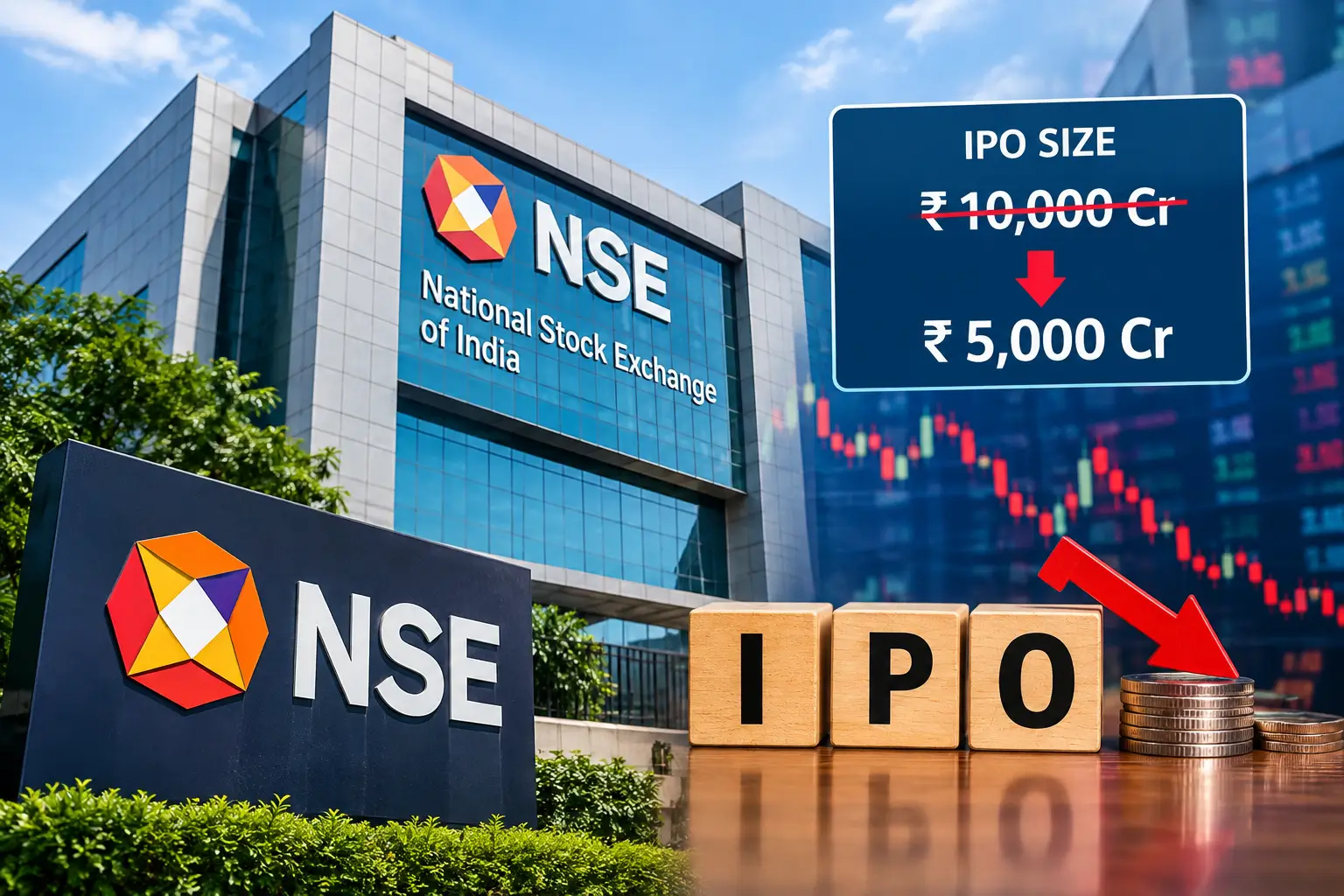
The NSE IPO 2026 is expected to be smaller than the approximately ₹30,000-crore offering that had been discussed earlier. Recent reports say the portion of NSE’s equity being offered for sale could fall from about 6% to roughly 5.2%-5.5%, with the latest report putting the offer at around 5.3%.
The reported price range is around ₹1,700 to ₹1,785 per share. At that range and with the smaller number of shares being sold, the total offer could be around ₹23,500 crore, according to a September 10 report. Earlier estimates had placed the IPO at around ₹30,000 crore.
The central reason appears straightforward: some existing shareholders are reportedly less willing to sell their NSE shares at the lower valuation being discussed. Rather than selling more shares at a price they consider unattractive, some shareholders may prefer to retain their holdings and wait for the post-listing market to establish a value.
Important: The reduced stake, price range and final issue size reported in the media should not be confused with the final legally binding offer terms until the company releases the relevant final offer documents. The latest reports are based partly on people familiar with the matter.
Table of Contents
- What Is Happening With the NSE IPO?
- Why Is NSE Cutting Its IPO Size?
- Why the Offer for Sale Structure Matters
- NSE IPO 2026: Key Numbers
- Why the Price Range Has Come Down
- Why Existing Shareholders Matter
- What the Lower Price Means for Valuation
- The Bigger IPO Market Problem
- What the Smaller IPO Means for Investors
- A Simple Example of the Size Reduction
- Will NSE Still Become India’s Biggest IPO?
- Why Investors Are Interested in NSE as a Business
- Risks Investors Should Understand
- NSE IPO 2026 Timeline
- What Investors Should Watch Next
- Frequently Asked Questions
- Official and Reference Sources
What Is Happening With the NSE IPO?
The National Stock Exchange of India has spent years preparing for a public listing. The proposed IPO is significant because NSE is not simply another company seeking access to public capital. It is one of the central pieces of India’s financial-market infrastructure.
That is why the NSE IPO 2026 has attracted unusual attention from retail investors, institutions, analysts and the wider business community.
The latest development is not that the IPO has been cancelled or postponed. The opposite is true. The process has moved substantially closer to a public listing after the Securities and Exchange Board of India cleared the IPO documents earlier in September.
What has changed is the expected size of the offer.
Earlier reports had suggested an offer of about 6% of NSE’s equity, involving roughly 148.9 million shares and potentially raising around ₹30,000 crore depending on the eventual pricing. More recent reports indicate that the number of shares offered may now be reduced.
The latest Times of India report says the offering is being reduced to approximately 5.3% of NSE’s equity base and could raise about ₹23,500 crore at the reported ₹1,700-₹1,785 price band.
Other reports have placed the possible stake at approximately 5.2%-5.5%, illustrating that the exact final number was still being reported differently by market sources before the final terms were announced.
That distinction is important. Investors should not treat every reported percentage as a confirmed final figure.
Why Is NSE Cutting Its IPO Size?
The most important question is not simply how much smaller the IPO may become. It is why the change is happening.
The answer appears to involve the interaction between price, shareholder expectations and market conditions.
1. Some shareholders reportedly want a better price
An IPO is a transaction between sellers and buyers. Existing shareholders have to decide whether the price offered by the market is attractive enough for them to give up part of their holdings.
In the case of NSE, some shareholders reportedly became less willing to sell after the expected price range moved lower.
Earlier market expectations had pointed toward a valuation closer to ₹5 lakh crore. More recent reports have suggested a valuation of around ₹4.4 lakh crore at the upper end of the reported ₹1,700-₹1,785 range.
For a shareholder that acquired NSE shares at a very low historical cost, the question is not simply whether a sale produces a large profit. It is also whether selling today makes sense when the shareholder believes the company could be worth more after listing.
2. A lower price changes the economics of an OFS
The NSE issue is structured as an Offer for Sale, or OFS. This means existing shareholders sell their shares to investors.
NSE itself is not issuing a large block of new shares to raise fresh operating capital through the offer.
Therefore, the sellers have a direct economic reason to consider the price carefully. If they believe the shares can command a higher valuation later, they may prefer to sell fewer shares now.
3. The IPO market has become more selective
India’s IPO market remains active, but investors have become more selective about valuations and business quality.
Reports in 2026 have highlighted a broader trend of companies reducing issue sizes, accepting more moderate valuations or delaying offerings as market conditions become less supportive.
This matters for NSE because a large IPO requires significant institutional demand. A deal of ₹25,000 crore or ₹30,000 crore is not the same as a small SME offering. The issuer and selling shareholders need enough demand at the chosen valuation to create a successful book.
4. NSE has an unusual advantage: it does not have to raise fresh cash
Because the offering is an OFS, NSE is not dependent on the IPO for expansion capital in the same way a company launching a fresh issue might be.
That gives the transaction greater flexibility. Existing shareholders can choose how much they want to sell, subject to the final offer structure and regulatory requirements.
The objective can therefore shift from simply maximising the number of shares sold to achieving a sensible market debut and establishing a liquid public market for the shares.
Why the Offer for Sale Structure Matters
Understanding the OFS structure is essential for understanding the NSE IPO 2026.
In a conventional IPO, investors often see two components: a fresh issue and an offer for sale.
A fresh issue creates new shares. The company receives the money and can use it for stated purposes such as expansion, debt repayment, acquisitions or general corporate needs.
An OFS works differently. Existing shareholders sell shares that they already own. The money goes to those selling shareholders rather than becoming new capital on the company’s balance sheet.
| Feature | Fresh Issue | Offer for Sale |
|---|---|---|
| Who sells? | Company issues new shares | Existing shareholders sell shares |
| Does the company receive the sale proceeds? | Yes | No, proceeds generally go to selling shareholders |
| Does share capital increase? | Usually yes | No new shares are created by the OFS itself |
| Main purpose | Raise fresh capital | Provide an exit or partial liquidity to existing holders |
For NSE, this distinction means investors should not interpret a ₹23,500-crore or ₹25,000-crore IPO as ₹23,500 crore of fresh cash entering NSE’s business.
NSE IPO 2026: Key Numbers
The following figures summarise what is currently being reported. Because the final offer terms can change before publication of the final prospectus, investors should verify them against the final documents before making any decision.
| Particular | Earlier expectation | Latest reported position |
|---|---|---|
| IPO type | Offer for Sale | Offer for Sale |
| Stake offered | About 6% | About 5.2%-5.5%; latest report around 5.3% |
| Earlier expected size | About ₹30,000 crore | Potentially around ₹23,500 crore based on latest report |
| Reported price range | Earlier expectations around ₹2,000-₹2,100 | ₹1,700-₹1,785 reported |
| Potential valuation | Around ₹5 lakh crore in earlier expectations | Around ₹4.4 lakh crore at the reported upper price |
| Fresh capital for NSE | Not applicable | OFS structure means sale proceeds go to selling shareholders |
The figures above combine the latest media reports and previously disclosed offer information. Final IPO terms should be checked against the final NSE/SEBI offer documents.
Why Has the Reported Price Range Come Down?
The reduction in the reported price range is arguably as important as the reduction in the number of shares being offered.

Recent reports have placed the expected price at ₹1,700-₹1,785 per share, compared with an earlier marketed range around ₹2,000-₹2,100.
That does not automatically mean that NSE’s business has lost the same percentage of value.
An IPO valuation is a market negotiation. The price depends on investor demand, comparable companies, expected earnings, market conditions, liquidity, growth prospects and the willingness of existing shareholders to sell.
A company can be financially strong and still choose a lower IPO price if management and selling shareholders believe that a more attractive price will create stronger demand and a better public-market outcome.
Price discovery is different from an internal valuation
Before a company is listed, its shares may trade in private or unlisted markets. Those transactions can create expectations, but they are not the same as a broad public-market price.
Once the company is listed, thousands or millions of investors can potentially participate. The market then continuously reassesses the company’s value.
That is why IPO pricing requires a balance.
If the price is too high, demand can weaken.
If the price is too low, existing shareholders may feel they are leaving money on the table.
The NSE situation illustrates this tension particularly well because many existing holders have been shareholders for years and may not be under immediate pressure to sell.
Why Existing Shareholders Matter So Much
The seller list is one of the most interesting parts of the NSE transaction.
Earlier reporting following regulatory approval indicated that 10 shareholders were expected to sell a combined 148.905 million shares, representing roughly 6% of NSE’s equity.
State Bank of India was reported as the largest seller, with approximately 24.75 million shares, or around 1% of NSE’s equity. Other selling shareholders included MS Strategic and Canada Pension Plan Investment Board, among others.
However, the latest reports suggest that not every shareholder necessarily wants to sell the full amount originally contemplated at the lower valuation.
That is the heart of the current story.
Imagine owning a valuable property that has been privately held for years. You are finally offered the chance to sell part of it publicly. But just before the sale, the expected price is reduced. You might reasonably decide to sell a smaller portion and retain more ownership.
That is broadly the economic logic behind the reported reduction.
Simple shareholder example:
Suppose an investor owns 10 million NSE shares. If the investor sells 600,000 shares in a 6% style offering, it receives cash immediately but reduces its exposure to future NSE gains.
If the expected price falls and the investor believes NSE may be worth more after listing, selling only 500,000 shares could look more attractive. The investor still receives liquidity while retaining a larger position.
What the Lower Price Means for NSE’s Valuation
The reported ₹1,700-₹1,785 range implies a valuation materially below the approximately ₹5 lakh crore level associated with earlier expectations.
At the upper end of the new reported range, Reuters reported that NSE could be valued at approximately ₹4.4 trillion, or around $46.4 billion.
That would still make NSE a very large publicly traded Indian financial-market company.
The reduction should therefore be viewed in context.
A valuation of roughly ₹4.4 lakh crore is not a small valuation. The key issue is whether the public market agrees that this valuation properly reflects NSE’s earnings, competitive position, growth prospects and regulatory environment.
Why valuation matters for investors
Investors should avoid looking at the IPO price in isolation.
A ₹1,785 share is not automatically cheap just because the price is lower than ₹2,100.
Likewise, a lower IPO price does not automatically mean the stock will rise after listing.
The relevant question is how much the entire company is worth relative to the earnings and cash flows it can generate in the future.
This is why investors should eventually compare NSE’s valuation with its profitability, return ratios, market share, regulatory risks and growth opportunities rather than focusing only on the IPO price.
The Bigger IPO Market Problem
The NSE story is also part of a wider change in India’s IPO environment.
The Indian primary market had two exceptionally strong years, but 2026 has been more challenging. Bloomberg-reported data cited by the Economic Times showed that IPO fundraising had fallen year-on-year, while issuers were becoming more willing to reduce issue sizes or accept lower valuations.
Another report from Moneycontrol noted that several Indian companies had reduced IPO sizes by 20%-40% amid selective investor demand, market volatility and greater scrutiny of valuations.
That background helps explain why NSE’s selling shareholders may be more cautious.
A huge IPO needs huge demand.
When several large companies are competing for institutional money, investors have more choices. A seller therefore has to consider not just the quality of the business but also the broader market environment at the exact moment the IPO opens.
Institutional investors have become more selective
Large institutional investors do not buy simply because a company is famous.
They assess valuation, earnings visibility, liquidity, governance, regulation, competitive position and potential returns.
For a stock exchange, there is another layer: regulatory risk.
NSE operates critical market infrastructure, so its business is closely connected with financial-market regulation. Investors have to consider not only revenue and profit but also regulatory decisions that could influence its operations.
What the Smaller IPO Means for Investors
For retail investors, a smaller issue does not automatically mean good news or bad news.
Its impact depends on demand.
A smaller IPO can make the deal easier to absorb if investors are interested, because fewer shares are being offered. But if existing shareholders reduce the number of shares sold because they want a higher valuation, that can also signal that sellers consider the current price unattractive.
Investors therefore need to separate two questions:
- Is the IPO smaller?
- Is the valuation attractive?
The first question concerns supply.
The second concerns value.
They are related but not identical.
Retail investors should not use GMP as the main decision tool
The grey market often becomes extremely active before high-profile IPOs. NSE is no exception.
However, grey-market premium is not an official exchange price and should not be treated as a guaranteed listing gain.
A GMP can move rapidly depending on sentiment, liquidity and expectations.
For a business as important as NSE, long-term investors should focus more heavily on the company’s actual financial performance and valuation than on short-term unofficial-market movements.
Investor reminder: A popular IPO can still be an expensive investment. Demand for an IPO and the long-term investment case are two different things.
A Simple Example of the Size Reduction
The easiest way to understand the change is to use a simplified example.
Assume NSE has 100 shares outstanding for illustration.
Under the earlier 6% plan, six shares would be offered to public investors.
Under a 5.3% structure, only about 5.3 shares would be offered.
That difference may look small in percentage terms, but when multiplied across NSE’s entire equity base, it represents millions of shares and thousands of crores of potential transaction value.
| Illustration | Earlier Plan | Reported Revised Plan |
|---|---|---|
| Illustrative equity base | 100% | 100% |
| Shares offered | 6% | 5.3% |
| Difference | 0.7 percentage point reduction | |
| Economic effect | More shares sold | More shares retained by existing holders |
The actual NSE numbers are much larger, but the principle remains the same.
Will NSE Still Become India’s Biggest IPO?
That was one of the most interesting possibilities when the IPO was expected to raise approximately ₹30,000 crore.
Hyundai Motor India’s 2024 IPO raised approximately ₹27,870 crore and became India’s largest IPO at the time.
If NSE had proceeded with a roughly ₹30,000-crore offering, it would have had a strong chance of taking that record.
The latest reduction changes that calculation.
A reported issue size of around ₹23,500 crore would be below Hyundai Motor India’s record.
Even reports estimating ₹25,000-₹27,000 crore would put the NSE offering close to the record but potentially below it.
That is why the change in issue size has received so much attention. The story is not simply about a few thousand crore of shares. It could determine whether NSE enters the market as India’s largest IPO by funds raised.
The bigger picture: The size reduction may mean NSE gives up the opportunity to claim the country’s largest IPO record, but that does not necessarily make the listing less important. The importance of NSE comes from the business itself and its role in India’s financial infrastructure.
Why Investors Are Interested in NSE as a Business
There is a reason the market has followed the NSE listing for so many years.
NSE occupies a powerful position in India’s financial system.
It operates trading infrastructure across important market segments and is associated with the Nifty 50, one of India’s most widely followed stock-market benchmarks.
The exchange earns revenue from activities connected to trading, market data, technology and other services.
Its scale gives the business characteristics that are different from a typical industrial company.
Trading activity matters
When market activity rises, exchanges can benefit from higher transaction-related revenue.
The opposite can happen when trading activity weakens.
However, NSE’s business is not simply a bet on whether the Nifty rises or falls on a particular day. Its revenue model is linked to the level and composition of market activity, the products being traded, transaction charges and associated services.
Derivatives are particularly important
NSE has a dominant position in India’s equity derivatives market and has been described as the world’s most active derivatives exchange by number of contracts traded.
That scale is one of the major reasons investors are interested in the company.
But high trading volumes also come with regulatory scrutiny. Market regulators continuously examine exchange operations, market access, technology and investor protection.
Nifty creates a valuable ecosystem
The Nifty family of indices has become deeply integrated into India’s investment industry.
Index funds, ETFs, derivatives, institutional portfolios and financial products use major NSE-linked indices as benchmarks or underlying references.
That creates another layer to the business beyond the traditional image of a stock exchange as simply a place where buyers and sellers meet.
Risks Investors Should Understand
A strong business does not mean a risk-free stock.
The NSE IPO carries several categories of risk that investors should understand before applying.
1. Valuation risk
The biggest immediate question may be valuation.
A lower IPO price compared with earlier expectations does not automatically make the shares undervalued.
Investors should compare the implied valuation with earnings, growth and comparable businesses.
2. Regulatory risk
NSE operates in a highly regulated sector.
Changes to trading rules, derivatives regulations, market-access requirements, transaction charges or governance requirements could affect its business.
The exchange has also spent years dealing with regulatory issues, making regulatory risk particularly important to understand.
3. Market-cycle risk
Exchange businesses can benefit from strong trading activity, but market conditions can change.
Periods of low volatility, falling participation or changes in trading behaviour can affect activity and revenue.
4. Competition
NSE operates in a competitive market. BSE remains an important competitor, and changes in technology, products and investor behaviour can influence market share.
5. Technology risk
Modern exchanges depend heavily on high-speed technology, cybersecurity and resilient infrastructure.
A major operational disruption could damage confidence and create financial or regulatory consequences.
6. Listing-day volatility
A high-profile IPO can attract intense speculation.
The listing price may differ substantially from the IPO price depending on demand and market sentiment.
Investors who apply purely for listing gains should recognise that a premium is never guaranteed.
Example:
If an investor buys an IPO at ₹1,785 and the stock lists at ₹1,650, the investor starts with a paper loss even if the underlying company remains fundamentally strong. Conversely, a high listing price does not prove that the stock will remain expensive over the long term.
NSE IPO 2026 Timeline
The NSE public-listing journey has been unusually long. The current process represents the latest stage of a plan that has faced regulatory and legal hurdles over several years.
| Date / Period | Development |
|---|---|
| 1992 | National Stock Exchange of India was incorporated. |
| 2026 | NSE moved forward with updated IPO documentation. |
| June 17, 2026 | The latest reported DRHP was dated June 17, 2026. |
| September 4, 2026 | SEBI clearance removed a major regulatory hurdle for the IPO. |
| September 8-9, 2026 | Reports emerged of a ₹1,700-₹1,785 expected price range and a possible reduction in the stake offered. |
| September 10, 2026 | Latest reports indicated an offer of around 5.3% and a possible issue size near ₹23,500 crore. |
The final subscription and listing schedule should be checked against the final offer documents and NSE/SEBI announcements.
What Investors Should Watch Next
The next stage of the NSE story will be more important than the headlines themselves.
1. Final price band
Investors should wait for the official price band rather than relying exclusively on media reports.
2. Final number of shares
The final number of shares offered will tell investors whether the reported reduction has actually been implemented.
3. Seller-wise allocation
The final seller list will reveal which existing shareholders are participating and how much they are selling.
4. Subscription data
Once the IPO opens, the quality of demand will become clearer. Investors should pay attention not only to total subscription but also to the participation of qualified institutional buyers.
5. Valuation versus earnings
This is ultimately the most important point.
A large and famous company can still be a poor investment if bought at an excessive valuation.
Likewise, a lower-than-expected IPO price can create an attractive opportunity if the business fundamentals justify the valuation.
6. Official documents
Investors should read the final Red Herring Prospectus and other official documents rather than relying only on social-media posts, grey-market discussions or short news clips.
A practical checklist for investors:
- Check the final IPO price band.
- Check the final issue size.
- Confirm that the issue is an OFS.
- Read the risk factors.
- Study NSE’s financial statements.
- Look at valuation rather than only the share price.
- Compare NSE with listed market-infrastructure businesses.
- Do not assume GMP equals guaranteed listing profit.
- Consider your own investment horizon and risk tolerance.
What Does the NSE IPO Size Cut Really Tell Us?
The most interesting lesson from the NSE IPO 2026 story is that an IPO is not just a company deciding how much money it wants to raise.
It is a negotiation between sellers and buyers.
The sellers want an attractive price.
Investors want an attractive valuation.
The company wants a successful transition into the public market.
Regulators want a fair, transparent and orderly process.
Those objectives do not always point in exactly the same direction.
That is what appears to be happening with NSE.
The original plan offered the possibility of a roughly ₹30,000-crore transaction and potentially the title of India’s largest IPO. But if the expected valuation falls and some shareholders become unwilling to sell at that price, reducing the number of shares offered can be a logical response.
From the seller’s perspective, retaining shares preserves future upside.
From the investor’s perspective, fewer shares could make the offering more manageable, but it does not automatically improve the investment case.
From NSE’s perspective, the listing itself may matter more than maximising the initial amount sold.
A successful listing can create a publicly traded market for NSE shares, improve transparency around the company’s valuation and provide liquidity to shareholders over time.
Why This IPO Matters Beyond NSE
The NSE listing is important for India’s capital markets because it brings one of the country’s most important financial institutions into the public market.
A listed exchange will be watched closely by investors, analysts and regulators.
Its quarterly financial results will become part of the normal public-market information cycle. Its governance will receive greater attention. Its valuation will be visible every trading day.
That transparency can be valuable.
It also creates a new investment opportunity for investors who believe India’s capital-market ecosystem will continue expanding.
India’s growing participation in equities, mutual funds, ETFs, derivatives and digital investing has created a large financial ecosystem around its exchanges.
NSE sits close to the centre of that ecosystem.
The question for investors is therefore not whether NSE is an important company. It clearly is.
The harder question is whether the final IPO valuation provides enough potential return to justify the risks.
Final Takeaway
The NSE IPO 2026 is changing shape just as it approaches one of the most important stages of its long journey toward a public listing.
Earlier expectations pointed to an offering of roughly 6% of NSE and a potential transaction value near ₹30,000 crore. More recent reports indicate that the stake may be reduced to around 5.2%-5.5%, with the latest report suggesting approximately 5.3%.
At the reported ₹1,700-₹1,785 price range, the latest estimate puts the potential offer size around ₹23,500 crore.
The main reason appears to be shareholder behaviour. Some existing holders reportedly prefer to retain their NSE shares rather than sell a larger portion at a lower valuation. The decision makes economic sense if those shareholders believe the market could value NSE more highly after listing.
At the same time, the lower reported price can make the IPO more accessible to investors if the final valuation proves attractive.
But investors should not jump to conclusions.
A smaller IPO is not automatically better.
A lower price is not automatically cheap.
A high GMP is not a guaranteed listing gain.
And a famous company is not automatically a good investment at every valuation.
The real test will come when the final offer documents are released, the price is officially established and institutional investors reveal their demand.
Until then, the NSE IPO story is best understood as a balancing act between valuation, shareholder willingness, market demand and the importance of creating a successful public market for one of India’s most important financial institutions.
Bottom line: NSE appears to be choosing a smaller IPO because some existing shareholders are reportedly unwilling to sell as many shares at the lower valuation being discussed. The reduction could take the issue from the earlier ₹30,000-crore expectation toward the ₹23,500-crore area, although the final size and terms should be confirmed through official offer documents.
Related Articles
Frequently Asked Questions About NSE IPO 2026
1. What is the NSE IPO 2026?
The NSE IPO 2026 is the planned public listing of the National Stock Exchange of India. The proposed offering is an Offer for Sale, meaning existing shareholders are expected to sell shares to public investors.
2. Why is NSE reducing its IPO size?
Recent reports indicate that some existing shareholders are less willing to sell their shares at the lower valuation being discussed. As a result, the portion offered may be reduced from the earlier plan of around 6%.
3. What is the latest reported NSE IPO price band?
Reports published around September 8-10, 2026 have indicated a possible price range of approximately ₹1,700 to ₹1,785 per share. Investors should wait for the official final price band.
4. What could be the final NSE IPO size?
The latest Times of India report indicates that the reduced offer could raise around ₹23,500 crore. Other reports had previously estimated ₹25,000-₹27,000 crore. The final amount depends on the final number of shares and official offer price.
5. Is the NSE IPO a fresh issue?
No. The proposed NSE offering is structured as an Offer for Sale. Existing shareholders are selling their shares. Therefore, the IPO proceeds are generally received by the selling shareholders rather than being fresh capital raised by NSE.
6. Will NSE become India’s largest IPO?
Earlier expectations of an approximately ₹30,000-crore issue could have put NSE above Hyundai Motor India’s ₹27,870-crore IPO. However, if the issue is reduced to around ₹23,500 crore, NSE would fall below that record.
7. Is a smaller IPO good for investors?
Not necessarily. A smaller supply can support demand if investor interest is strong, but investors should focus on valuation, financial performance and long-term business prospects rather than issue size alone.
8. Should investors rely on NSE IPO GMP?
No. Grey-market premium is unofficial and can change rapidly. It may provide a sentiment indicator, but it is not a guarantee of the listing price or future returns.
9. What should investors check before applying?
Investors should read the final offer document, verify the price band and issue size, study the risk factors and financial statements, understand the OFS structure and assess whether the implied valuation is appropriate for their investment goals.
10. Where can investors find official NSE information?
Investors should use NSE’s official investor-relations pages, official offer documents and SEBI’s official filings rather than relying solely on social-media posts or unofficial IPO websites.
Official and Reference Sources
National Stock Exchange of India — Investor Relations:
Official NSE Financials and Investor Relations
NSE Annual Reports:
Official NSE Annual Reports
NSE Announcements:
Official NSE Investor Announcements
NSE IPO / Public Issue Information:
Official NSE IPO Information
Securities and Exchange Board of India:
Official SEBI Website
Recent market reporting:
Reuters, Times of India, Economic Times, Financial Express and Business Standard reports published in September 2026 were reviewed for the latest reported pricing and issue-size developments.
Editorial Note
This article was prepared using publicly available NSE information, regulatory material and recent financial-market reporting available around September 10, 2026. Because IPO terms can change before the final offer documents are issued, figures described as “reported”, “expected” or “likely” should be treated as provisional.
Disclaimer: This article is for educational and informational purposes only and should not be considered investment advice, a recommendation to buy or sell securities, or a guarantee of IPO listing gains. Investing in equities involves risk, including the possible loss of capital. Readers should independently review the final NSE IPO documents, SEBI disclosures and applicable regulations and, where appropriate, consult a qualified financial adviser before making investment decisions.
NSE IPO 2026, NSE IPO, National Stock Exchange IPO, NSE IPO Size, NSE IPO Price, IPO 2026, Indian IPO, Stock Market India, NSE News, IPO News, India Stock Market, NSE Listing