The ₹500 Problem
How small expenses quietly become thousands
You probably don’t lose thousands of rupees in one dramatic purchase.
More often, money disappears through decisions that feel too small to matter.
This is how small expenses add up: individual purchases feel insignificant, but repeated spending can create a much larger total over time.
Why does ₹50 feel harmless when ₹18,250 doesn’t?
Imagine spending ₹50 today. It might be a snack, a delivery charge, a small digital purchase, a drink, or something you bought simply because it was convenient.
Looking at that single transaction, it is easy to conclude that it doesn’t really matter.
The problem changes when the same kind of decision happens repeatedly. A small expense can remain psychologically small while becoming financially significant over time.
This is simple arithmetic, not a prediction of what any particular person will spend. The point is to make repeated spending visible.
A small daily amount can create a surprisingly large yearly total.
Daily spending becomes easier to understand when you stop looking at the purchase and start looking at the pattern.
over 365 days
over 365 days
over 365 days
over 365 days
These are illustrative calculations using 365 days. They do not represent typical spending for everyone.
The brain notices the purchase, but the bank balance sees the pattern.
A ₹50 purchase is usually experienced as an individual event. You buy something, receive it, use it, and move on.
The next day, another small purchase can feel completely unrelated. Then another one happens a few days later.
This makes repeated spending difficult to notice without deliberately looking at the transactions together.
A person may therefore remember the occasional large purchase very clearly while forgetting dozens of smaller transactions.
Small expenses usually hide inside ordinary life.
The categories below are examples, not assumptions about your spending. The purpose is to show how several different small decisions can add up.
An occasional snack or drink can seem insignificant when viewed separately.
Paying a little extra because something saves time or effort.
Small purchases that were not part of the original plan.
What does this look like when several small expenses happen together?
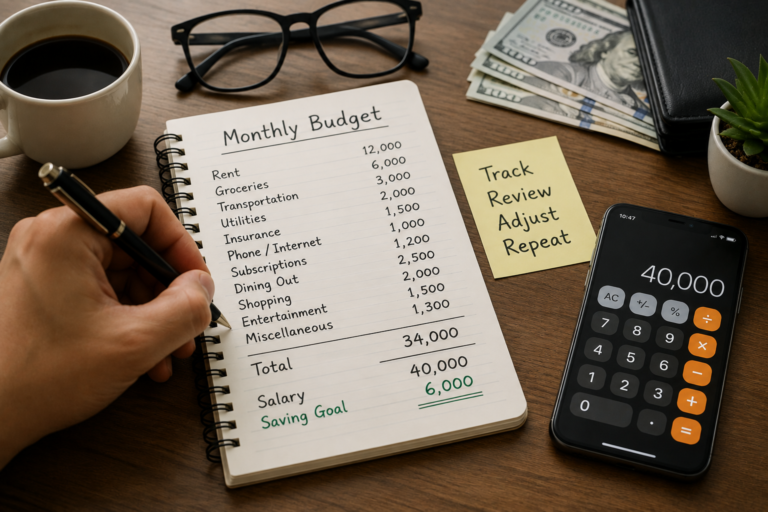
Consider a completely hypothetical example. Someone doesn’t make one huge purchase, but several smaller ones throughout the month.
At ₹3,900 a month, the same pattern would amount to ₹46,800 over 12 months if it continued unchanged.
over 12 months
The goal isn’t to eliminate every small expense.
Small spending is not automatically wasteful. A ₹50 purchase can provide convenience, enjoyment, time savings, or something you genuinely value.
The useful question is not simply: “Did I spend ₹50?”
A better question can be: “Was this ₹50 intentional, and am I comfortable with how often it happens?”
Intentional
You know why you spent it and consider the purchase worthwhile.
Unnoticed
The purchase happens repeatedly without you really tracking it.
Don’t change your spending first. Just observe it.
For seven days, write down every small purchase you make. Don’t judge the purchase while recording it. Just capture the amount and what it was for.
Fictional example. Your actual total could be higher, lower or zero on some days.
After seven days, don’t ask only “How much did I spend?”
Look for patterns.
Did the same type of expense appear several times?
Were you paying small amounts mainly because something was easier?
Which expenses weren’t part of your original plan?
Are there recurring payments you rarely think about?
One small decision becomes meaningful when it repeats.
The problem isn’t necessarily the ₹500.
It’s whether you know what the ₹500 became.
Five hundred rupees can be food, transport, entertainment, convenience, savings, a useful purchase, or simply an expense you forgot about.
The number becomes useful when you connect it to a pattern.
Notice. Track. Decide.
You don’t need to treat every small purchase as a mistake. You just need enough visibility to understand your own pattern.
See the small transactions.
Look at them together.
Choose what matters to you.
Questions about small expenses
How much is ₹50 a day for a year?
₹50 × 365 days = ₹18,250. This is a simple mathematical example and assumes the amount is spent every day.
Is every small expense bad?
No. A small expense can be useful or enjoyable. The important distinction is between spending intentionally and spending without noticing a repeated pattern.
How can I find my small expenses?
Review your bank, card or payment-app transaction history and group smaller purchases by category. Looking at several weeks together can reveal patterns that individual transactions hide.
What is the easiest way to start tracking?
Start with seven days. Record the amount, date and reason for each small purchase. The first goal is observation, not restriction.
Questions & Answers
Have a question about this article? Ask it below. Other GrayGaps readers can share their experience and help answer it.