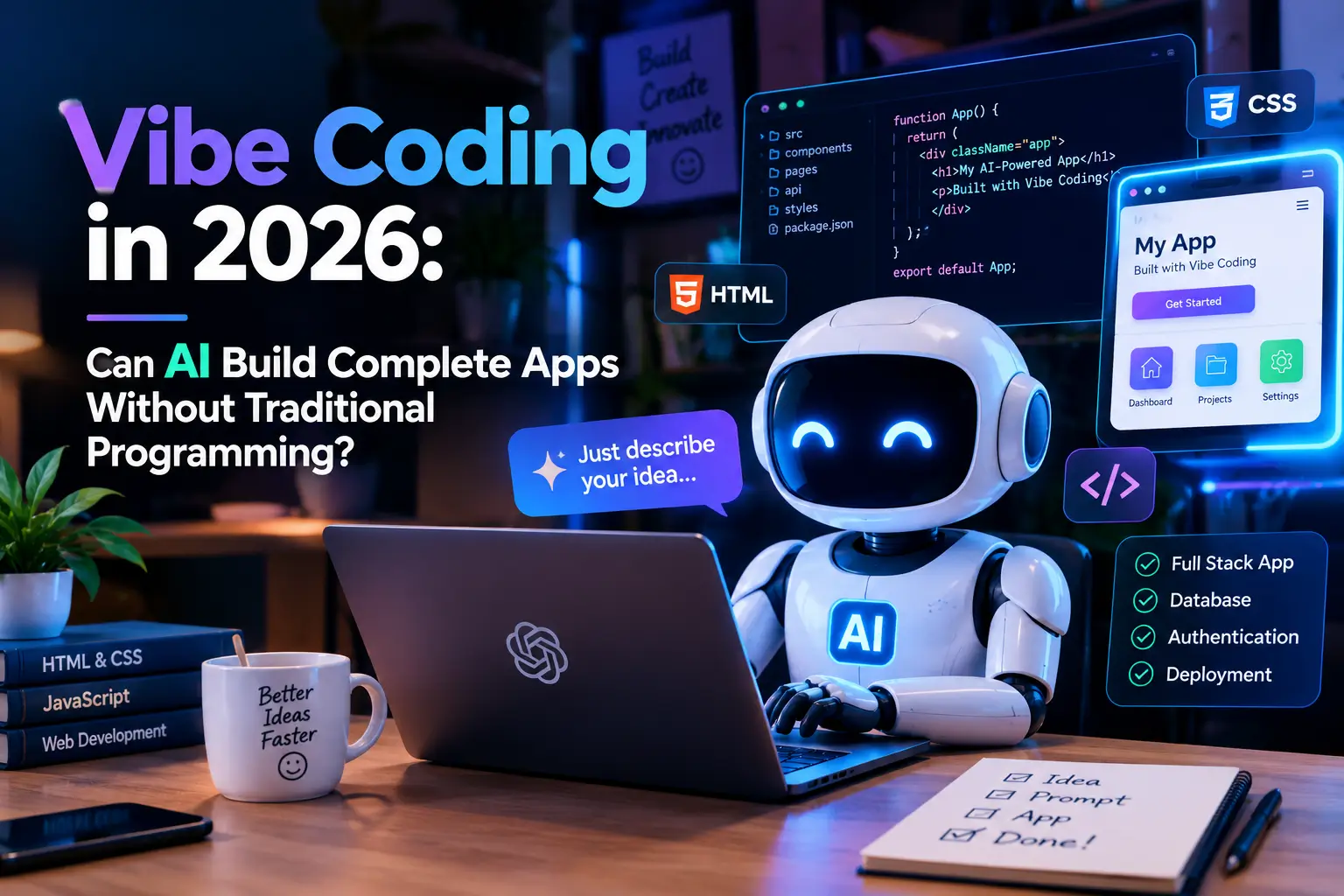
Can AI Really Build Complete Apps? The Rise of Vibe Coding in 2026
Vibe Coding in 2026 is changing the way people think about software development. Instead of writing every function manually, developers and non-programmers can describe what they want in natural language and use AI coding systems to generate, modify, test, debug and improve software.
But there is an important distinction between AI generating an application and AI independently delivering production-ready software. Modern coding agents can perform increasingly complex development tasks, but they do not eliminate the need for requirements, architecture, testing, security, review and human responsibility.
Quick Answer
Can AI build complete apps without traditional programming?
Yes, AI can now build substantial portions of many applications from natural-language instructions, especially websites, dashboards, prototypes, CRUD applications, internal tools and relatively straightforward web applications. Modern coding agents can work across multiple files, run commands, execute tests and iterate on problems.
However, “complete app” does not always mean “production-ready app.” Complex applications still require software architecture, database design, authentication, security, testing, deployment, monitoring, performance optimization and human review.
Table of Contents
- What Is Vibe Coding in 2026?
- Why Vibe Coding Is Becoming So Popular
- How AI Coding Agents Build Applications
- Vibe Coding vs Traditional Programming
- What AI Can Build Today
- Can AI Really Build a Complete App?
- The Modern AI App Development Workflow
- AI and Front-End Development
- AI and Back-End Development
- AI and Database Development
- AI and API Integration
- AI-Powered Debugging
- AI-Powered Software Testing
- Security Problems in AI-Generated Code
- The Biggest Limitations
- Do Developers Still Need Programming Skills?
- The New Skills Developers Need
- Example: Building a Web App With AI
- How to Write Better Coding Prompts
- 10 Common Vibe Coding Mistakes
- The Future of Vibe Coding
- Frequently Asked Questions
- Final Takeaway
Featured Image
Add your generated featured image here.
Suggested ALT text:
Vibe Coding in 2026 with AI coding agents building complete software applications
What Is Vibe Coding in 2026?
Vibe Coding in 2026 describes a software-development approach in which people communicate their desired software behavior using natural language and rely heavily on AI systems to generate and modify code.
The concept is broader than simply asking an AI chatbot to produce a function.
A modern AI coding workflow can involve requirements analysis, project creation, file generation, code editing, dependency installation, testing, debugging, documentation and iterative improvements.
That difference is important.
Earlier AI coding assistants were mainly autocomplete systems. A developer typed code and the AI suggested the next lines. Modern agentic development systems can operate at a much higher level.
GitHub’s current documentation describes agentic workflows in which an agent can research a repository, create a plan, edit files, run tools and iterate on changes. 5
OpenAI similarly describes Codex as a coding agent designed for tasks ranging from routine pull requests to features, refactoring and migrations. 6
This means the central question is no longer simply:
“Can AI write code?”
The more interesting question is:
“How much of the software-development lifecycle can AI perform reliably when a human provides the goal, context and constraints?”
That is where Vibe Coding in 2026 becomes significant.
Why Vibe Coding Is Becoming So Popular
Software development has traditionally required people to understand programming languages, frameworks, databases, APIs, development environments and deployment systems.
Those skills remain valuable.
But AI is changing the interface through which people interact with software development.
Instead of beginning with:
const express = require("express");
const app = express();

app.get("/users", async (req, res) => {
    // implementation
});
a person can begin with a requirement such as:
“Build a responsive user dashboard with authentication, a navigation menu, a profile page, a searchable table and an API endpoint for retrieving user records.”
The AI can then translate the requirement into technical implementation.
This lowers the initial barrier between an idea and a working prototype.
It also changes the role of developers.
Instead of manually producing every line of code, developers increasingly spend more time defining requirements, reviewing architecture, testing behavior, checking security and directing AI systems.
That does not mean programming knowledge has become irrelevant.
In fact, understanding programming can become more important when AI-generated projects become large enough to require debugging and architectural decisions.
How AI Coding Agents Build Applications
AI coding agents can operate through a loop that resembles an engineering workflow.
- Understand the request.
- Inspect the project.
- Determine the required files.
- Create an implementation plan.
- Write or modify code.
- Install or configure dependencies.
- Run the application.
- Run tests.
- Analyze errors.
- Fix problems.
- Repeat the cycle.
- Prepare the final changes for review.
GitHub’s documentation specifically describes agent mode as capable of determining which files need changes, offering code changes and terminal commands, and iterating when problems occur. 7
This is substantially different from basic code autocomplete.
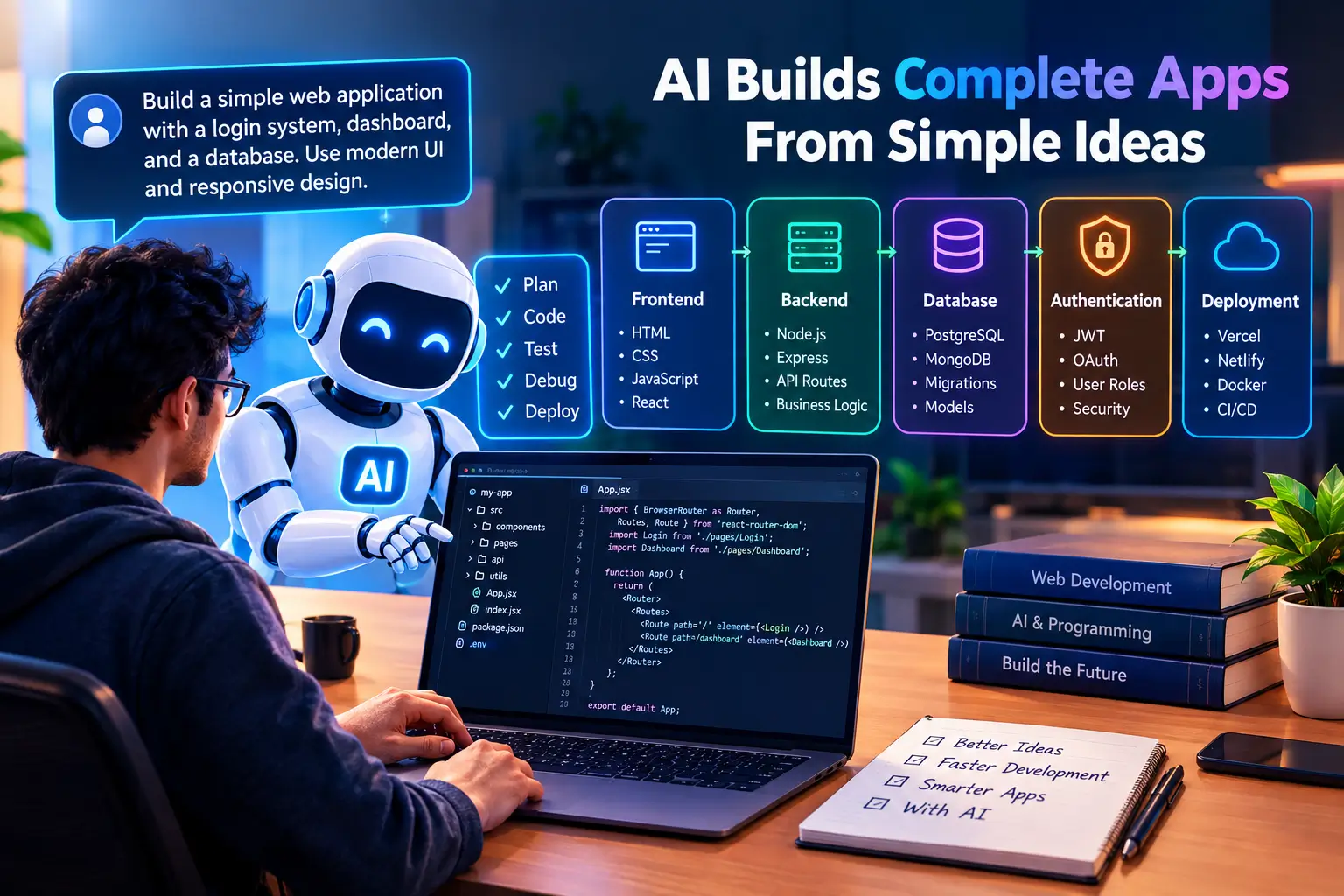
Planning
The first important stage is planning.
A good AI agent should understand the application’s requirements before changing dozens of files.
For example, an online store might require:
- Product pages
- Search
- Shopping cart
- User authentication
- Order management
- Payment integration
- Database storage
- Admin controls
- Email notifications
- Security controls
Each requirement can create additional technical requirements.
Implementation
After planning, the agent can create or modify source files.
Depending on the development environment, this can involve HTML, CSS, JavaScript, TypeScript, Python, Java, Go, PHP, SQL and other technologies.
Testing
The agent can then run tests or application commands.
If a test fails, the failure can become new information for the next development step.
Iteration
This iterative loop is one of the most important features of agentic programming.
The AI does not necessarily generate everything perfectly on the first attempt.
Instead, it can generate, test, observe, modify and test again.
Vibe Coding vs Traditional Programming
Traditional programming and Vibe Coding in 2026 should not be treated as completely opposite approaches.
In practice, they can exist together.
| Area | Traditional Programming | Vibe Coding |
|---|---|---|
| Code creation | Developer writes most code manually | AI generates a significant portion of code |
| Instructions | Technical implementation | Natural-language requirements plus technical context |
| Debugging | Developer investigates manually | AI can assist with diagnosis and fixes |
| Testing | Developer creates and runs tests | AI can generate and execute tests |
| Architecture | Developer designs system | AI can suggest architecture but human review remains important |
| Security | Developer performs security work | AI can identify potential issues but requires verification |
| Learning curve | High programming requirement | Lower initial barrier |
The biggest difference is the interface.
Traditional programming communicates with computers primarily through formal programming languages.
Vibe Coding adds natural language as another interface.
But the software underneath still consists of code.
What AI Can Build Today
AI can generate a surprisingly wide variety of software.
1. Websites
AI can generate responsive websites containing navigation, sections, forms, cards, animations and interactive components.
2. Landing Pages
Marketing pages are particularly suitable for AI-assisted development because their requirements can often be expressed clearly.
3. Dashboards
AI can create dashboards containing charts, filters, tables and API-connected data.
4. CRUD Applications
Create, Read, Update and Delete applications are another strong use case.
Examples include inventory systems, employee directories, content management systems and internal administration tools.
5. Personal Productivity Apps
Task managers, note-taking applications, habit trackers and simple calendar applications can often be developed quickly with AI assistance.
6. Educational Tools
AI can create quizzes, flashcard applications, calculators, learning dashboards and interactive demonstrations.
7. Developer Tools
AI can build utilities that process JSON, convert files, validate data, format text or automate repetitive development tasks.
8. APIs
AI can generate REST APIs, database models, authentication systems and API documentation.
9. Browser Applications
Many modern web applications can be created through a combination of HTML, CSS, JavaScript and back-end technologies.
10. Prototypes
One of the strongest use cases is rapid prototyping.
A founder can describe an idea and receive a working prototype much faster than starting from an empty code editor.
Can AI Really Build a Complete App?
This question requires a careful definition of “complete.”
If complete means a functioning prototype with a user interface, database and basic features, AI can accomplish a significant amount of the work.
If complete means a highly secure, scalable, production-critical application used by thousands or millions of people, the requirements are much higher.
A production application may require:
- Architecture
- Authentication
- Authorization
- Database design
- Input validation
- Secure API design
- Rate limiting
- Error handling
- Logging
- Monitoring
- Automated testing
- Performance testing
- Backup systems
- Deployment pipelines
- Security reviews
- Privacy controls
- Accessibility
- Documentation
- Maintenance
An AI system may help with many of these areas.
But generating code is not equivalent to proving that the application is correct.
Important: An application can look professional while still containing serious architectural, security or data-handling problems.
This is why Vibe Coding in 2026 is best understood as an AI-assisted development methodology rather than a guarantee that traditional software engineering is unnecessary.
The Modern AI App Development Workflow
A practical AI development workflow can be divided into ten stages.
Stage 1: Define the Problem
Start with the problem instead of the technology.
For example:
“Users need a simple way to track their daily expenses and see monthly spending categories.”
Stage 2: Define Users
Explain who will use the application.
Different users may require different permissions and interfaces.
Stage 3: Define Features
Write down the minimum features required for version one.
Stage 4: Define Data
Explain what information must be stored.
Stage 5: Ask AI for Architecture
Before generating hundreds of lines of code, ask the AI to propose a technical structure.
Stage 6: Build the Smallest Working Version
Do not ask for every feature simultaneously.
Build the foundation first.
Stage 7: Test
Run the application and verify each feature.
Stage 8: Add Features Incrementally
Give the AI smaller tasks instead of one enormous instruction.
Stage 9: Review Security
Check authentication, permissions, input validation, secrets and external integrations.
Stage 10: Deploy and Monitor
After deployment, monitor errors, performance and user behavior.
AI and Front-End Development
Front-end development is one of the areas where Vibe Coding in 2026 can be particularly visible.
A user can describe a page in natural language.
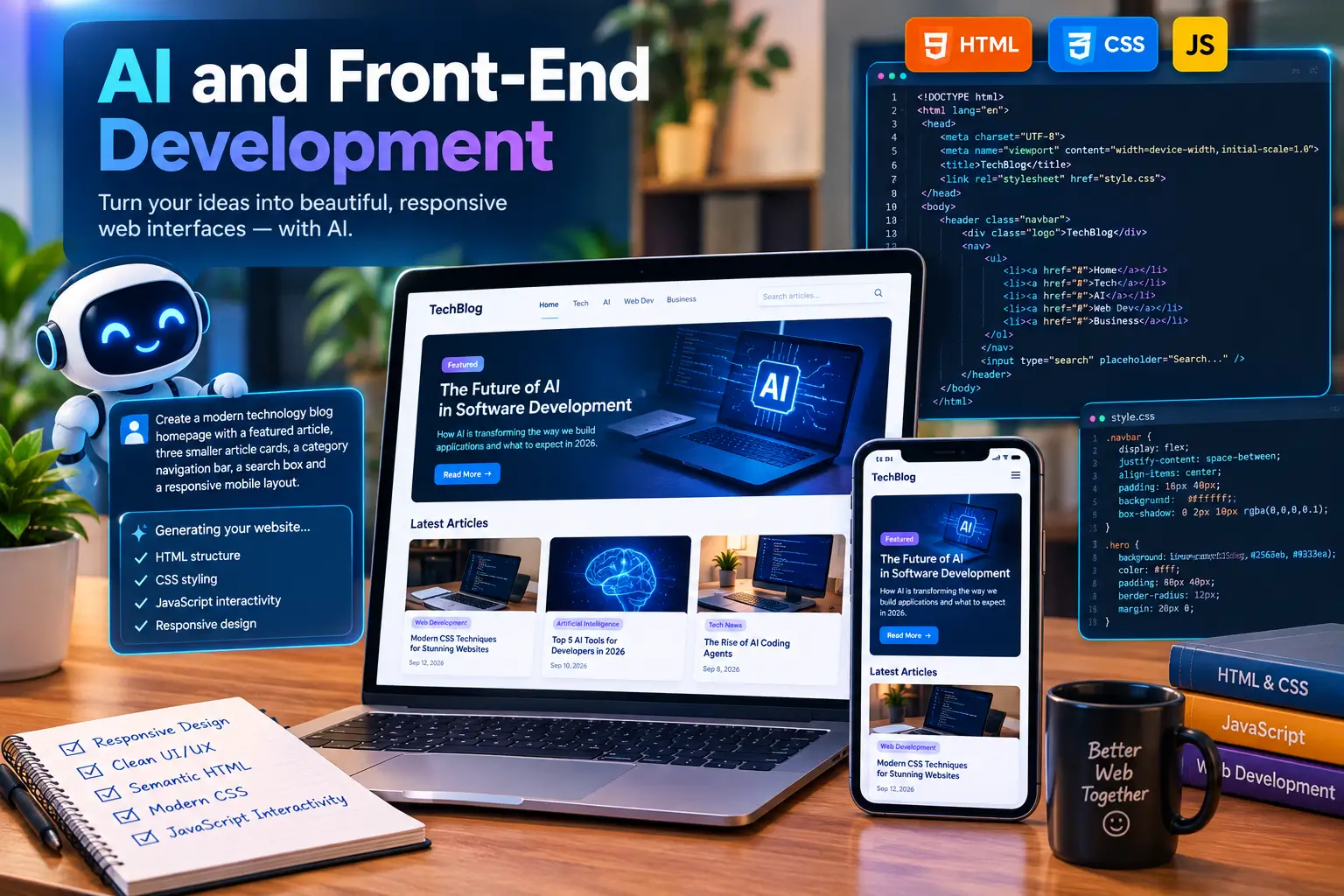
For example:
“Create a modern technology blog homepage with a large featured article, three smaller article cards, a category navigation bar, a search box and a responsive mobile layout.”
An AI system can translate that request into HTML, CSS and JavaScript.
It can also modify the result when the user asks for changes.
For example:
- Make the cards wider.
- Reduce the heading size on mobile.
- Add a dark navigation bar.
- Improve spacing.
- Add a search button.
- Make the layout responsive.
- Improve accessibility.
This makes natural-language iteration one of the most interesting aspects of AI-assisted development.
AI and Back-End Development
Back-end development is more complicated because it involves business logic, databases, APIs, authentication and security.
AI can nevertheless generate considerable amounts of back-end code.
For example, a user might request:
Create an API endpoint:

GET /api/products

Return products from the database.

Support:
- pagination
- search
- category filtering
- validation
- error handling
The AI may generate the required route, database query, validation logic and response structure.
But the developer still needs to verify whether the implementation is secure and appropriate.
AI and Database Development
Databases are another important part of AI-assisted software development.
AI can help create tables, schemas, relationships, migrations and queries.
For an e-commerce application, a simple model could contain:
| Table | Purpose |
|---|---|
| users | Stores user account information |
| products | Stores product information |
| orders | Stores customer orders |
| order_items | Stores products associated with orders |
| payments | Stores payment-related records |
AI can generate SQL and database models quickly.
However, database design becomes increasingly important as applications scale.
A poor schema can create performance problems that are difficult to fix later.
AI and API Integration
Modern applications rarely operate in isolation.
They often communicate with external services through APIs.
Examples include:
- Payment services
- Email platforms
- Maps
- Cloud storage
- Authentication providers
- Analytics systems
- AI model APIs
- Search services
- Messaging systems
AI can help developers understand API documentation and create integration code.
It can also explain authentication requirements and generate request and response handling.
But API credentials must be handled carefully.
Private API keys should never be hard-coded into public front-end JavaScript.
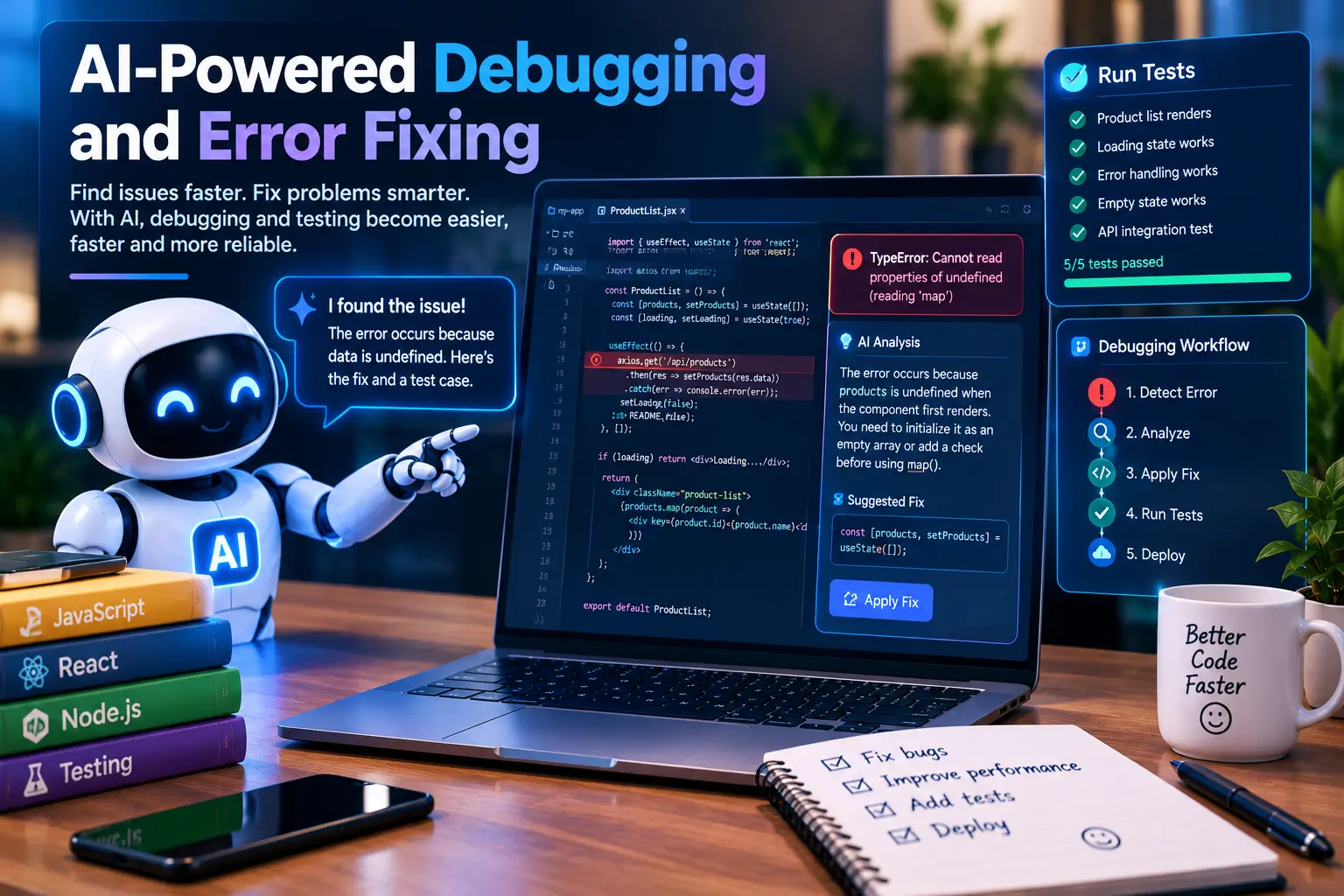
AI-Powered Debugging and Error Fixing
One of the most useful applications of AI coding agents is debugging.
Software bugs often produce error messages that are difficult for beginners to understand.
AI can translate those errors into plain language.
For example:
TypeError: Cannot read properties of undefined
(reading 'map')
An AI assistant can explain that the code is attempting to call map() on a value that is currently undefined.
It can then inspect the surrounding code and propose a fix.
Agentic systems can go further by applying a change and running tests again.
GitHub describes agent workflows that can iterate on changes and remediate problems during development. 8
AI-Powered Software Testing
Testing is one of the areas where developers should avoid relying on visual inspection alone.
An application can look correct while failing in unexpected situations.
AI can help generate:
- Unit tests
- Integration tests
- API tests
- UI tests
- Edge-case tests
- Regression tests
For example, if an application accepts a user’s age, tests should not only check normal values.
They should also consider:
- Negative numbers
- Very large numbers
- Empty values
- Text instead of numbers
- Decimal values
- Missing fields
AI can help identify these cases.
But the test itself must also be reviewed.
A test that checks the wrong expected result can give false confidence.
Security Problems in AI-Generated Code
One of the biggest mistakes in Vibe Coding in 2026 is assuming that generated code is automatically secure.
AI systems can produce code containing vulnerabilities or insecure assumptions.
Potential problems include:
- Weak authentication
- Improper authorization
- SQL injection
- Cross-site scripting
- Insecure file uploads
- Exposed API keys
- Unsafe dependencies
- Insufficient input validation
- Improper error handling
- Overly broad permissions
Modern agentic coding systems are therefore being developed with security controls and permission boundaries.
GitHub’s responsible-use documentation notes that agentic coding features can modify files, execute commands and create pull requests, making security controls and human review important. 9
OpenAI has similarly described controls around coding agents, including technical boundaries, approval requirements and telemetry. 10
Rule for AI-generated software: Never treat “the AI generated it” as evidence that the code is secure.
The Biggest Limitations of Vibe Coding in 2026
1. AI Can Misunderstand Requirements
Natural language is flexible.
That is useful for humans but can create ambiguity for software.
If the requirement is unclear, the AI may implement a reasonable interpretation that is nevertheless wrong for the project.
2. Large Projects Become Difficult
A small application may be easy to understand.
A large enterprise application can contain thousands of files, complex dependencies and years of business rules.
Maintaining consistency becomes harder.
3. AI Can Introduce Technical Debt
AI can produce code quickly.
Fast code generation can encourage people to add features before thinking about architecture.
The result may work initially but become difficult to maintain.
4. Generated Code Can Be Over-Engineered
AI sometimes introduces libraries or abstractions that are unnecessary.
5. Generated Code Can Be Under-Engineered
The opposite problem is also possible.
The AI may produce a simple implementation that works for a prototype but fails under real-world conditions.
6. Context Matters
The quality of an AI coding result depends heavily on the context available to the model.
If the system cannot see the relevant files, requirements or architecture, its answer may be incomplete.
7. Testing Still Matters
AI can generate code and tests, but verification remains necessary.
8. Security Requires Special Attention
Applications handling payments, personal information or sensitive business data require stronger controls than simple experiments.
Do Developers Still Need Programming Skills?
Yes, programming skills remain useful even when AI writes much of the code.
The reason is simple.
If the AI creates a project containing thousands of lines of code, somebody must still understand whether the architecture makes sense.
Programming knowledge helps a developer ask better questions.
It also makes debugging much easier.
For example, knowing the difference between front-end and back-end code helps identify where an error is likely to exist.
Understanding HTTP helps when debugging APIs.
Understanding SQL helps when debugging database queries.
Understanding authentication helps when evaluating login systems.
Understanding JavaScript helps when inspecting browser behavior.
Therefore, AI may reduce the amount of code a person must manually type without eliminating the value of programming knowledge.
The New Skills Developers Need
Vibe Coding in 2026 changes which development skills become especially valuable.
Requirements Engineering
Developers need to turn vague ideas into precise software requirements.
System Architecture
Knowing how components fit together becomes increasingly important.
Code Review
Developers must be able to inspect AI-generated changes.
Testing
Good developers must understand how to verify software behavior.
Security
Security knowledge is essential when AI can generate and modify application code rapidly.
Prompt Engineering
Clear instructions can improve AI-generated software.
Debugging
When the AI fails, developers need to understand why.
Product Thinking
Building the correct product is more important than generating large amounts of code.
Example: Building a Web App With AI
Imagine you want to build a simple expense tracker.
The application should allow users to add expenses and view monthly totals.
A traditional development process might begin with choosing the framework, creating the project, designing components and writing the initial code.
With Vibe Coding in 2026, the first instruction could instead describe the desired result.
Example prompt:
Build a responsive expense-tracking web application. Users should be able to add an expense with a title, amount, date and category. Display expenses in a table. Add monthly totals and category summaries. Use a clean responsive interface. Separate the application into reusable components and include validation for invalid amounts and missing fields.
The AI can then propose an architecture.
For a prototype, the architecture might contain:
- Frontend interface
- Expense form
- Expense list
- Summary component
- Data layer
- Validation functions
The next step is implementation.
Instead of asking for the entire project in one massive prompt, it is often better to work in stages.
Prompt 1: Project Structure
Create the project structure first.

Do not implement every feature yet.

Explain:
1. Files
2. Components
3. Data flow
4. Validation strategy
5. Testing strategy
Prompt 2: User Interface
Implement the expense form and expense table.

Use semantic HTML.
Make the interface responsive.
Add validation messages.
Do not add unrelated features.
Prompt 3: Data Handling
Implement the expense data layer.

Support:
- create expense
- retrieve expenses
- update expense
- delete expense

Add validation and error handling.
Prompt 4: Testing
Create tests for:
- valid expenses
- missing titles
- invalid amounts
- empty categories
- date validation
- monthly calculations
This staged process gives the developer more control than asking an AI to “build everything” without constraints.
How to Write Better AI Coding Prompts
Good prompts are specific without becoming unnecessarily complicated.
A strong coding prompt can include six parts.
- Goal
- Users
- Features
- Technology
- Constraints
- Expected output
Weak Prompt
“Make me an ecommerce website.”
Better Prompt
“Build a responsive e-commerce prototype for a small electronics store. Create a product listing page, product detail page, search, category filtering, shopping cart and checkout interface. Use semantic HTML, responsive CSS and modular JavaScript. Keep payment processing mocked for the prototype. Include validation and error states. Explain the folder structure before implementation.”
The second prompt gives the AI much more useful context.
Ask AI to Explain Before Changing
For complicated projects, ask the AI to explain its proposed approach before allowing it to modify the codebase.
This creates a review point.
Use Small Tasks
Instead of:
“Build my entire application.”
Use:
“Implement the authentication module. Do not modify unrelated components. Add tests for successful login, invalid credentials and missing fields.”
Smaller tasks make errors easier to identify.
10 Common Vibe Coding Mistakes
1. Building Without Requirements
Do not start coding before understanding the problem.
2. Trusting Every AI Output
Generated code needs review.
3. Ignoring Security
Never assume generated authentication or API code is automatically secure.
4. Adding Too Many Features
Start with a minimum viable version.
5. Skipping Tests
A working screen does not prove the application works correctly.
6. Ignoring Error Messages
Use errors as information for debugging.
7. Allowing Unnecessary Dependencies
Every dependency creates maintenance considerations.
8. Giving AI Excessive Permissions
Agents should receive only the permissions required for their tasks.
9. Never Reading the Code
You do not need to memorize every line, but you should understand important parts of the system.
10. Confusing Prototype With Production Software
A prototype can demonstrate an idea without meeting production requirements.
Vibe Coding and the Future of Software Architecture
As AI generates more code, software architecture becomes increasingly important.
If AI can produce thousands of lines in a short time, the limiting factor may shift from code generation to system organization.
Good architecture can make AI-assisted development easier because the project contains clear boundaries.
For example:
/src
  /components
  /pages
  /services
  /api
  /database
  /utils
  /tests
When responsibilities are separated, an AI agent can work on one area without unnecessarily changing unrelated parts.
This is particularly useful for large projects.
The Human-AI Development Team
The future of software development may not be humans versus AI.
A more practical model is humans working with AI systems.
| Human Responsibility | AI Assistance |
|---|---|
| Define the product goal | Translate requirements into implementation ideas |
| Make architecture decisions | Suggest architecture options |
| Evaluate business requirements | Generate implementation plans |
| Approve important changes | Implement code changes |
| Set security requirements | Identify potential vulnerabilities |
| Review production readiness | Run tests and report issues |
This model makes AI a development partner rather than an uncontrolled replacement for engineering judgment.
GitHub’s current agent documentation explicitly describes human review and approval as part of agentic development workflows. 11
Is Vibe Coding the Same as No-Code?
No.
No-code platforms generally provide visual interfaces where users assemble applications without directly managing conventional source code.
Vibe Coding is different because AI can generate and modify actual source code.
The user may not manually type the code, but the underlying application can still consist of HTML, CSS, JavaScript, Python, SQL or another programming language.
This creates a hybrid category between traditional programming and conventional no-code development.
| Approach | Main Interface | Source Code |
|---|---|---|
| Traditional programming | Code editor | Directly written |
| No-code | Visual builder | Usually abstracted |
| Vibe Coding | Natural language + development tools | AI-generated and human-reviewed |
| AI coding agent | Natural language + agent environment | Agent can create and modify code |
What Does Vibe Coding Mean for Programming Careers?
The effect of AI on programming careers is likely to be more complicated than simply “AI replaces programmers.”
Software development contains many different activities.
Some are repetitive.
Some require deep technical knowledge.
Some require communication with customers.
Some require architecture.
Some require security expertise.
Some involve understanding a business domain.
AI can automate portions of these activities at different speeds.
That means developers may increasingly spend less time manually writing routine code and more time supervising, reviewing, designing and integrating systems.
Programming education may also evolve.
Students may need to learn both traditional programming concepts and effective AI-assisted development.
How Beginners Can Learn Programming in the Vibe Coding Era
Beginners should not interpret AI as a reason to skip fundamentals.
Instead, AI can become a learning assistant.
A beginner learning JavaScript could ask AI to explain:
- Variables
- Functions
- Objects
- Arrays
- Loops
- Promises
- Async and await
- DOM manipulation
- Events
- APIs
Then the learner can ask the AI to create small examples.
The important step is understanding why the code works.
Copying generated code without learning the underlying concepts can create a dangerous dependency.
When something breaks, the user may not know how to diagnose the problem.
AI-Generated Code and Performance
An application can be functionally correct while still being inefficient.
For example, a database query may return the correct records but perform poorly when the database grows.
AI can help identify potential performance problems, but performance engineering often requires real measurements.
Developers should use profiling and monitoring rather than assuming that generated code is optimized.
Important performance areas include:
- Database queries
- API response times
- JavaScript execution
- Image sizes
- Network requests
- Caching
- Server resources
- Database indexes
Who Maintains an AI-Built Application?
This is one of the most important questions surrounding Vibe Coding in 2026.
Software does not stop requiring maintenance after launch.
Dependencies are updated.
Browsers change.
APIs change.
Security vulnerabilities are discovered.
Users request new features.
Business requirements change.
Servers need monitoring.
Databases need maintenance.
Someone must remain responsible for the application.
AI can assist with maintenance, but ownership cannot simply disappear.
From AI Assistants to Autonomous Coding Agents
The biggest shift in AI programming is the movement from suggestion-based tools toward agents that can perform multi-step work.
A traditional assistant might suggest a function.
An agent can potentially:
- Read an issue.
- Inspect the repository.
- Plan the implementation.
- Modify multiple files.
- Run tests.
- Inspect failures.
- Apply fixes.
- Run the tests again.
- Create a pull request.
GitHub documents this type of workflow through its Copilot agents, including research, planning, implementation and pull-request workflows. 12
OpenAI’s current Codex materials similarly describe agentic workflows involving features, refactoring, migrations and background engineering tasks. 13
This is why Vibe Coding in 2026 is more significant than simply asking a chatbot to generate code.
The Future of Vibe Coding in 2026 and Beyond
The future of AI-assisted programming is likely to involve increasingly capable development agents.
Several trends are particularly important.
1. Longer Development Tasks
Agents are increasingly designed to work through longer sequences of development tasks.
2. Multiple Agents
Different agents may specialize in coding, testing, security, documentation or research.
3. Better Repository Understanding
AI systems are becoming increasingly focused on understanding entire repositories instead of isolated code snippets.
4. Automated Testing
Testing will become an increasingly important part of agentic software development.
5. Human Approval Gates
Important changes may continue to require human approval.
6. AI-Native Development Environments
Development environments may increasingly be designed around conversations, agents and task delegation.
7. Natural Language as a Development Interface
Natural language may become a major interface for directing software systems.
However, code itself is unlikely to disappear.
Computers still need precise instructions.
The major change is who produces those instructions and how they are created.
Related Programming and AI Topics
Readers interested in AI-assisted programming can continue with these related GrayGaps resources:
Official Resources for Learning More About AI Coding
Frequently Asked Questions About Vibe Coding in 2026
What is Vibe Coding in 2026?
Vibe Coding in 2026 refers to using natural-language instructions and AI coding systems to create, modify, test and improve software. The approach can involve AI assistants as well as more autonomous coding agents.
Can AI build a complete app?
AI can build substantial applications and prototypes, including front-end interfaces, APIs, database layers and tests. However, production-ready software still requires verification, security, testing, deployment and maintenance.
Can a non-programmer use Vibe Coding?
Yes. Natural-language development can allow beginners to create software without manually writing every line of code. However, learning programming fundamentals remains useful for debugging, reviewing and maintaining the resulting application.
Will Vibe Coding replace programmers?
Vibe Coding can automate some programming tasks, but software development includes architecture, requirements, security, testing, product decisions and maintenance. AI changes how these tasks can be performed rather than making every software-engineering responsibility disappear.
Is Vibe Coding the same as no-code?
No. Vibe Coding generally involves AI generating or modifying actual source code, while no-code platforms usually abstract most source-code details behind visual interfaces.
Can AI debug its own code?
AI coding agents can inspect errors, modify code and rerun tests. Some agent workflows are specifically designed for iterative development. However, successful test execution does not prove that every possible problem has been eliminated.
Can AI build a website from one prompt?
AI can generate a working website from a detailed prompt, particularly for straightforward sites and prototypes. Complex websites generally require multiple iterations and human review.
Can AI build an Android or iOS app?
AI can assist with mobile application development by generating components, screens, logic, API integrations and tests. A complete mobile application still requires platform-specific testing, signing, deployment and maintenance.
Can AI create a database?
Yes. AI can generate database schemas, SQL queries, migrations and data-access code. Developers should review the schema, indexes, permissions and data-handling practices.
Is AI-generated code safe?
AI-generated code is not automatically safe. It should be reviewed, tested and scanned for security issues, particularly when it handles authentication, payments, personal information or sensitive systems.
Should beginners learn programming if AI can code?
Learning programming remains valuable. Fundamental knowledge helps people understand generated code, identify mistakes, debug applications and communicate technical requirements effectively.
What is an AI coding agent?
An AI coding agent is a system designed to perform multi-step software-development tasks. Depending on its permissions and environment, it may inspect files, plan changes, edit code, execute commands, run tests and prepare changes for review.
Final Takeaway: Can AI Replace Traditional Programming?
Vibe Coding in 2026 shows that software development is moving toward a new interaction model.
People can increasingly describe what they want in natural language while AI systems translate those requirements into code and development actions.
For websites, prototypes, dashboards, internal tools, CRUD applications and many relatively straightforward projects, this can dramatically reduce the amount of code that humans need to write manually.
AI can also help with debugging, testing, refactoring, documentation and repetitive development work.
But the idea that AI can simply replace traditional programming for every application is too simplistic.
Production software requires more than code.
It requires requirements.
It requires architecture.
It requires security.
It requires testing.
It requires performance considerations.
It requires deployment.
It requires monitoring.
It requires maintenance.
And most importantly, it requires someone who is responsible for the final system.
The biggest opportunity created by Vibe Coding in 2026 may therefore not be the disappearance of programming.
It may be the transformation of programming from a task dominated by manually typing code into a broader engineering process where humans define goals, constraints and quality standards while AI handles an increasing amount of implementation work.
The future of programming may not be “humans or AI.” It may be humans directing AI to build, test and improve software while humans remain responsible for understanding what the software should do and whether it is safe and reliable.
Questions & Answers
Have a question about this article? Ask it below. Other GrayGaps readers can share their experience and help answer it.