Quick Answer
Astronomers have found strong evidence that the young Milky Way merged with a smaller galaxy approximately 11.8 billion years ago.
The ancient galaxy is referred to as Low-energy-Kraken-Heracles (LKH). Researchers identified evidence of the merger by studying ancient globular clusters using detailed Hubble Space Telescope observations and other astronomical data.
The event occurred only about 1.5 billion years after the Big Bang, making it the earliest major merger in the Milky Way’s history that has been firmly identified by this type of evidence.
The discovery gives scientists a better understanding of how the Milky Way grew from a much younger galaxy into the enormous system we see today.
The Milky Way galaxy merger discovered through ancient globular clusters reveals a remarkable chapter in the early history of our galaxy. Scientists found evidence that the young Milky Way absorbed a dwarf galaxy about 11.8 billion years ago.
Table of Contents
- The Milky Way Was Not Always the Galaxy We Know Today
- What Happened 11.8 Billion Years Ago?
- How Did Scientists Discover a Merger That Happened Billions of Years Ago?
- Why Are Globular Clusters So Important?
- What Did Hubble Help Scientists Discover?
- What Is LKH?
- Was This Really a Galaxy Collision?
- Did the Merger Trigger New Star Formation?
- Why Does This Discovery Matter?
- Did This Merger Create the Solar System?
- Has the Milky Way Swallowed Other Galaxies?
- What Is Galactic Archaeology?
- What Happens Next?
- Frequently Asked Questions
- The Bigger Picture
The Milky Way Was Not Always the Galaxy We Know Today
When we look at the Milky Way today, it can seem like an enormous and permanent structure.
But our galaxy has been changing for billions of years.
The Milky Way did not appear in its current form all at once. It grew through a combination of star formation, gas accumulation and mergers with smaller galaxies.
Smaller galaxies can be pulled toward larger systems by gravity. Over time, their stars, gas and dark matter can become part of the larger galaxy.
Astronomers have already found evidence for several important mergers in the Milky Way’s history.
One of the best-known examples is Gaia-Enceladus, also known as Gaia-Sausage-Enceladus, which merged with the Milky Way roughly 10 billion years ago.
The Milky Way is also still interacting with the Sagittarius dwarf galaxy.
The new research takes scientists even farther back into the early history of our galaxy.
What Happened 11.8 Billion Years Ago?
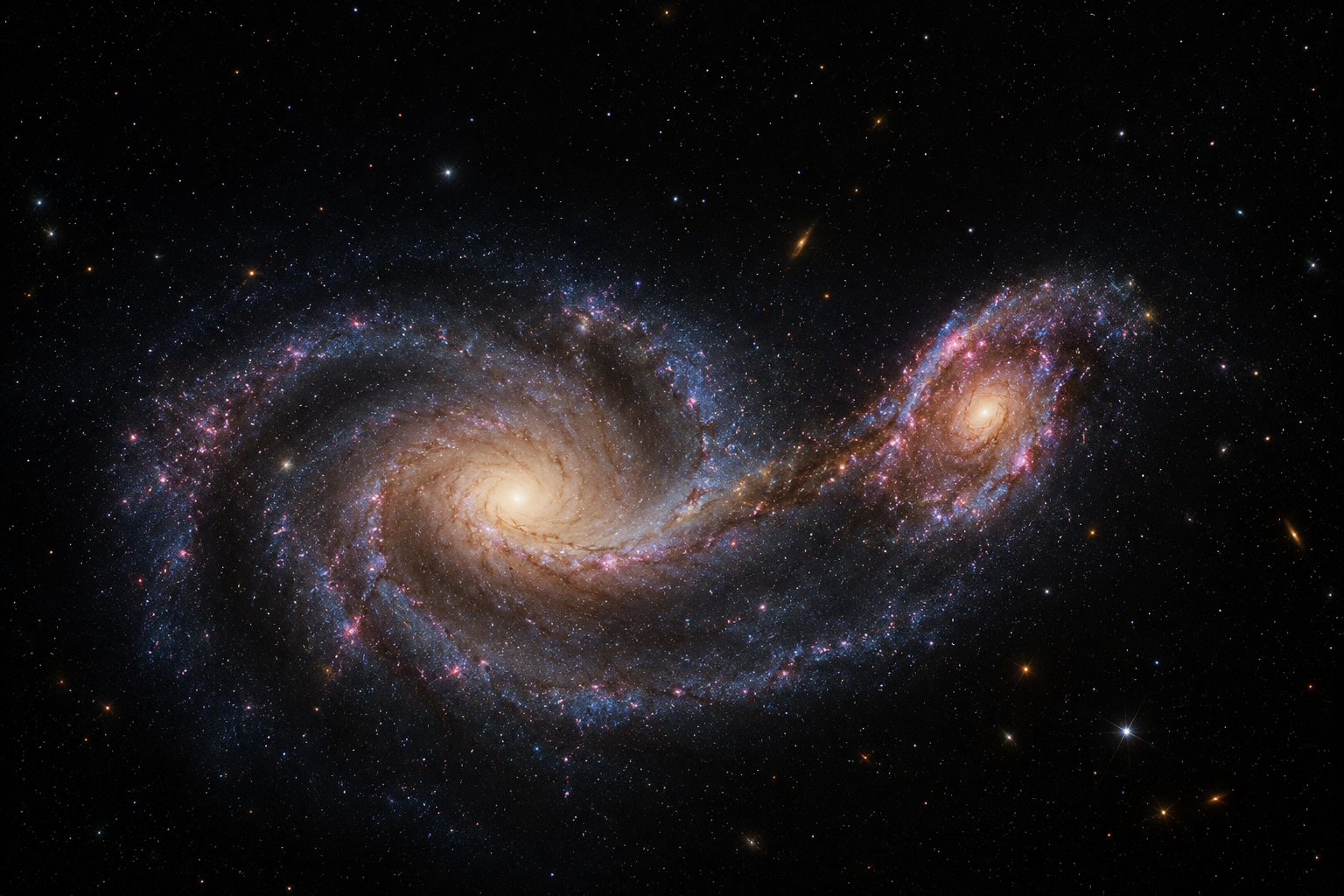
Approximately 11.8 billion years ago, the young Milky Way merged with a smaller galaxy.
The progenitor system is referred to as Low-energy-Kraken-Heracles, or LKH.
The researchers estimate that the smaller galaxy had a stellar mass of roughly 500 million times the mass of the Sun.
That is enormous by human standards, but the young Milky Way itself was much smaller than the galaxy we see today.
The merger therefore represented a significant event during the early development of our galaxy.
The research estimates that the event occurred approximately 1.5 billion years after the Big Bang.
That means this merger happened during a very early period of cosmic history, when galaxies were still undergoing major growth and transformation.
How Did Scientists Discover a Merger That Happened Billions of Years Ago?
Scientists obviously cannot watch an event that happened almost 12 billion years ago.
There is no photograph showing LKH approaching the Milky Way.
Instead, astronomers searched for evidence left behind by the merger.
Their investigation focused on some of the oldest stellar structures in our galaxy: globular clusters.
These clusters contain large numbers of ancient stars packed into relatively compact regions.
Because many of their stars formed billions of years ago, they can preserve clues about the history of the galaxy in which they originated.
Researchers can study their ages, chemical properties and other characteristics to determine whether different groups of stars share a common origin.
In this case, the researchers found evidence of a previously unidentified stellar population associated with an ancient merger.
Why Are Globular Clusters So Important?
Globular clusters are among the oldest stellar structures in the Milky Way.
They can contain thousands or even hundreds of thousands of stars bound together by gravity.
Their great age makes them especially valuable for reconstructing the early history of our galaxy.
Astronomers can examine characteristics such as:
- Age
- Metallicity
- Chemical composition
- Motion
- Location within the Milky Way
When groups of clusters have different combinations of these properties, scientists can investigate whether they formed in different environments.
This is particularly useful when trying to determine whether some stars originally belonged to another galaxy.
In a sense, these ancient clusters act like a historical record written in stars.
What Did Hubble Help Scientists Discover?
The research relied on detailed observations from the Hubble Space Telescope.
Hubble’s ability to observe crowded stellar regions helped researchers obtain precise information about ancient globular clusters.
The researchers identified three distinct age-metallicity sequences among the globular clusters they studied.
One population was associated with the progenitor of the Milky Way.
Another was associated with the later Gaia-Enceladus merger.
A third population was different.
Its characteristics pointed toward an even earlier merger.
That third population provided the evidence for the ancient event associated with LKH.
The research also used other astronomical information, including data from the European Space Agency’s Gaia mission, to help study the positions and motions of stars.
The combination of these observations allowed researchers to reconstruct a previously hidden part of the Milky Way’s history.
Why This Is Important
Scientists did not discover LKH by photographing an intact galaxy.
They reconstructed its existence from the ancient stars and stellar populations that survived after the merger.
What Is LKH?
LKH stands for Low-energy-Kraken-Heracles.
The name refers to the progenitor system involved in the ancient merger.
There is an important distinction here.
LKH is not a separate dwarf galaxy that astronomers can photograph today.
The merger happened billions of years ago, and the smaller galaxy was incorporated into the Milky Way.
Its stars became part of the larger galaxy.
Scientists are therefore reconstructing LKH from the evidence that remains inside the Milky Way.
In other words, the galaxy disappeared as a separate system, but parts of its history survived in its stars.
Was This Really a Galaxy Collision?
Not in the same way that two physical objects collide on Earth.
The distances between individual stars are enormous.
Even when two galaxies merge, direct collisions between individual stars are extremely unlikely.
Instead, a galaxy merger is primarily a gravitational interaction.
Gravity changes the paths of stars and affects the distribution of gas and dark matter.
The galaxies can become distorted and eventually form one combined system.
So when scientists describe the Milky Way as having “swallowed” another galaxy, they are describing an enormous gravitational process rather than billions of stars physically crashing together.
Did the Merger Trigger New Star Formation?
Galaxy mergers can have major effects on gas.
Galaxies contain enormous quantities of gas that can eventually form stars.
When two galaxies interact, their gas can become compressed and disturbed.
This can trigger periods of increased star formation.
The LKH merger therefore may have contributed more than just stars to the young Milky Way.
The interaction also involved gas and dark matter, which could have influenced how the galaxy continued to grow.
Reporting on the research indicates that the interaction between gas in the merging systems may have helped trigger new star formation.
This is another reason galaxy mergers are important when scientists study how galaxies evolve.
Why Does This Discovery Matter?
The importance of the discovery goes beyond the fact that the Milky Way absorbed another galaxy.
It helps scientists answer a much larger question:
How did the Milky Way become the galaxy we see today?
Scientists have long studied how much of the Milky Way’s growth came from stars forming inside the galaxy and how much came from material arriving from smaller galaxies.
The new evidence shows that mergers were already important during the Milky Way’s early history.
The young Milky Way was therefore not developing in complete isolation.
It was interacting with its surroundings and incorporating material from other systems.
This also helps explain why the Milky Way contains different populations of stars with different histories.
Some stars formed inside our galaxy.
Others came from galaxies that no longer exist as separate systems.
Did This Merger Create the Solar System?
No.
The LKH merger occurred approximately 11.8 billion years ago.
The Solar System formed much later, approximately 4.6 billion years ago.
The Sun and Earth therefore did not exist when the merger occurred.
However, the event is still part of the much larger history that eventually produced the environment in which our Solar System formed.
Over billions of years, mergers changed the Milky Way’s structure, stellar populations and chemical environment.
Understanding those changes helps scientists reconstruct the long evolutionary history of our galaxy.
So it would be incorrect to say that LKH directly created Earth or the Sun.
It is more accurate to say that the merger was one chapter in the long development of the Milky Way.
Has the Milky Way Swallowed Other Galaxies?
Yes.
LKH was not the only galaxy involved in the Milky Way’s growth.
The Milky Way later merged with Gaia-Enceladus, an event that occurred roughly 10 billion years ago.
Our galaxy is also currently interacting with the Sagittarius dwarf galaxy.
These events show that the Milky Way’s development has been an ongoing process.
Our galaxy is not an isolated island in space.
It exists within a much larger gravitational environment where galaxies interact, merge and change.
What Is Galactic Archaeology?
Imagine discovering artifacts from a civilization that disappeared thousands of years ago.
You cannot watch that civilization directly.
But the surviving evidence can reveal information about its history.
Astronomers use a similar approach when studying ancient stellar populations.
The original galaxy may have disappeared billions of years ago, but some of its stars remain.
By examining those stars, scientists can reconstruct events that happened long before Earth existed.
That is why studies of ancient globular clusters can be described as galactic archaeology.
The Milky Way itself has changed dramatically.
But some of its oldest stars still preserve pieces of its past.
What Happens Next?
The Milky Way’s merger history is still being reconstructed.
Scientists can continue studying globular clusters and other ancient stellar populations.
Additional observations may reveal more evidence of ancient mergers or provide more precise information about events that are already suspected.
Researchers can also investigate how these mergers affected the structure, star formation and dark-matter distribution of the Milky Way.
The more ancient stellar populations astronomers study, the more detailed the history of our galaxy becomes.
Frequently Asked Questions
How old is the Milky Way?
The Milky Way does not have one precise “birth date.” It formed and evolved over billions of years, and scientists reconstruct its history by studying the ages, chemistry and motions of its stars.
How long ago did the LKH merger happen?
The merger occurred approximately 11.8 billion years ago, around 1.5 billion years after the Big Bang.
What galaxy merged with the Milky Way?
The progenitor system is referred to as Low-energy-Kraken-Heracles (LKH).
How did scientists discover the merger?
Researchers studied ancient globular clusters and identified three distinct age-metallicity sequences. The third population provided evidence for an earlier merger involving LKH.
Did the stars from the two galaxies physically crash into each other?
Generally, no.
The enormous distances between individual stars make direct stellar collisions extremely unlikely.
A galaxy merger is primarily a gravitational interaction involving stars, gas and dark matter.
Did the LKH merger create the Sun?
No.
The merger happened billions of years before the Solar System formed.
Is the Milky Way still interacting with another galaxy?
Yes. The Milky Way is currently interacting with the Sagittarius dwarf galaxy.
Could scientists discover more ancient mergers?
Yes. Astronomers are continuing to study ancient globular clusters and other stellar populations to reconstruct additional parts of the Milky Way’s history.
How massive was the galaxy that merged with the Milky Way?
The research estimates a stellar mass of roughly 5 × 10⁸ solar masses, or about 500 million times the mass of the Sun.
Why is this considered an important discovery?
The evidence provides a much firmer identification of a major merger that occurred extremely early in the Milky Way’s history, helping scientists understand how our galaxy assembled and evolved.
The Bigger Picture
The most fascinating part of this discovery isn’t simply that the Milky Way swallowed another galaxy.
It is what the event tells us about how galaxies grow.
The Milky Way was not built in a single step.
Stars formed inside it.
Smaller galaxies were pulled toward it by gravity.
Gas was exchanged and compressed.
Dark matter accumulated.
And over billions of years, countless events transformed a young galaxy into the enormous system we see today.
Some stars in the Milky Way were born here.
Others came from galaxies that disappeared billions of years ago.
Their original galaxies are gone, but some of their stars remain.
By studying those ancient stars, astronomers can reconstruct events that happened long before humans appeared.
The Milky Way Is a Cosmic Record
Our galaxy is not simply a collection of stars.
It is also a record of billions of years of cosmic history.
Some of the evidence of that history is still written in the stars around us.
The night sky may look peaceful.
But the history of the Milky Way is anything but.
Sources and Further Reading
- Primary research: “Proof that the Milky Way experienced a significant merger only 1.5 billion years after the Big Bang” — arXiv
- Independent reporting: Reuters — “The Milky Way devoured a smaller galaxy about 11.8 billion years ago”
- NASA: NASA Science — Hubble Space Telescope
- European Space Agency: ESA — Gaia Mission
Editorial note: This article is intended for general science education. It is based on the scientific research and reporting available at the time of publication. Future observations and analysis may refine scientists’ understanding of the Milky Way’s early history.
Article date: August 18, 2026
Last reviewed: August 18, 2026
Questions & Answers
Have a question about this article? Ask it below. Other GrayGaps readers can share their experience and help answer it.