Science • August 28, 2026
Black Holes: The Most Mysterious Objects in the Universe
Black holes are among the most extreme objects in the universe. Their gravity is so powerful that once something crosses their event horizon, it cannot escape—not even light.
Table of Contents
5. How Do Scientists Detect Black Holes?
7. What Happens to Time Near a Black Hole?
9. What Happens When Black Holes Merge?
10. How Are Black Holes Imaged?
11. The Black Hole at the Center of the Milky Way
12. What Is James Webb Revealing?
13. What Scientists Still Don’t Know
What Is a Black Hole?
A black hole is a region of space where an enormous amount of mass has been compressed into an extremely small area. The resulting gravitational field is so strong that beyond a boundary called the event horizon, nothing can escape to the outside universe.
Black holes are not literally empty holes or tunnels in space. They are physical objects with mass, and their gravity affects the objects and light around them. NASA describes them as some of the most mysterious objects in the universe because scientists understand many of their observable properties while still lacking a complete explanation of what happens deep inside them.
The idea of a black hole comes from Einstein’s general theory of relativity, which describes gravity as the curvature of spacetime. Under extreme conditions, that curvature can become strong enough for an event horizon to form.
What Is the Event Horizon?
The event horizon is the boundary surrounding a black hole that marks the point of no return. It is not a solid surface like the surface of Earth. Instead, it is a boundary in spacetime.
Once an object crosses the event horizon, escaping would require a speed greater than the speed of light. According to our current understanding of physics, nothing can travel faster than light, so an object that crosses this boundary cannot return to the outside universe.
The size of the event horizon depends on the mass of the black hole. A more massive black hole has a larger event horizon.
How Do Black Holes Form?
One of the best-understood ways to create a black hole begins with a massive star. During most of its lifetime, a star maintains a balance between the inward pull of gravity and the outward pressure produced by energy generated in its core.
When a sufficiently massive star runs out of nuclear fuel, that balance can collapse. Its core can rapidly contract under gravity. Depending on the mass and conditions of the collapsing core, the final object can become a neutron star or a black hole.
NASA explains that stars more than roughly eight times the Sun’s mass can end their lives through core collapse, while sufficiently massive stellar cores can collapse into stellar-mass black holes.
Black holes can also grow after they form. They can gain mass by accreting surrounding material and by merging with other black holes.
Types of Black Holes
Astronomers generally divide black holes into three main observed categories based on their mass: stellar-mass, intermediate-mass and supermassive. A fourth category, primordial black holes, remains hypothetical.
| Type | General Size | What We Know |
|---|---|---|
| Stellar-mass | A few to hundreds of times the Sun’s mass | Usually associated with the collapse of massive stars and also capable of growing through mergers and accretion. |
| Intermediate-mass | Hundreds to hundreds of thousands of solar masses | Scientists are actively searching for and confirming objects in this range. |
| Supermassive | Hundreds of thousands to billions of solar masses | Found at the centers of most large galaxies. |
| Primordial | Potentially a very wide range | A theoretical population that may have formed during the early universe; no definitive evidence has been found. |
The boundaries between these categories are approximate and scientists continue to refine them as new observations become available.
How Do Scientists Detect Black Holes?
Because black holes do not emit or reflect ordinary light from inside their event horizons, astronomers usually find them by observing what happens around them. In other words, scientists can identify an invisible object by measuring its influence on visible matter.
One method is to observe stars orbiting an apparently invisible massive object. If a star moves around something that cannot be seen but has enough mass to explain its motion, astronomers can infer the presence of a black hole.
Another method involves hot gas. When matter falls toward a black hole, it can form a rapidly rotating accretion disk. Friction and other physical processes can heat this material to enormous temperatures, producing radiation that telescopes can detect.
Black holes can also be identified through gravitational waves. When two black holes orbit each other and eventually merge, they send ripples through spacetime. Observatories such as LIGO, Virgo and KAGRA can detect these signals.
- Movement of nearby stars
- X-rays and other radiation from hot surrounding material
- Gravitational waves from black-hole mergers
- Gravitational lensing of background light
- Images of black-hole shadows and surrounding emission
What Is an Accretion Disk?
An accretion disk is a rotating structure of gas and other material surrounding some black holes. The material has angular momentum, so instead of falling directly inward, it can form a rapidly spinning disk.
As material moves closer to the black hole, collisions, friction and magnetic processes can convert gravitational energy into heat. The resulting disk can become extremely hot and bright.
This explains why some black-hole systems appear incredibly bright even though the black hole itself does not produce visible light. What astronomers observe is mainly radiation from material outside the event horizon.
Not every black hole has an accretion disk. An isolated black hole that has little surrounding matter can be extremely difficult to detect.
What Happens to Time Near a Black Hole?
Black holes provide one of the most dramatic examples of gravitational time dilation predicted by Einstein’s theory of relativity. Gravity affects the measurement of time, meaning clocks in different gravitational environments do not necessarily run at the same rate relative to one another.
As an object approaches a black hole, the effects of gravitational time dilation become increasingly strong. A distant observer can describe the infalling object as appearing to slow dramatically near the event horizon.
However, saying that “time simply stops” at the event horizon is an oversimplification. The experience of the observer falling toward the black hole and the measurements made by a distant observer are not identical.
What Is Spaghettification?
Spaghettification is an informal term scientists and science communicators use to describe the extreme stretching of an object caused by tidal forces near a black hole.
The gravitational pull on the side of an object closer to the black hole can be much stronger than the pull on the side farther away. This difference can stretch the object lengthwise while compressing it in another direction.
The strength of this effect depends on the black hole’s mass and the object’s distance from it. Around a smaller stellar-mass black hole, tidal forces near the event horizon can be extremely strong. Around a sufficiently massive supermassive black hole, the tidal forces at the horizon can be comparatively weaker.
What Happens When Black Holes Merge?
Two black holes can orbit each other as a binary system. As they orbit, they can lose energy through gravitational radiation. Their orbit gradually shrinks until the two black holes merge.
The merger creates a larger black hole and releases energy in the form of gravitational waves. These waves travel across the universe and can eventually reach Earth.
The first direct detection of gravitational waves was announced in 2016. The signal came from a pair of merging black holes and marked the beginning of gravitational-wave astronomy.
Today, gravitational-wave observations provide scientists with a completely different way to study black holes, including objects that may be difficult to detect through ordinary light.
How Are Black Holes Imaged?
In 2019, the Event Horizon Telescope collaboration released the first image showing the shadow of a black hole. The target was the supermassive black hole at the center of the galaxy Messier 87, known as M87*.
The image did not show the black hole itself as a glowing object. Instead, scientists observed a bright ring of emission surrounding a dark central region created by the extreme gravitational environment.
The Event Horizon Telescope works by combining radio observations from telescopes around the world, effectively creating an Earth-sized virtual telescope.
In 2022, the collaboration released the first image of Sagittarius A*, the supermassive black hole at the center of the Milky Way.
The Black Hole at the Center of the Milky Way
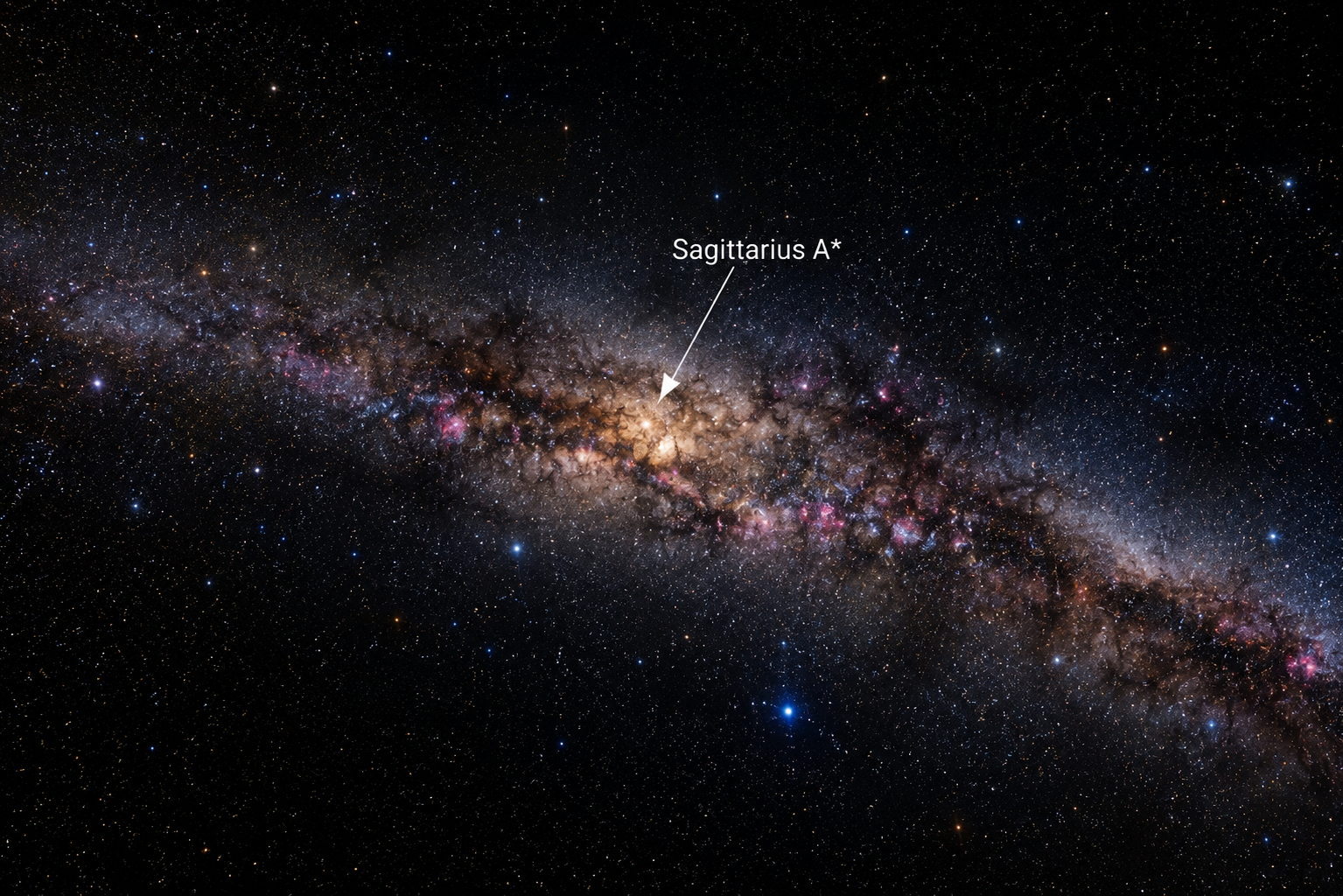
At the center of our galaxy is a supermassive black hole called Sagittarius A*, or Sgr A*. It is located roughly 26,000 light-years from Earth and has a mass of about four million Suns.
Scientists discovered strong evidence for this object by tracking stars moving around the center of the Milky Way. Their extremely fast orbits revealed that a huge amount of mass must be concentrated within a relatively small region.
Sagittarius A* is relatively quiet compared with some actively feeding supermassive black holes, but its surrounding environment is still highly energetic.
What Is the James Webb Telescope Revealing?
The James Webb Space Telescope is giving astronomers an unusually detailed view of distant galaxies and the black holes within them. Because light takes time to travel, looking at very distant objects also allows scientists to study the universe as it existed billions of years ago.
One of the major questions is how supermassive black holes became so large so early in cosmic history. Webb observations are helping researchers investigate the relationship between young galaxies and the black holes growing inside them.
Webb has also observed Sagittarius A*. NASA reports that observations of the Milky Way’s central black hole revealed both faint infrared flickers and brighter flares. The rapid changes provide information about activity occurring extremely close to the black hole.
These observations are part of a much larger effort to understand how black holes grow and how their activity affects their surrounding galaxies.
What Scientists Still Don’t Know
Black holes are no longer purely theoretical ideas. Scientists have strong observational evidence for them and have even produced images of their shadows. Yet some of the most fundamental questions remain unanswered.
One major mystery is the origin of the earliest supermassive black holes. Some enormous black holes appear to have existed surprisingly early in the universe, giving scientists limited time to explain how they could have grown to such enormous masses.
Another major problem concerns the center of a black hole. Classical general relativity predicts a singularity under simplified conditions, but physicists do not yet have a complete theory combining gravity with quantum mechanics that can describe this extreme environment.
Scientists are also searching for convincing examples of intermediate-mass black holes, which could help explain how stellar-mass black holes may eventually become supermassive.
Primordial black holes remain another possibility. These hypothetical objects could have formed during the earliest moments of the universe, but there is currently no definitive evidence confirming that they exist.
Black Hole Facts at a Glance
| Question | Answer |
|---|---|
| Can light escape from inside the event horizon? | No. The event horizon is the boundary beyond which light cannot escape to the outside universe. |
| Are black holes completely invisible? | The black hole itself does not emit or reflect ordinary light from inside the horizon, but its surroundings can be extremely bright. |
| Can black holes grow? | Yes. They can gain mass by accreting matter and merging with other black holes. |
| Does every black hole have an accretion disk? | No. An accretion disk requires surrounding material that can fall toward the black hole. |
| Is there a black hole in the Milky Way? | Yes. Sagittarius A* is a supermassive black hole at the center of our galaxy. |
| Have scientists photographed a black hole? | Scientists have imaged the shadow and surrounding emission of black holes, beginning with M87* in 2019. |
| Can black holes merge? | Yes. Their mergers produce gravitational waves that can be detected across enormous distances. |
Could a Black Hole Destroy Earth?
There is no known black hole close enough to Earth to pose such a threat. Black holes do not behave like cosmic vacuum cleaners that automatically pull everything in from enormous distances.
If the Sun were somehow replaced by a black hole with exactly the same mass, the planets would continue to orbit at roughly the same distances because the gravitational influence at those distances would be essentially the same. The major difference would be the loss of sunlight and heat.
The danger from a black hole depends on its mass and distance. A black hole would need to pass sufficiently close to the Solar System to seriously disturb planetary orbits.
Frequently Asked Questions
What is a black hole in simple words?
A black hole is a region of space where gravity is so strong that nothing can escape once it crosses the event horizon.
How are black holes formed?
Stellar-mass black holes can form when the cores of sufficiently massive stars collapse. Black holes can later grow by consuming matter and merging with other black holes.
Can we see a black hole?
We cannot directly see the black hole itself using ordinary visible light. Scientists can observe its effects and image the shadow created by its surrounding gravitational environment.
What happens if something enters a black hole?
Once an object crosses the event horizon, it cannot return to the outside universe. Depending on the black hole and the object’s location, extreme tidal forces can stretch and compress it.
What is the biggest type of black hole?
Supermassive black holes are the largest commonly observed category, with masses ranging from hundreds of thousands to billions of times the mass of the Sun.
What is Sagittarius A*?
Sagittarius A* is the supermassive black hole at the center of the Milky Way. It has a mass of roughly four million Suns.
What is spaghettification?
Spaghettification describes the stretching and compression caused by extreme tidal forces near a black hole.
Can black holes merge?
Yes. Two black holes can spiral together and merge, producing gravitational waves.
Are primordial black holes real?
They remain hypothetical. Scientists have proposed that they could have formed in the early universe, but no definitive evidence has confirmed their existence.
Final Takeaway
Black holes are among the most fascinating objects in modern astronomy because they combine extreme gravity with some of the deepest unanswered questions in physics. Scientists now have strong evidence for black holes across a wide range of masses, and observations from telescopes and gravitational-wave detectors continue to reveal how these objects behave.
From the collapse of massive stars to the enormous black holes found at the centers of galaxies, these objects play an important role in our understanding of the universe. Yet the deepest mystery remains: what really happens inside the event horizon?
As new observatories continue to study black holes across different wavelengths and through gravitational waves, scientists are getting closer to answering some of these questions. For now, black holes remain a remarkable reminder that the universe still contains phenomena far beyond everyday human experience.
Sources
The information in this article is independently written for GrayGaps. The following authoritative sources were used for scientific reference and verification:
-
NASA Science — Black Holes
-
NASA Science — Types of Black Holes
-
NASA Science — Anatomy of a Black Hole
-
NASA Webb — How Do We Know There Are Black Holes?
-
NASA Webb — Infrared Flickers and Flares from Sagittarius A*
-
Event Horizon Telescope
Disclaimer: This article is intended for general educational and informational purposes. Black-hole research is an active scientific field, and new observations may change or refine current understanding. The explanations here simplify some highly complex astrophysical concepts for general readers.
“`
Questions & Answers
Have a question about this article? Ask it below. Other GrayGaps readers can share their experience and help answer it.