Quick Answer
AI for studying can be a powerful learning tool when it helps students understand difficult concepts, practice skills, test their knowledge and identify mistakes without doing all the thinking for them.
The best approach is to use AI as a tutor, study partner and feedback tool rather than as an answer machine. Try the problem yourself first, ask AI for guidance when necessary, verify important information, and then repeat the task without AI.
The key question is simple: Can you still explain or solve the problem when the AI is not available? If you can, AI is supporting your learning rather than replacing it.
Table of Contents
- Introduction
- Why Are Students Turning to AI?
- The Problem With Asking AI for Every Answer
- AI as a Tutor Instead of an Answer Machine
- Using AI to Understand Difficult Concepts
- Using AI for Active Recall
- AI Can Help Identify What You Don’t Know
- Using AI to Create a Personal Study Plan
- Using AI to Practice Before an Examination
- The Difference Between Assistance and Substitution
- Why AI Answers Should Be Checked
- AI and Critical Thinking
- What Students Should Avoid
- The Academic Integrity Question
- The Student-AI Relationship
- A Practical AI Study Method
- The Future of AI in Education
- What Good AI-Assisted Learning Looks Like
- Frequently Asked Questions
- Conclusion
- Sources and Further Reading
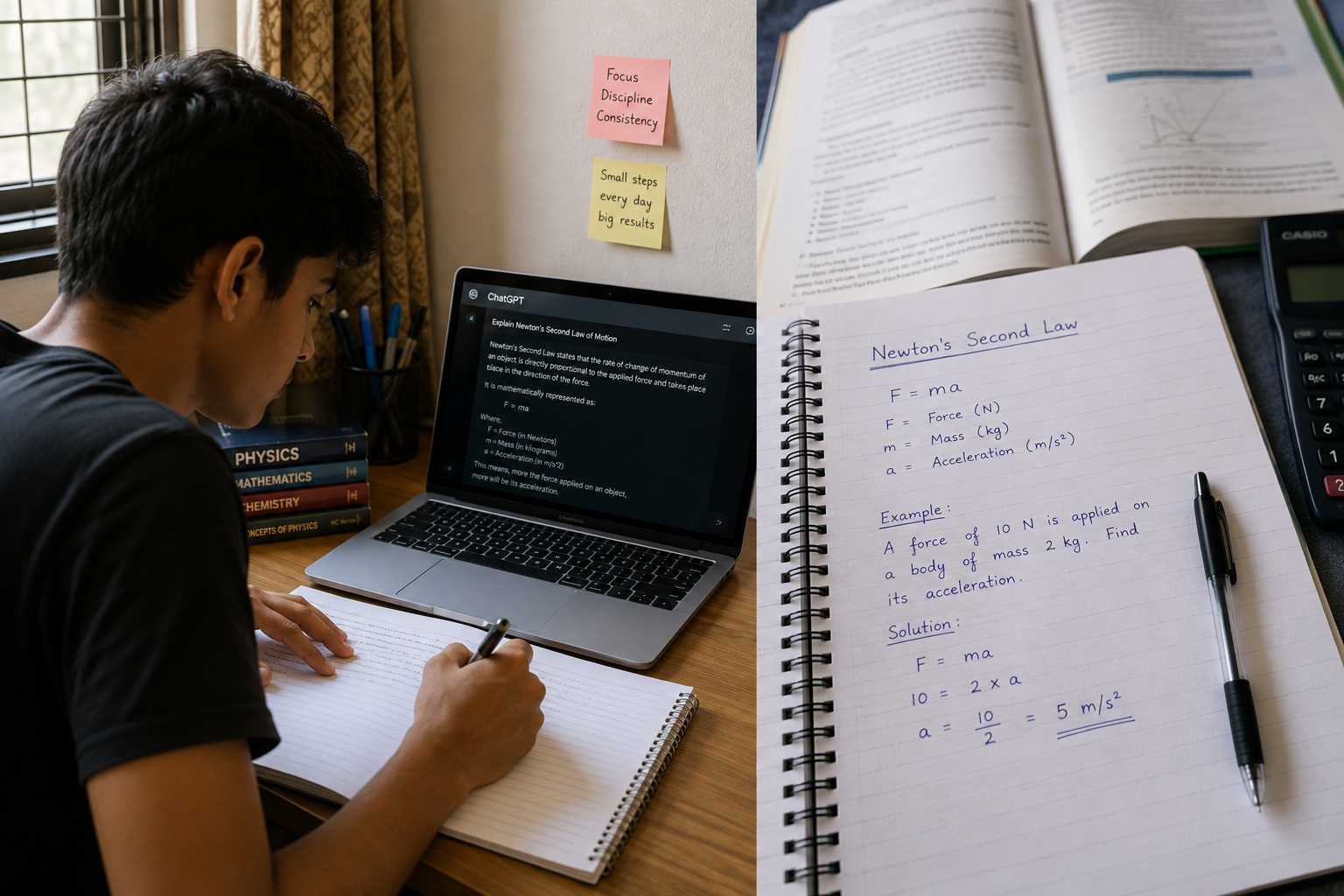
How to Use AI for Studying Without Letting AI Do the Learning for You
Artificial intelligence has quietly become part of everyday education. Students now use AI assistants to understand difficult subjects, solve problems, research topics, improve writing, create study materials and prepare for examinations.
For many students, asking an AI system a question can feel almost like having a personal tutor available at any time.
This change is happening remarkably quickly. A 2026 Pew Research Center survey found that 54% of U.S. teenagers had used chatbots to get help with schoolwork, while 57% had used them to search for information. Among teenagers who use chatbots for schoolwork, some use them extensively, with one in ten saying they use chatbots for all or most of their schoolwork.
The growing use of AI does not necessarily mean that students are learning less. The important question is how the technology is being used.
There is a major difference between asking an AI system to explain something you cannot understand and asking it to complete the work that you were supposed to understand yourself.
The first can become a learning tool.
The second can become a replacement for learning.
That difference is becoming one of the most important questions in modern education.
Why Are Students Turning to AI?
Traditional education has always involved moments when a student becomes stuck. A textbook may explain a concept in a way that does not make sense to a particular learner. A teacher may not be immediately available. A difficult mathematical problem may seem impossible, or a programming error may remain confusing even after several attempts.
AI assistants can respond to these situations almost instantly.
A student can ask for a simpler explanation, request another example, change the difficulty level or continue asking questions until the concept becomes clearer. This makes AI fundamentally different from a static textbook because the interaction can adapt to the student’s questions.
Google’s 2026 Our Life with AI survey found that learning and understanding new concepts was the leading reason people reported using AI. Among students aged 18 and above surveyed by Google, 83% said they used AI for schoolwork and 78% said they used it to understand complex topics.
AI is therefore not being used only as a shortcut.
For many learners, it is becoming an additional layer between the student and the information they are trying to understand.
The Problem With Asking AI for Every Answer
The convenience of AI creates a problem that is easy to overlook.
Learning requires mental effort.
When a student struggles with a problem, attempts a solution, discovers a mistake and tries again, the brain is doing more than producing an answer. It is building understanding.
If an AI system immediately provides the completed solution, the student may finish the assignment while skipping much of the thinking that the assignment was designed to develop.
This creates an important distinction between performance and learning.
A student may submit better homework because an AI system helped produce it. That does not automatically mean the student will perform better when the AI is unavailable.
Recent research has made this distinction an active area of study. Research involving AI-assisted student work has illustrated why completing academic tasks more efficiently should not automatically be interpreted as evidence of deeper learning.
The result is a simple principle:
AI should reduce unnecessary difficulty, not eliminate the thinking that produces understanding.
AI as a Tutor Instead of an Answer Machine
One of the most useful ways to use AI for studying is to treat it as a tutor.
Instead of writing:
“Give me the answer to this question.”
a student can ask:
“Help me understand how to solve this problem, but don’t give me the final answer yet.”
That small change can completely alter the interaction.
The AI can explain the relevant concept, ask the student what they think the next step should be and point out mistakes without immediately completing the problem.
The student remains responsible for the reasoning.
This approach is especially useful for subjects such as mathematics, programming, physics and chemistry, where being able to reproduce a solution independently is often more important than simply seeing the correct answer.
A student can also ask the AI to behave like a teacher who asks questions rather than providing solutions.
“Ask me one question at a time to help me discover where I am making the mistake.”
The objective is not to make the AI less capable.
It is to make the student more capable.
Using AI to Understand Difficult Concepts
AI can be particularly useful when a textbook explanation does not match the way a student thinks.
Imagine a student trying to understand recursion in programming. A technical definition might make sense to an experienced programmer but remain confusing to a beginner.
The student could ask an AI system to explain recursion using a simple example, then ask for a programming example, then ask why the example stops, and finally attempt to write a similar function independently.
The AI becomes a flexible explanation system.
The same approach can be used in history, biology, economics, mathematics, engineering and almost any other subject.
A useful learning conversation might progress from:
- “Explain this concept simply.”
- “Give me an example.”
- “Give me a different example.”
- “Explain why the example works.”
- “Ask me questions to check whether I understand it.”
The final stage is particularly important because explaining information to yourself and answering questions about it requires more active thinking than simply reading an explanation.
Using AI for Active Recall
One of the most useful ways to transform AI from an answer generator into a study partner is to use it for active recall.
Active recall means attempting to retrieve information from memory rather than simply reading it again.
A student can provide the AI with a topic and ask it to create questions without immediately showing the answers.
For example, after studying databases, a student could ask for a series of questions about normalization, SQL joins and transactions. The student answers each question independently and then asks the AI to evaluate the responses.
The process can become more effective when the questions gradually increase in difficulty.
A simple question checks whether the student remembers the definition.
A more difficult question checks whether the student can apply the concept.
An advanced question can require the student to compare concepts or solve a new problem.
This makes the AI useful not because it knows the answers, but because it can continuously generate opportunities for the student to retrieve and apply knowledge.
AI Can Help Identify What You Don’t Know
Another useful application is discovering weaknesses.
Students often know which subjects they dislike, but they do not always know exactly what they do not understand.
An AI assistant can help expose those gaps.
A student might ask:
“Give me ten questions covering this chapter. Don’t tell me which concepts they test.”
After answering them, the student can ask the AI to identify patterns in the mistakes.
The important part is that the student attempts the questions first.
If the AI simply produces a list of weaknesses without testing the student, the result may be less useful.
Learning improves when the student encounters the gap personally.
This also makes AI useful for examination preparation because the student can repeatedly test the same topic until the weaknesses become smaller.
Using AI to Create a Personal Study Plan
AI can also help organize study time.
A student preparing for an examination may have several subjects, different levels of understanding and a limited amount of time.
Instead of asking AI to study everything for them, the student can provide the available time and topics and ask for a realistic study schedule.
The resulting plan should still be treated as a starting point rather than an unquestionable instruction.
A useful study plan should leave room for practice, revision and rest rather than filling every available minute with new information.
The student also needs to adjust the schedule according to actual performance.
If one topic takes twice as long to understand as expected, the plan should change.
AI can help organize the process, but the student remains responsible for deciding what actually needs attention.
Using AI to Practice Before an Examination
AI can act as a practice examiner.
Instead of asking:
“Give me the important questions for my exam.”
a stronger approach is:
“Give me a timed mock examination covering these topics. Do not provide answers until I submit my responses.”
The student can then attempt the examination without assistance.
Afterward, the AI can explain mistakes and identify concepts that need revision.
A useful study cycle
Study → Test yourself → Find weaknesses → Review → Test again
The cycle is more valuable than repeatedly asking an AI system to summarize the same chapter.
The Difference Between Assistance and Substitution
There is a useful way to think about AI-assisted learning.
If AI helps a student perform a task that the student could not reasonably do alone, it can provide useful support.
But if AI performs the exact mental activity the student was supposed to develop, it may substitute for learning.
Consider writing an essay.
Using AI to brainstorm possible questions about a topic can support the student’s thinking.
Using AI to explain unclear grammar can support the student’s writing.
Using AI to suggest areas that require stronger evidence can support revision.
Submitting an entirely AI-generated essay as one’s own is different because the student has outsourced much of the work that the assignment may have been designed to assess.
The same distinction applies to programming, mathematics, research and other subjects.
When AI becomes the person doing the thinking, the student may receive the result without developing the underlying skill.
Why AI Answers Should Be Checked
AI systems can produce convincing explanations that are incorrect.
This is particularly important in education because a confident explanation can create a false sense of understanding.
A student may remember an incorrect explanation simply because it was presented clearly.
AI-generated information should therefore be checked against textbooks, academic sources, teachers, official documentation or other reliable references when accuracy matters.
This is especially important for scientific facts, historical claims, mathematical reasoning, medical information and technical documentation.
AI literacy is increasingly becoming part of education for exactly this reason. Schools are not only considering how students can use AI; they are also teaching students to understand its limitations, misinformation risks, bias and appropriate use.
The ability to question an AI answer may become just as important as the ability to ask an AI a good question.
AI and Critical Thinking
Critical thinking does not become less important when AI becomes more capable.
In some ways, it becomes more important.
A student who cannot evaluate information may be more vulnerable to a convincing AI-generated mistake than a student who understands how to question evidence.
For example, a student can ask:
- “What evidence supports this explanation?”
- “What part of this answer is uncertain?”
- “Are there alternative explanations?”
- “Which claims should I verify?”
- “Can you explain why this answer is correct?”
These questions turn AI into something closer to a discussion partner.
The student is no longer simply consuming information.
The student is evaluating it.
What Students Should Avoid
AI can become harmful to learning when convenience consistently replaces effort.
Some patterns are particularly problematic:
- Asking AI to complete assignments before attempting them.
- Copying explanations without understanding them.
- Using AI-generated answers during assessments when it is prohibited.
- Treating AI output as automatically correct.
- Avoiding difficult subjects because AI can perform the difficult parts.
- Using AI-generated essays or code without being able to explain them.
- Allowing AI to make every academic decision.
None of these problems means that AI itself is bad for education.
They show that the same tool can support learning or replace learning depending on how it is used.
The Academic Integrity Question
One of the biggest challenges facing schools and universities is determining where legitimate assistance ends and academic misconduct begins.
There is no single worldwide rule.
Institutions have different policies, and individual assignments can have different requirements.
A student should therefore check the rules of their school, college or university before using AI for assessed work.
The debate is also more complicated than simply asking whether AI was used.
For example, using AI to explain a difficult concept may be allowed in one course but restricted in another. Generating ideas may be acceptable while submitting AI-generated writing as one’s own may violate academic-integrity rules.
Students should understand the specific policy rather than assuming that every form of AI use is either permitted or forbidden.
Research published in 2026 illustrates how uncertain these boundaries can be. Research from Oxford University Press involving almost 4,000 young people in the United Kingdom found that students themselves had different views about what constitutes inappropriate AI use for schoolwork.
The rules are still evolving.
The Student-AI Relationship
The most useful mental model may not be “student versus AI.”
It may be “student with AI.”
The student should remain the person who decides what needs to be learned, evaluates information, attempts problems and takes responsibility for the final understanding.
AI can provide explanations, questions, examples, feedback and organizational assistance.
This relationship is more similar to using a calculator, textbook, tutor or search engine than replacing the student’s responsibility entirely.
The difference is that AI can interact with the student in a much more personalized way.
That makes it powerful.
It also makes responsible use more important.
A Practical AI Study Method
A student who wants to use AI for studying without becoming dependent on it can follow a simple learning cycle.
1. Study the material independently
Read the textbook, attend the lecture or watch the lesson and attempt to understand the basic concepts before asking AI for assistance.
2. Ask AI about the specific difficulty
When something remains unclear, use AI to explain the specific difficulty. Ask for examples, analogies or alternative explanations rather than immediately requesting the final answer.
3. Attempt the task yourself
Before asking AI to solve a problem, make your own attempt. Even an incorrect attempt can provide useful information about what you understand and where your reasoning breaks down.
4. Use AI for feedback
After attempting the task, ask AI to identify mistakes or explain where your reasoning went wrong.
5. Verify important information
Check important claims against reliable sources such as textbooks, academic publications, official documentation and authoritative websites.
6. Repeat the task without AI
After receiving help, close the AI conversation and attempt a similar problem independently.
The final test is simple:
Can you still solve the problem when the AI is not there?
If the answer is yes, the AI has probably supported the learning process.
If the answer is no, the student may have become dependent on the tool.
The Future of AI in Education
AI is unlikely to disappear from education.
Instead, schools and universities are increasingly trying to determine how it should be used.
Recent research shows that AI is already embedded in student learning in several countries, while educational institutions are still developing policies and teaching methods around it.
A 2026 study of secondary students in Austria found that AI was already part of students’ everyday academic lives, while schools had not yet integrated it systematically into classroom practice.
Google has also expanded its education-focused AI products in 2026, including tools intended to help students organize research, create study materials and practice concepts.
The direction of education is therefore moving away from a simple question of whether students will use AI.
They already are.
The more important question is whether students will learn how to use it intelligently.
The most valuable skill may not be knowing how to generate an answer.
It may be knowing when to generate an answer, when to question it, when to verify it and when to put the AI away and solve the problem yourself.
What Good AI-Assisted Learning Looks Like
Good AI-assisted learning has a recognizable pattern.
The student remains mentally involved.
The AI explains rather than simply completes.
The student attempts before receiving the solution.
Errors become opportunities for further practice.
Important information is verified.
And the student can eventually perform the skill without assistance.
Poor AI-assisted learning looks very different.
The student asks for the answer, copies it, submits it and moves on.
The work may be completed quickly, but the underlying knowledge may never have been developed.
That distinction is likely to become one of the defining educational issues of the AI era.
Good AI-assisted learning
- Understand first.
- Attempt the task.
- Ask AI for guidance.
- Question the response.
- Verify important information.
- Practice independently.
Frequently Asked Questions
Is using AI for studying cheating?
Not automatically. Whether AI use is considered acceptable depends on the rules of the particular school, university, teacher or assignment. Using AI to understand a concept can be very different from submitting AI-generated work as your own.
Can AI replace a teacher?
AI can provide explanations, practice questions and feedback, but it does not completely replace the role of a teacher. Teachers provide human judgment, context, encouragement, classroom interaction and responsibility for the educational environment.
Is AI good for students?
AI can be useful for students when it supports understanding, practice and feedback. Its benefits depend heavily on how it is used. Using AI to avoid thinking can have very different consequences from using it to strengthen understanding.
Should students use AI to solve math problems?
AI can be useful for explaining mathematical methods and identifying mistakes. A stronger learning approach is to attempt the problem first and ask AI for guidance when necessary rather than immediately requesting the final solution.
Can AI help with exam preparation?
Yes. AI can generate practice questions, simulate examinations, explain mistakes and help organize revision. Students should still attempt practice questions independently so that the results represent their own knowledge.
How can students avoid becoming dependent on AI?
The simplest method is to regularly work without AI. Attempt problems independently, write explanations from memory and complete practice examinations without assistance. If you can only perform a task when AI is available, you should spend more time practicing it independently.
Can AI improve learning?
It can, but the effect depends on how it is used. AI can provide personalized explanations and immediate feedback, while research also warns that outsourcing cognitive work to AI can produce better task performance without necessarily producing deeper learning. The educational value therefore depends on whether AI supports or replaces the student’s thinking.
What is the best way to use AI for education?
Use AI as a tutor, practice partner and feedback tool rather than as a replacement for your own thinking. Learn the concept, attempt the task, use AI when necessary, verify important information and then test yourself without AI.
Can students use AI to create study notes?
Yes. AI can help organize information into summaries, explanations, questions and revision material. However, students should compare the generated notes with their original learning materials because AI-generated summaries can contain omissions or inaccuracies.
Should I use AI before trying a difficult question?
Usually, it is better to make your own attempt first. Even if the attempt is incorrect, it forces you to reason about the problem. You can then use AI to identify where your reasoning went wrong instead of allowing it to perform the entire task.
Can AI help students understand difficult subjects?
Yes. Students can ask AI to explain a concept using simpler language, examples, analogies or different approaches. The student should then test their understanding by explaining or applying the concept independently.
Should students verify AI-generated information?
Yes. AI systems can produce incorrect or outdated information while presenting it confidently. Important academic information should be checked against textbooks, academic sources, teachers, official documentation or other authoritative references.
Can AI help create mock examinations?
Yes. AI can generate practice examinations based on a specified subject, syllabus and difficulty level. For the exercise to be useful, students should complete the mock examination without AI assistance and only review the answers afterward.
Conclusion
Artificial intelligence has changed the relationship between students and information.
A student no longer has to wait for a teacher, search through several books or spend hours trying to understand a confusing explanation before getting another perspective. An AI assistant can provide an explanation within seconds and adapt that explanation to the student’s questions.
That is a powerful educational opportunity.
But speed is not the same as learning.
The purpose of education is not simply to produce correct answers. It is to develop knowledge, reasoning, creativity, problem-solving ability and the confidence to work independently.
AI can help develop those abilities when it is used as a support system.
It can also weaken them when it becomes a substitute for thinking.
The most effective student in the AI era may therefore not be the student who knows how to make AI do the most work.
It may be the student who knows exactly when to use AI and when not to use it.
Use AI to explain what you cannot understand.
Use it to challenge your knowledge.
Use it to generate questions.
Use it to find mistakes.
Use it to explore ideas.
But when it is time to demonstrate what you actually learned, put the AI aside and see what you can do on your own.
That is where assistance becomes learning.
Sources and Further Reading
The following sources were used for factual background and research discussed in this article. Readers should consult the original sources for full methodology, limitations and additional context.
-
Pew Research Center — How Teens Use and View AI, February 24, 2026.
Read the Pew Research Center report -
Google — Our Life with AI: Learners and educators are AI’s new “super users,” January 15, 2026.
Read the Google research and findings -
Oxford University Press — New research shows teenagers are divided over AI use for schoolwork, June 9, 2026.
Read the Oxford University Press report -
Social Sciences & Humanities Open — The AI generation at school: A large-scale survey on student practices, perceptions, and worries, 2026.
Read the research paper -
Frontiers in Education — Artificial intelligence in higher education: student use, perceived benefits, and emerging risks, 2026.
Read the research article
Educational Disclaimer
This article is provided for general educational and informational purposes. AI tools, school policies, privacy practices and educational research can change over time. Students should follow the academic-integrity rules of their own institution and verify important information with teachers, textbooks or authoritative sources.
AI-generated educational content should not automatically be treated as correct. Students should independently verify important academic claims, particularly when preparing for examinations or completing assessed work.
Article date: August 21, 2026
Last reviewed: August 21, 2026
Questions & Answers
Have a question about this article? Ask it below. Other GrayGaps readers can share their experience and help answer it.