AI Coding Agents in 2026: 11 Powerful Ways They’re Reshaping Modern Software Development
Artificial Intelligence • Programming • 2026
How Intelligent Development Workflows Are Evolving in 2026
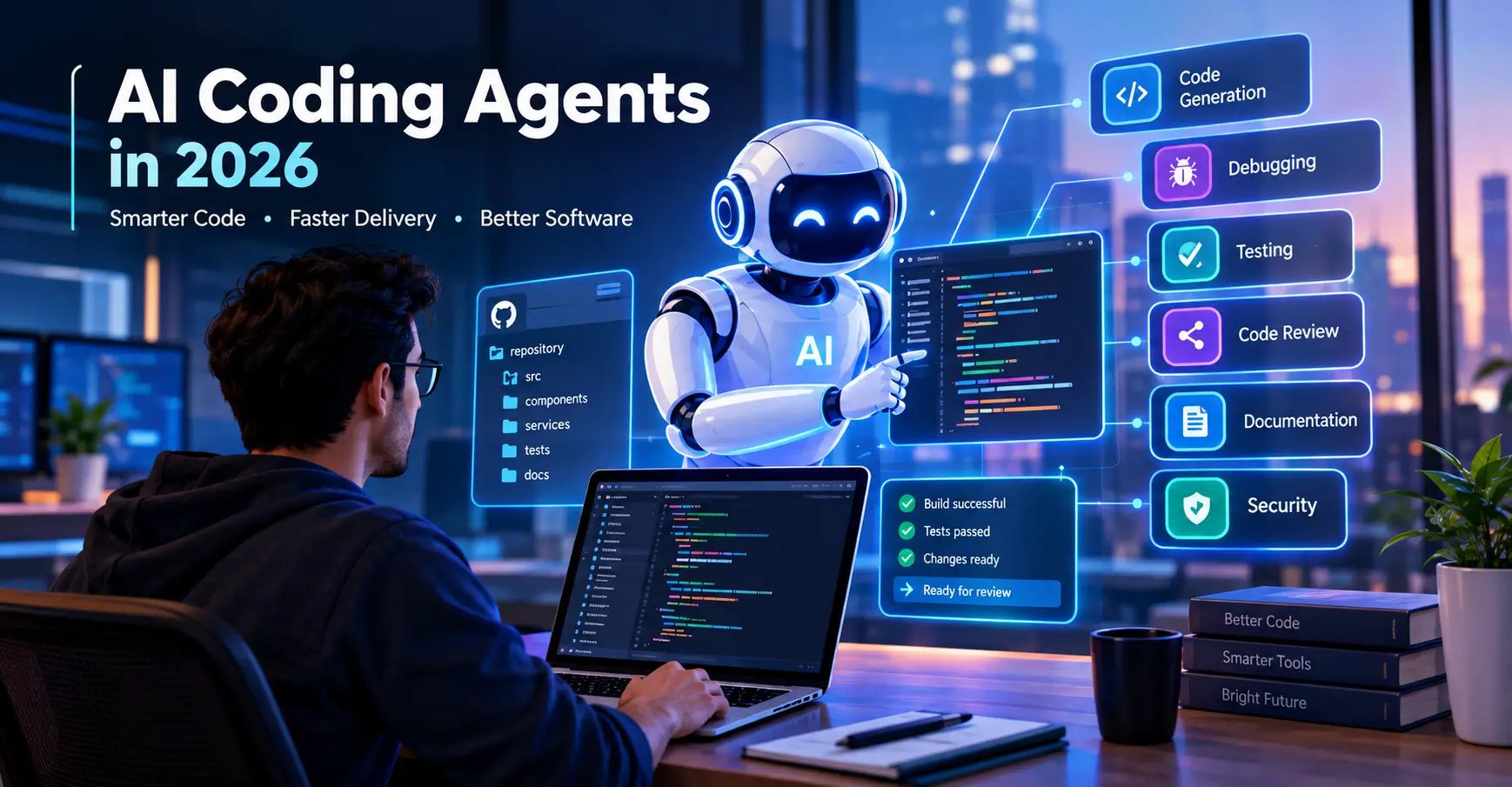
AI coding agents in 2026 and their role in modern software development.
AI Coding Agents are changing how modern software is designed, written, tested,
debugged and maintained. Instead of providing only code suggestions, today’s
agentic systems can work through multi-step engineering tasks and interact with
development environments.
GrayGaps Technology
AI Coding Agents in 2026: The New Era of Software Engineering
AI Coding Agents have become one of the most significant developments
in modern software engineering. Programming assistants have existed for years, but
the latest generation of AI systems is moving beyond simple autocomplete and
question-answering.
A modern coding agent can potentially inspect a repository, understand a software
issue, create a plan, modify several files, execute tests, analyze failures and
continue working through a task. The exact capabilities differ between products,
models and development environments, but the general direction is clear: AI is
becoming more deeply integrated into the engineering workflow.
This shift matters because software development contains many activities beyond
typing code. Developers spend time understanding existing systems, searching for
bugs, writing tests, reviewing pull requests, updating documentation and maintaining
legacy applications.
AI Coding Agents can participate in many of those activities. The result is not
simply faster code generation. It is a different way of organizing software work.
The change is already visible in developer research. Stack Overflow’s 2025 Developer
Survey reported that 84% of respondents were using or planning to use AI tools in
their development process. At the same time, concerns about accuracy, security and
privacy remained substantial.
That combination is important. AI adoption is growing, but adoption does not mean
developers automatically trust every output. Verification remains a central part of
professional software engineering.
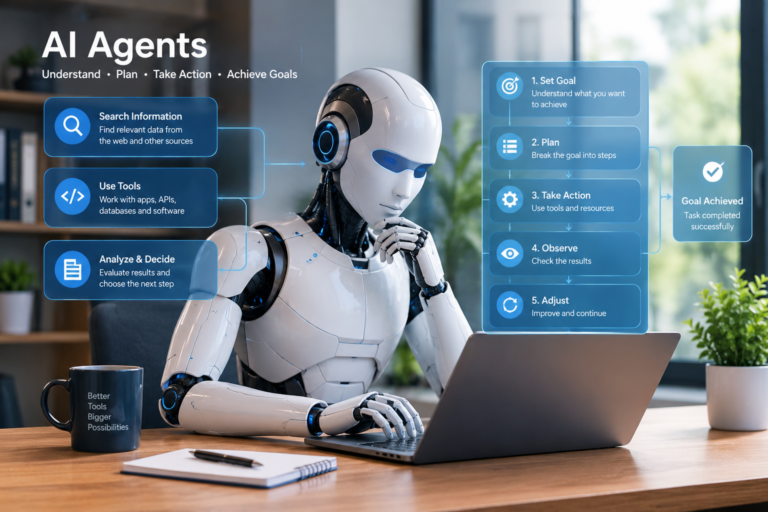
What Exactly Are AI Coding Agents?
AI Coding Agents are AI-powered systems designed to perform multiple connected
programming actions rather than simply returning a single answer.
Depending on the platform, an agent may read source files, search a repository,
edit code, create files, execute terminal commands, run tests and inspect the
results of those actions.
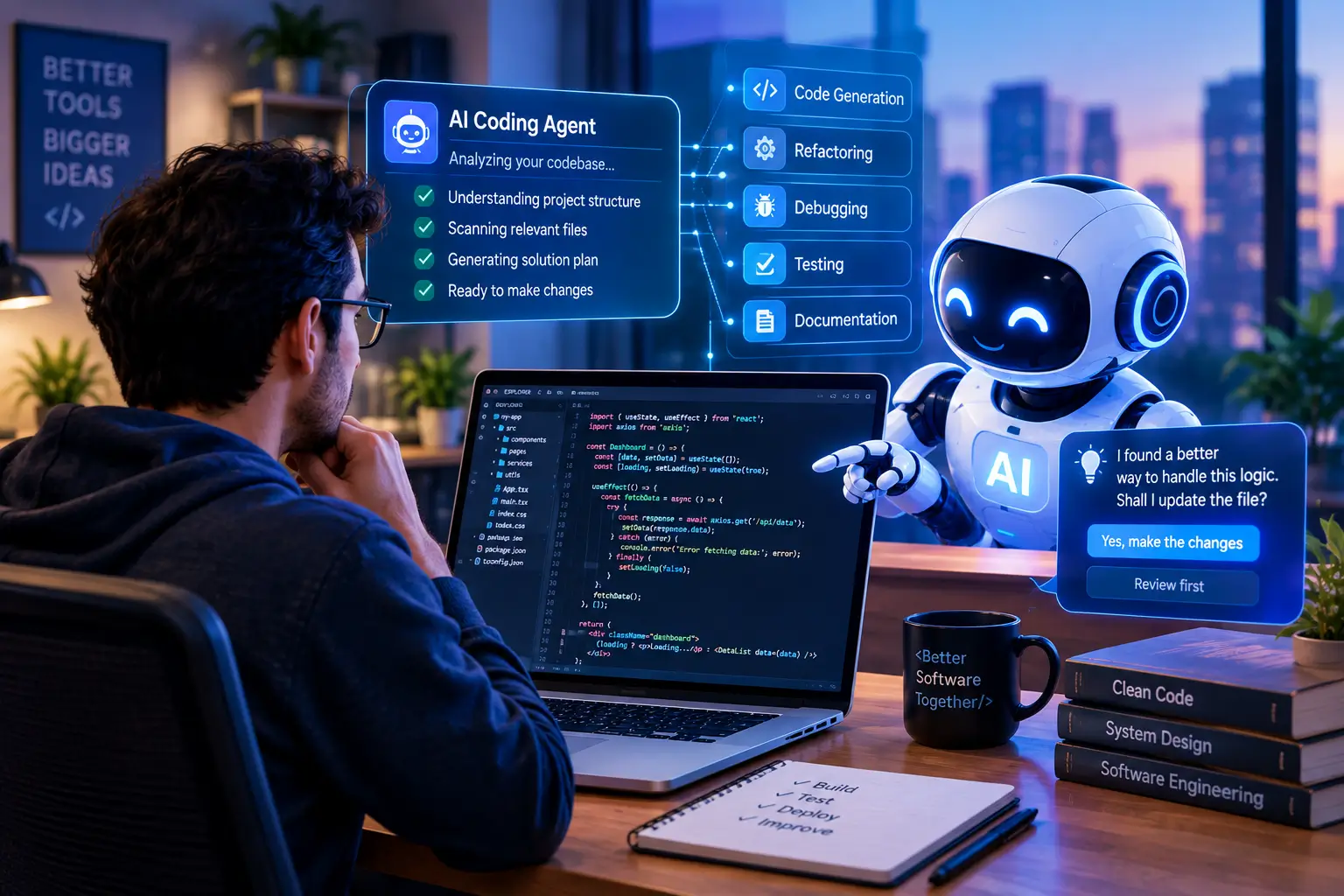
AI Coding Agents working with developers and software code in a modern development workflow.
The defining concept is the ability to work toward a goal through multiple steps.
A developer can provide a task such as fixing a failing API test, adding a feature
or updating an application component. The agent can then determine which files
matter, make changes and use feedback from the environment.
This makes AI Coding Agents different from basic autocomplete systems. They are
closer to software-development collaborators that can interact with the tools
developers already use.
From Code Suggestions to Autonomous Engineering
Traditional AI coding assistants generally help developers while they remain in
control of each individual action. An agentic workflow gives the AI greater ability
to decide what step should happen next.
Development Activity
Traditional AI Assistance
Agentic Workflow
Code suggestions
Common
Common
Repository exploration
Limited or user-directed
Can search and inspect files
Multi-file changes
Possible
Core workflow
Testing
Usually developer initiated
Can run tests and inspect results
Debugging
Conversation-based assistance
Can iterate using test feedback
Task planning
Limited
Central capability
The difference is therefore about workflow and autonomy rather than a strict
technical boundary. Many modern tools combine both assistant and agent features.
Inside the Workflow: How Coding Agents Actually Operate
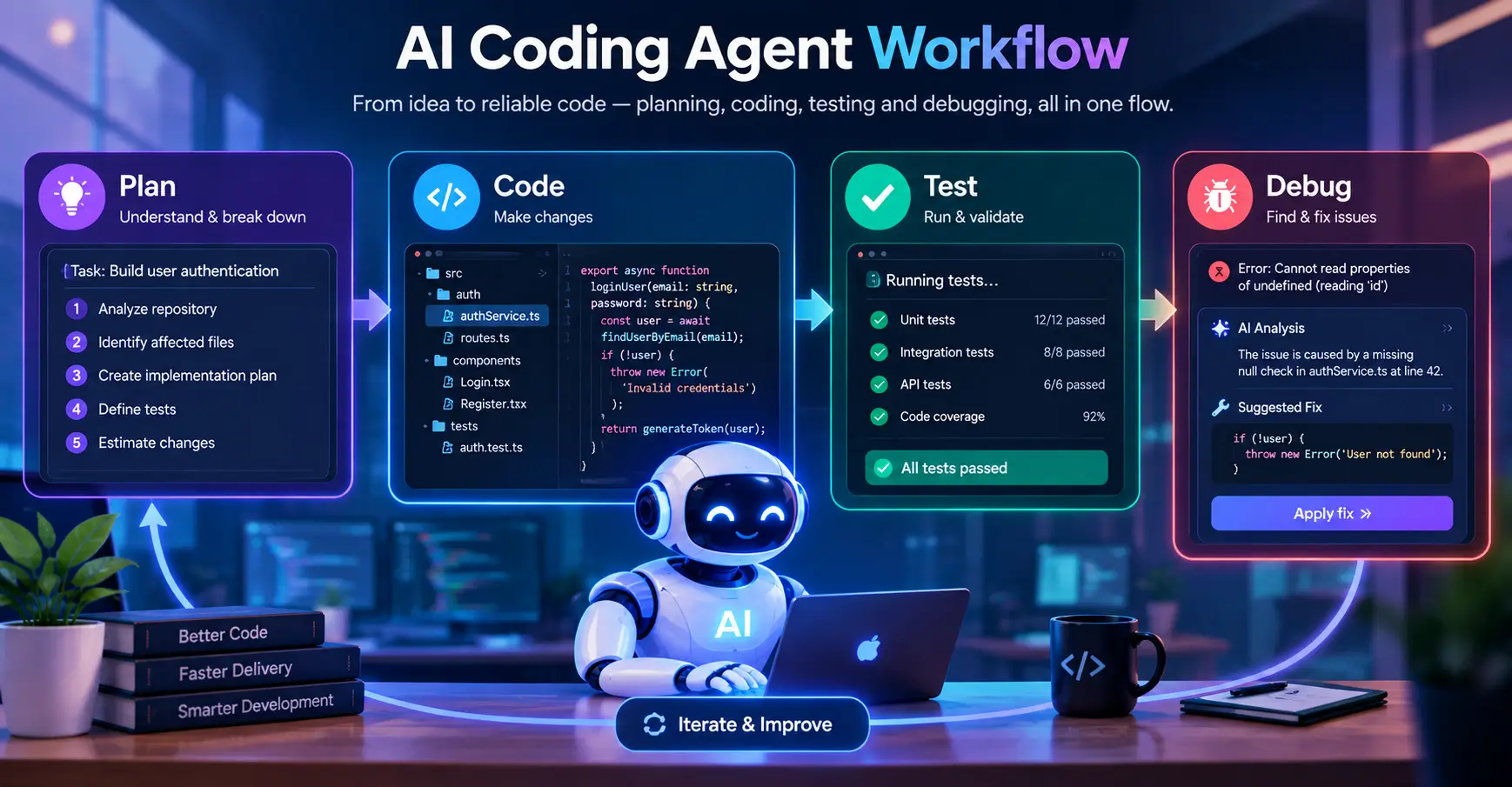
AI agent workflow from planning and coding to software testing and debugging.
A typical agentic coding workflow combines an AI model with repository context,
development tools and an execution environment.
Developer requirement
↓
Understand the task
↓
Explore the repository
↓
Create a plan
↓
Modify source files
↓
Run tests
↓
Inspect failures
↓
Revise implementation
↓
Run validation again
↓
Human review
The feedback loop is one of the most important features. The agent does not need to
assume that its first implementation is correct. Test results, compiler errors and
other development signals can provide additional information.
This approach can make development more iterative, but it also makes testing and
observability increasingly important. If the environment cannot provide useful
feedback, an agent has fewer opportunities to discover its own mistakes.
11 Major Changes AI Is Bringing to Software Development
1. Turning Requirements Into Working Features
One of the most useful applications of AI Coding Agents is turning a clearly defined
requirement into a collection of software changes.
A feature may require updates to a database model, backend service, API endpoint,
frontend interface and tests. An agent can help identify the files involved and
coordinate changes across them.
The developer still needs to define expected behavior and review the result, but
the amount of repetitive implementation work can be reduced.
2. Finding Bugs Faster With Agentic Debugging
Debugging often involves searching through unfamiliar code, tracing execution paths
and comparing logs with expected behavior.
An AI Coding Agent can assist by analyzing error messages, locating relevant code,
forming possible explanations and testing potential fixes.
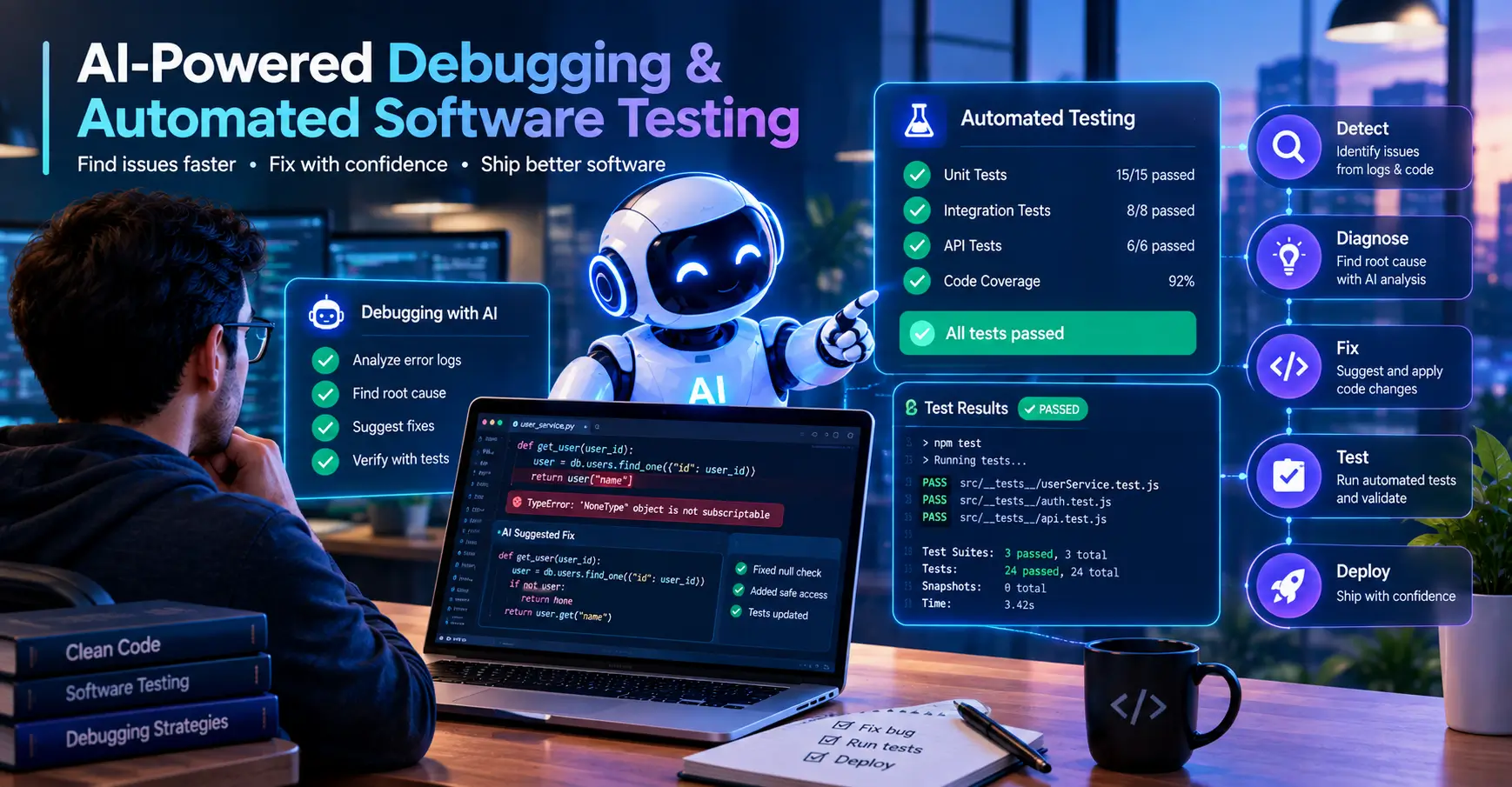
AI-powered debugging and automated software testing for modern software development.
The output should still be verified. A plausible diagnosis is not necessarily a
correct diagnosis.
3. The New Role of Automated Testing
AI can generate unit tests, integration tests and edge-case scenarios. Agents can
also execute those tests and respond to failures.
This makes testing part of the coding loop rather than simply a final checkpoint.
Strong test suites can act as guardrails for agent-generated changes.
4. Modernizing Legacy Software With AI
Legacy code can be difficult because documentation may be incomplete and architecture
may have evolved over many years.
AI Coding Agents can help explain old modules, trace dependencies, identify repeated
patterns and suggest smaller refactoring opportunities.
Incremental changes are generally easier to test and review than large autonomous
rewrites.
5. AI-Assisted Code Reviews and Quality Checks
AI can provide another layer of code review by looking for duplicated logic,
potential edge cases, missing tests and suspicious implementation patterns.
Human review remains important because source code alone cannot always reveal
business requirements or organizational context.
6. Documentation Without the Manual Busywork
Agents can help create README updates, API explanations, migration notes, release
summaries and technical documentation.
Documentation should still be checked against the actual software because generated
explanations can become inaccurate when implementation details are misunderstood.
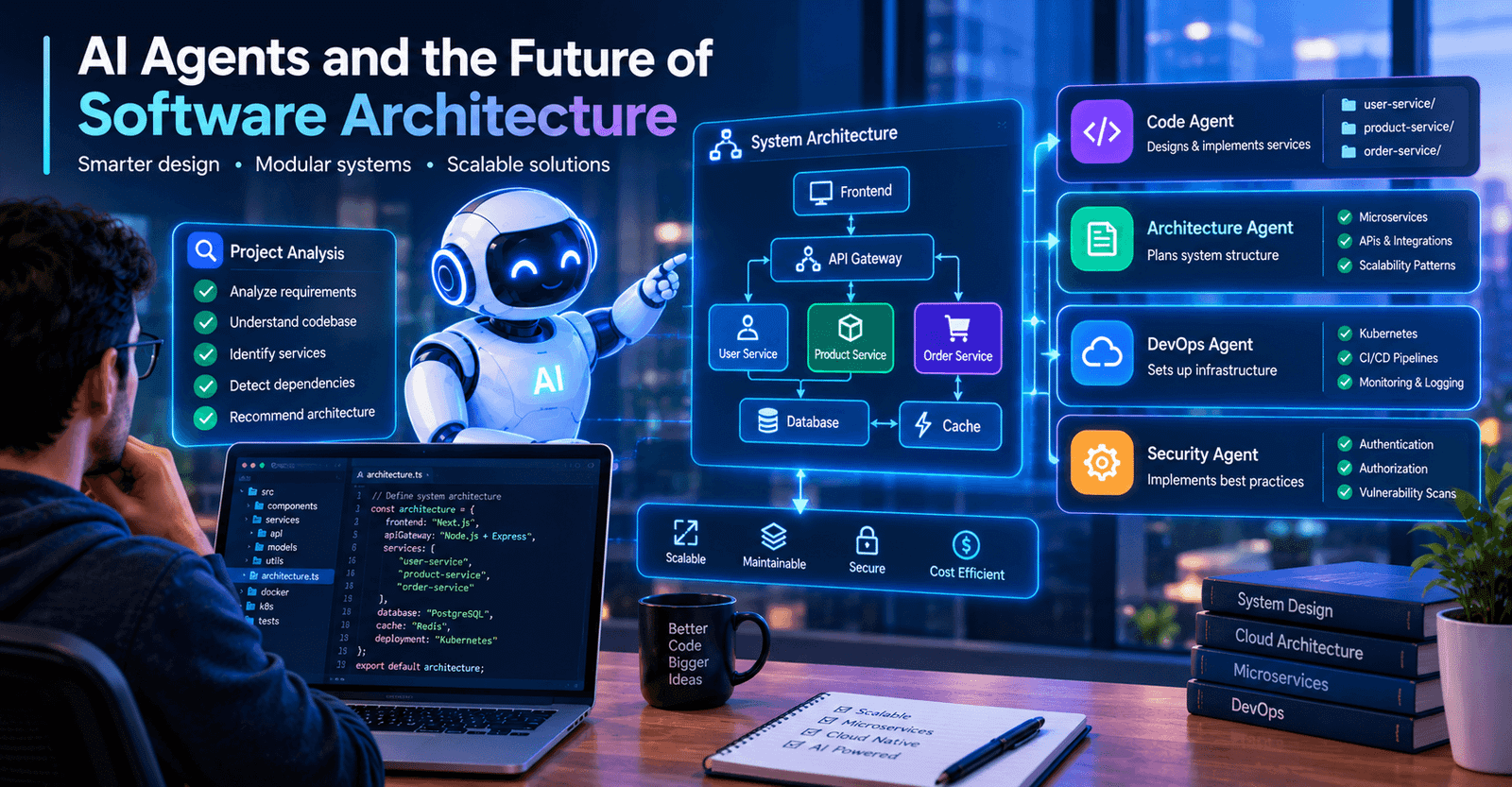
7. AI Agents and the Future of Software Architecture
AI systems can analyze dependencies, compare architectural options and identify
potential inconsistencies.
AI agents shaping the future of software architecture and modern application development.
Architecture nevertheless requires decisions about performance, reliability,
security, cost and future maintenance. These decisions need appropriate human
oversight.
8. Supporting DevOps and Infrastructure Work
Coding agents can assist with CI configuration, deployment scripts, infrastructure
files, log analysis and operational troubleshooting.
Because infrastructure actions can have significant consequences, organizations
should apply stronger permissions and approval processes to production environments.
9. Reducing Repetitive Boilerplate
CRUD operations, configuration files, test scaffolding and repetitive application
patterns can often be generated quickly.
This allows developers to focus more attention on requirements and design decisions.
10. Parallelizing Engineering Tasks
Agentic systems can make it possible to divide larger projects into several
investigations or implementation tasks.
This can increase the amount of work being produced simultaneously, but it can also
increase the amount of code that humans need to review and integrate.
11. Redefining Developer Productivity
Lines of code become a less useful productivity measurement when AI can generate
large amounts of code rapidly.
More meaningful measurements can include defect rates, delivery reliability,
review effort, customer outcomes and the amount of time developers spend on valuable
engineering decisions.
Does AI Really Improve Developer Productivity?
Research suggests that many developers perceive productivity benefits from AI tools,
but the results are not simply positive or negative.
The 2025 Stack Overflow Developer Survey reported that 52% of developers said AI
tools or agents had a positive effect on their productivity. Among developers using
AI agents, approximately 70% agreed that agents reduced the time spent on specific
development tasks.
However, the same research found substantial concern about accuracy. This creates
an important distinction between generating code quickly and delivering reliable
software.
If an AI system creates a feature quickly but introduces defects that require lengthy
debugging, the apparent productivity gain may be reduced.
Security, Privacy and the Human Approval Layer
AI Coding Agents can have significantly more access than ordinary chatbots. If an
agent can read repositories, execute commands or access development systems, its
permissions need to be managed carefully.
Use least-privilege access.
Keep passwords and API keys outside prompts.
Use isolated development environments when appropriate.
Review sensitive changes before deployment.
Monitor agent actions.
Run automated security checks.
Maintain audit logs for important workflows.
Security should therefore be treated as part of agent architecture rather than an
afterthought.
What Happens to the Developer’s Role?
AI Coding Agents are changing the distribution of engineering work. Developers may
spend less time writing repetitive code and more time defining requirements,
evaluating architecture, reviewing implementation and investigating difficult
problems.
Skills such as system design, testing, security, debugging and technical communication
remain important because generated code still requires evaluation.
The developer’s role can increasingly resemble that of an engineer directing and
verifying a group of powerful computational tools.
Where AI Coding Agents Still Struggle
Incorrect assumptions
Agents may misunderstand requirements or infer behavior that was never intended.
Incomplete context
Large repositories can contain undocumented business rules and historical decisions
that are difficult for an AI system to discover.
Security mistakes
Generated code can contain vulnerabilities or unsafe implementation patterns.
Technical debt
Fast implementation can encourage unnecessary complexity if changes are accepted
without architectural review.
Review bottlenecks
If agents generate significantly more code, human review can become the new limiting
factor.
A Practical Guide to Using Coding Agents Safely
Start with clearly defined tasks.
Give the agent explicit requirements and constraints.
Use automated tests as guardrails.
Review meaningful code changes.
Keep production permissions restricted.
Protect secrets and private information.
Prefer smaller changes over massive rewrites.
Monitor agent activity in sensitive environments.
Measure actual engineering outcomes.
What Developers Should Learn in 2026
The rise of AI does not make programming fundamentals obsolete. Developers should
continue learning programming languages, algorithms, databases, networking,
cybersecurity and software architecture.
They should also become skilled at evaluating AI-generated code. Understanding why
a program works, how it can fail and how to test it is essential when software can
be generated rapidly.
Prompting is useful, but engineering judgment is more important.
Where Agentic Software Development Is Heading Next
The direction of current development points toward longer-running AI systems that
can handle more complex engineering workflows.
Future development environments may coordinate multiple specialized agents. One
system could analyze requirements, another could implement code, another could run
tests and another could review security.
The central challenge will not simply be generating software. It will be generating
software that is reliable, secure, maintainable and aligned with the original
requirements.
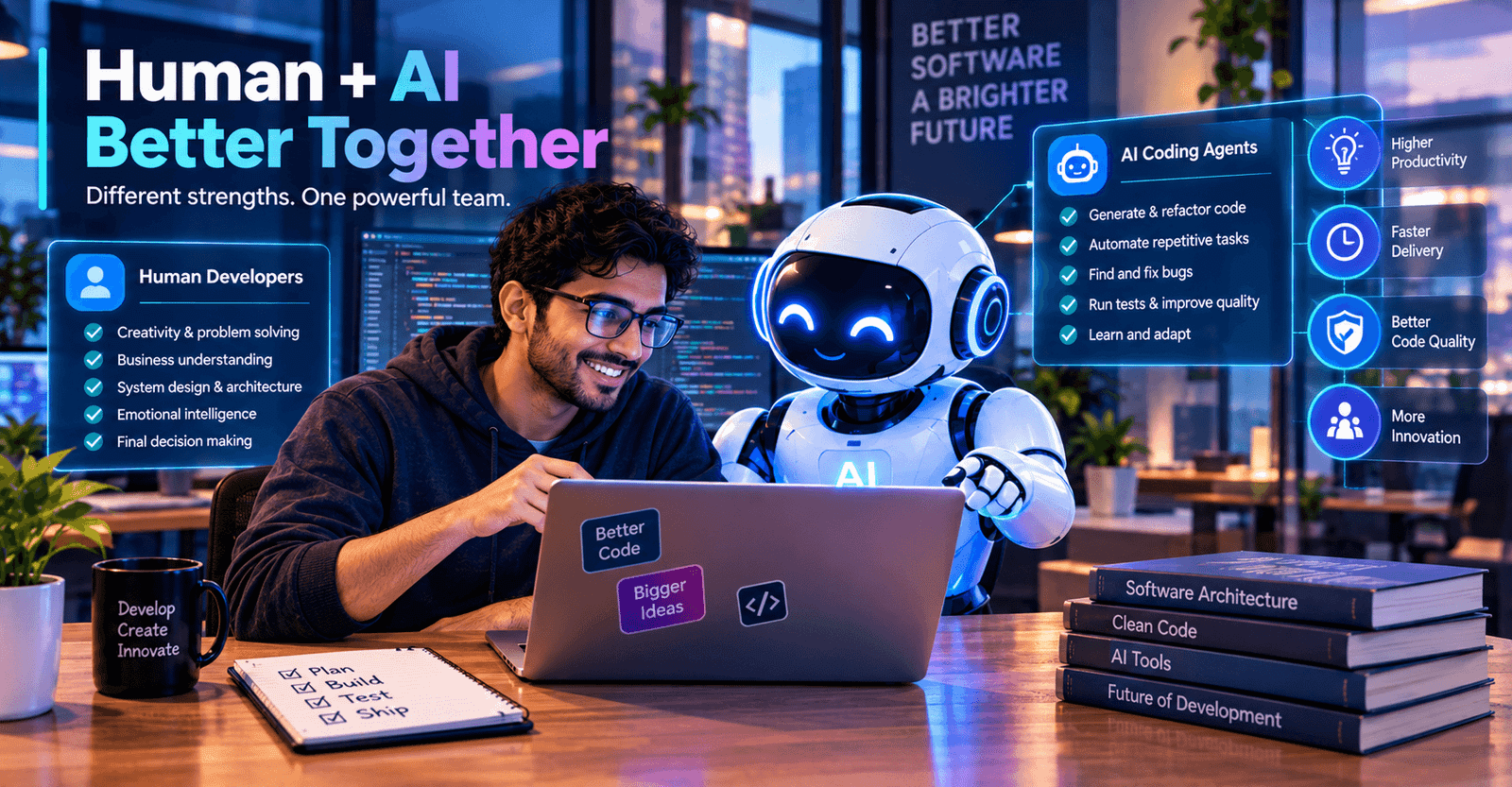
The Human-AI Development Team
Human developers collaborating with AI coding agents in modern software development.
The most practical future of AI Coding Agents is likely to involve collaboration
between humans and increasingly capable AI systems.
AI can handle repetitive implementation, repository search, test generation and
certain debugging tasks. Humans provide product context, architecture, accountability,
security judgment and final approval.
This combination works best when autonomy is matched with appropriate controls.
Related GrayGaps Articles
If you want to understand the broader development of intelligent AI systems, read:
AI Coding Agents are AI-powered systems that can perform multi-step software
development tasks using tools such as repositories, terminals, editors and testing
environments.
How are coding agents different from autocomplete?
Autocomplete generally predicts code as a developer types. Coding agents can work
through larger tasks involving multiple files and development tools.
Can AI Coding Agents build applications?
They can assist with substantial application development, but complex projects still
require requirements analysis, architecture, testing, security and human review.
Will AI Coding Agents replace developers?
They automate portions of development work, but software projects still require
people to define requirements, evaluate results, make architectural decisions and
take responsibility for important technical choices.
Are AI Coding Agents safe?
Safety depends on the model, tools, permissions and development process. Sensitive
workflows should use restricted access, testing, monitoring and human approval.
Are AI Coding Agents useful for beginners?
They can help beginners understand programming concepts and experiment with code.
However, learning fundamental programming skills remains important for evaluating
AI-generated results.
What is the biggest benefit of coding agents?
One major benefit is the ability to automate multiple connected development steps,
including repository exploration, implementation, testing and debugging.
What is the biggest challenge?
A major challenge is verification. AI-generated software can appear correct while
containing logical, security or architectural problems.
Research Sources and Further Reading
The following sources provide additional research and official documentation related
to AI-assisted software development, developer adoption and AI agents.
— Official information about AI models and agent technologies.
Final Takeaway: The Developer Workflow Is Changing
AI Coding Agents are transforming software development by moving AI from simple
code suggestion toward multi-step engineering assistance.
The technology can help developers explore repositories, implement features,
generate tests, investigate bugs, refactor legacy systems and prepare documentation.
But faster generation does not automatically mean better software.
The strongest development workflows will combine AI capabilities with reliable
testing, security controls, code review and human judgment.
For developers, the opportunity is to use AI to reduce repetitive work while
strengthening the skills that machines cannot reliably replace: understanding
requirements, evaluating trade-offs, designing systems and taking responsibility
for the final result.
As AI Coding Agents continue to evolve through 2026 and beyond, software development
is likely to become increasingly collaborative between human engineers and intelligent
software tools.
Disclaimer
This article is intended for educational and informational purposes. AI models,
coding agents, development platforms and their capabilities change rapidly.
Performance can vary depending on the model, programming language, repository,
tools and development environment. Always review and test AI-generated code and
consider security, privacy, licensing and production requirements before deployment.
COMMUNITY Q&A
Questions & Answers
Have a question about this article?
Ask it below. Other GrayGaps readers can
share their experience and help answer it.