Artificial Intelligence • August 28, 2026
AI Agents Explained: How Autonomous AI Systems Work and What They Can Do
AI agents are changing how people use artificial intelligence. Instead of simply responding to a question, an AI agent can understand a goal, plan a sequence of tasks, use software tools, evaluate results and continue working toward the desired outcome.
Table of Contents
2. AI Agent vs Chatbot: What Is the Difference?
4. Main Components of an AI Agent
8. Real-World Uses of AI Agents
9. AI Agents for Software Development
11. AI Agents for Research and Education
14. Will AI Agents Replace Jobs?
What Is an AI Agent?
An AI agent is a software system that uses artificial intelligence to work toward a specific objective. Instead of only generating an answer when a person asks a question, an agent can determine what needs to be done, break a goal into smaller steps, select appropriate tools and evaluate the results of its actions.
For example, imagine asking an AI system to research several products and prepare a comparison. A traditional chatbot might explain how to compare products or provide information from its available knowledge. An AI agent could potentially search permitted sources, collect information, organize the results, identify missing details and produce a final comparison.
The important idea is that an agent is built around action and goal completion, not just text generation.
However, the term “AI agent” is used broadly. Some systems perform only a small number of automated steps, while more sophisticated agents can operate through longer workflows involving multiple tools and decisions.
AI Agent vs Chatbot: What Is the Difference?
A chatbot generally focuses on conversation. You provide an input, the system processes it and generates a response. This can be extremely useful for answering questions, explaining concepts, brainstorming and writing.
An AI agent can go a step further by being given a goal and the ability to perform actions. It may decide what to do next, interact with external systems and use the results of one step to determine the next step.
| Feature | Traditional Chatbot | AI Agent |
|---|---|---|
| Main purpose | Conversation and response generation | Working toward a goal |
| Planning | Usually limited | Can plan multiple steps |
| Tool use | May have limited tool access | Can be designed to use multiple tools |
| Decision-making | Mostly focused on generating the next response | Can select actions based on the current state and goal |
| Task execution | Usually gives instructions or information | Can perform permitted actions through connected tools |
The distinction is not absolute. Modern AI assistants can combine conversational abilities with agent-like features, so the boundary between a chatbot, assistant and agent can sometimes be unclear.
How Do AI Agents Work?
At a high level, an AI agent follows a continuous cycle. It receives a goal or instruction, determines what information or actions are required, performs an action, observes the result and then decides what to do next.
This process can repeat several times until the agent reaches a stopping condition. The stopping condition might be successful completion of the task, failure to make progress, a safety restriction or a request for human approval.
A simplified AI-agent workflow looks like this:
- Receive a goal — Understand what the user or system wants.
- Analyze the task — Determine what information and actions are needed.
- Plan — Break the objective into manageable steps.
- Choose tools — Select appropriate software, databases, websites or APIs.
- Take action — Execute the selected operation.
- Observe the result — Check what happened.
- Adjust — Continue, correct the approach or request human input.
- Finish — Return the completed result or report what could not be completed.
The exact architecture differs between systems. Some agents use a single language model with tools, while more complex systems can contain multiple specialized components or agents.
Main Components of an AI Agent
Although AI-agent architectures vary considerably, several capabilities appear repeatedly. These components allow an agent to move from simply producing information to performing a sequence of goal-directed operations.
| Component | Purpose |
|---|---|
| AI model | Interprets instructions, reasons about tasks and generates decisions or outputs. |
| Instructions | Define the agent’s role, objectives, limitations and operating rules. |
| Tools | Allow the agent to interact with external systems and information. |
| Memory | Can preserve relevant information across steps or, in some systems, across interactions. |
| Planning | Helps organize complex objectives into a sequence of actions. |
| Feedback | Allows the system to evaluate results and determine what should happen next. |
| Guardrails | Restrict actions and reduce the chance of unsafe, unauthorized or unwanted behavior. |
How AI Agents Use Tools
Tool use is one of the features that makes an AI agent different from a system that only generates text. A tool gives an AI system a controlled way to interact with something outside the model itself.
Depending on the system, tools can include search services, calculators, databases, code execution environments, calendars, email systems, business applications and APIs.
For example, an agent asked to analyze sales data might use a database tool to retrieve records, a calculation tool to process the numbers and a document-generation tool to prepare a report.
The AI model does not necessarily perform every operation itself. Instead, it can decide which tool should be used, provide the required parameters and then interpret the result returned by that tool.
Do AI Agents Have Memory?
Memory is an important concept in agent design, but it does not mean every AI agent automatically remembers everything a user has ever said.
An agent can have different forms of memory depending on how it is designed. Short-term memory can keep track of information within the current task, while a separate storage system can preserve selected information for later use.
For example, an agent working on a long research task might need to remember which sources it already checked, what conclusions it reached and which questions remain unanswered.
Memory can make an agent more useful, but it also creates privacy and security considerations. Systems need appropriate rules for what information is stored, how long it is retained and who can access it.
Types of AI Agents
There is no single universally accepted classification of AI agents. Different researchers and companies use different terminology depending on the architecture and level of autonomy.
A practical way to understand the major approaches is to look at how much planning, memory and independence the system uses.
- Reactive agents: Respond directly to current inputs with limited internal planning.
- Planning agents: Break a larger objective into a sequence of actions.
- Tool-using agents: Interact with external tools, APIs or software.
- Memory-enabled agents: Store and retrieve relevant information during or across tasks.
- Multi-agent systems: Use several specialized agents that cooperate or communicate.
- Autonomous agents: Can operate through multiple steps with relatively little human intervention, subject to their permissions and safeguards.
These categories can overlap. A single system can be a planning agent, tool-using agent and memory-enabled agent at the same time.
Real-World Uses of AI Agents
AI agents can potentially be used wherever a task involves repeated decisions, information gathering and actions across digital systems. Their usefulness increases when the task has clearly defined goals and appropriate tools.
| Area | Possible Use |
|---|---|
| Customer service | Understand customer requests, retrieve account information and guide or complete permitted support workflows. |
| Software development | Analyze code, write changes, run tests and help investigate errors. |
| Research | Search information, compare sources, organize findings and prepare summaries. |
| Business operations | Automate repetitive workflows involving documents, data and business software. |
| Education | Support personalized learning, research, practice and feedback. |
| Data analysis | Retrieve data, process information, identify patterns and create reports. |
AI Agents for Software Development
Software development is one of the areas where agent-style AI can be particularly useful because programming already involves structured tools and repeatable workflows.
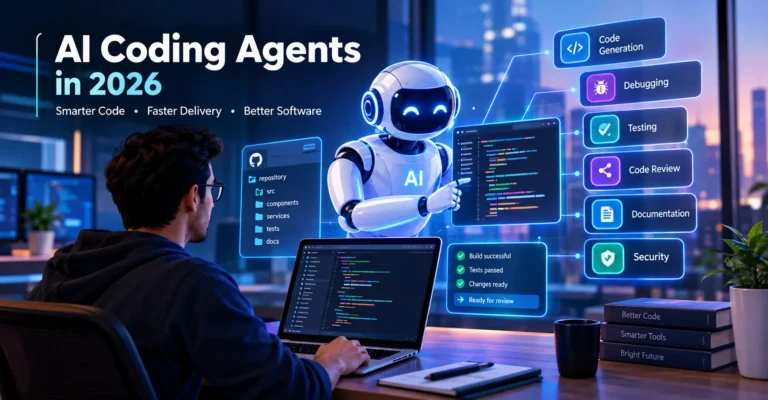
A coding agent can potentially inspect a software project, identify relevant files, propose or make changes, run tests and use the test results to determine whether additional changes are required.
This is different from simply asking an AI to write a code snippet. An agent can work across multiple files and use development tools as part of a larger task.
Human review remains important, especially when an agent has permission to modify production systems, access sensitive information or make changes that could affect customers.
AI Agents in Business
Businesses often contain workflows made up of many small digital steps. Employees may need to read documents, copy information between applications, check records, send messages and update databases.
AI agents can potentially coordinate some of these steps. For example, an internal operations agent could receive a request, retrieve information from an approved business system, check whether required conditions are met and prepare the next action.
The biggest opportunity is not necessarily replacing an entire job with one AI system. In many cases, the more practical approach is to automate portions of a workflow while allowing employees to handle decisions that require judgment, accountability or human interaction.
Organizations also need strong access controls. An agent should only have the permissions required for its job.
AI Agents for Research and Education
Research often requires gathering information from multiple sources, comparing evidence and organizing large amounts of material. AI agents can help automate parts of this process when they have access to suitable research tools.
For students, an agent could potentially help organize a study plan, explain difficult concepts, generate practice questions and track which topics require more attention.
For researchers, agents may assist with literature discovery, data preparation, coding experiments or document organization. However, an agent’s output should not automatically be treated as verified evidence. Sources still need to be checked, especially when the work involves scientific, legal, financial or medical claims.
Benefits of AI Agents
The main attraction of AI agents is their ability to connect reasoning with action. Instead of requiring a person to manually coordinate every step, an agent can potentially handle multiple related operations.
- Automation: Repetitive digital workflows can be completed with less manual effort.
- Speed: Agents can perform multiple information-processing steps quickly.
- Consistency: Well-designed workflows can follow predefined rules repeatedly.
- Scalability: Digital agents can potentially handle many similar tasks.
- Tool integration: Agents can connect AI capabilities with existing software.
- Personalization: Agents can adapt tasks based on available information and user requirements.
The actual benefit depends heavily on the quality of the underlying model, tools, data, workflow design and safeguards. Adding an agent to a poorly designed process does not automatically make that process better.
Limitations and Risks of AI Agents
AI agents can be powerful, but greater autonomy also creates greater risks. A chatbot that produces an incorrect answer is one problem; an agent that acts on an incorrect assumption can create consequences outside the conversation.
For this reason, agentic systems need safeguards around their tools and permissions. Important actions may require human approval rather than being executed automatically.
Some of the major concerns include:
- Incorrect reasoning or inaccurate information
- Unexpected actions caused by ambiguous instructions
- Unauthorized access to data or software
- Prompt injection and other security attacks
- Privacy problems caused by excessive data access or storage
- Errors being repeated across automated workflows
- Difficulty predicting how a system will behave in unusual situations
- Financial, operational or reputational damage when agents have excessive permissions
The safest approach is to treat an AI agent as a system that requires carefully designed permissions, monitoring and testing—not as an infallible digital employee.
Will AI Agents Replace Jobs?
AI agents are likely to change many jobs, but predicting exactly which jobs will disappear is much harder than identifying individual tasks that can be automated.
Most occupations contain a mixture of repetitive activities, communication, judgment, creativity, physical work and responsibilities that require accountability. An agent may automate some of these tasks without replacing the entire occupation.
This means the impact of AI agents may be better understood as a transformation of work rather than a simple division between “jobs that survive” and “jobs that disappear.”
Workers who learn how to use AI systems effectively may be able to complete certain tasks faster and spend more time on activities requiring human judgment, communication and domain expertise.
The Future of AI Agents
The development of AI agents is moving toward systems that can handle increasingly complex workflows. Future agents may become better at planning, tool use, long-running tasks and collaboration between multiple specialized systems.
One important direction is the development of multi-agent systems. Instead of asking one AI system to perform every part of a complex task, different agents can specialize in research, analysis, coding, verification or communication.
Another important area is reliability. For agents to become genuinely useful in high-stakes environments, they need to become better at knowing when they are uncertain, checking their own work and asking humans for approval when necessary.
The future of AI agents therefore depends on more than simply making models smarter. It also depends on better tools, security, evaluation methods, access controls and human oversight.
AI Agents at a Glance
| Question | Answer |
|---|---|
| What is an AI agent? | An AI system designed to pursue a goal through reasoning, planning, tool use and actions. |
| Is an AI agent the same as a chatbot? | Not necessarily. A chatbot mainly focuses on conversation, while an agent can be designed to perform multi-step tasks. |
| Can AI agents use tools? | Yes. Agents can be connected to tools such as search, databases, APIs, software and code environments. |
| Can AI agents remember information? | Some can use short-term or persistent memory, depending on their design. |
| Are AI agents fully autonomous? | Not necessarily. The level of autonomy depends on the system, permissions, workflow and human oversight. |
| Can AI agents write code? | Yes. Coding agents can be designed to inspect projects, modify code and run development tools. |
| Are AI agents always reliable? | No. They can make incorrect decisions or take inappropriate actions, which is why testing and safeguards are important. |
What Makes an AI Agent Different From Automation?
Traditional automation usually follows a predefined sequence of rules. If condition A happens, perform action B. This approach works extremely well when the process is predictable.
AI agents can introduce more flexibility because an AI model can interpret less structured instructions and choose among different possible actions. This makes agents useful for tasks where the exact sequence cannot be completely defined in advance.
However, traditional automation remains valuable. A deterministic workflow is often easier to test, predict and audit than an AI-driven process. The best systems may therefore combine both approaches: conventional automation for predictable operations and AI agents for tasks requiring interpretation or flexible decision-making.
Frequently Asked Questions
What is an AI agent in simple words?
An AI agent is a software system that can work toward a goal by deciding what steps to take, using available tools and responding to the results.
What is the difference between AI and an AI agent?
Artificial intelligence is the broader field of technology. An AI agent is a particular type of AI system designed to perform goal-directed tasks and potentially take actions using tools.
Can AI agents work without humans?
Some agents can perform certain tasks with limited human intervention, but the level of autonomy depends on their design and permissions. Human oversight remains important for sensitive or high-impact operations.
Can AI agents access the internet?
An AI agent can access online information when it is connected to an appropriate search or browsing tool and is given permission to use it. An AI model should not automatically be assumed to have live internet access.
Can AI agents replace programmers?
AI coding agents can automate parts of software development, but programming also involves architecture, requirements, security, testing, communication and accountability. Human developers remain important, particularly for complex and high-impact systems.
Are AI agents safe?
AI agents can be useful and safe when appropriately designed, tested and restricted, but they can also create risks if they have excessive permissions or operate without sufficient safeguards.
What are examples of AI agent tasks?
Examples include researching information, analyzing data, assisting with software development, handling customer-service workflows, organizing documents and coordinating tasks across business applications.
What is a multi-agent system?
A multi-agent system uses multiple AI agents that can specialize in different tasks and communicate or coordinate with one another to accomplish a larger objective.
Final Takeaway
AI agents represent an important shift in the way artificial intelligence can be used. Instead of limiting AI to answering questions or generating content, agent-based systems can connect reasoning with tools and actions to work toward a defined objective.
Their potential applications range from software development and research to customer service, education, data analysis and business operations. The biggest advantage is their ability to coordinate multiple steps that would otherwise require a person to switch between different tools and applications.
At the same time, greater autonomy creates greater responsibility. AI agents can make mistakes, misunderstand instructions or perform unwanted actions if they are poorly designed or given excessive permissions.
The most useful future may therefore not be about giving AI unlimited independence. It will be about building systems that know what they are allowed to do, when they should act, when they should verify their work and when they should ask a human for help.
Sources
This article is independently written for GrayGaps. The following authoritative sources are provided for further reading and verification of AI-agent concepts, AI systems and responsible AI development.
-
IBM — AI Agents
-
Google Cloud — What Are AI Agents?
-
Microsoft Research — AutoGen
-
NIST — AI Risk Management Framework
-
NIST — Artificial Intelligence
Disclaimer: This article is intended for general educational and informational purposes. AI technology is developing rapidly, and terminology, capabilities and best practices may change over time. The examples described here represent possible applications of AI agents and should not be interpreted as guarantees that every AI-agent system can perform those tasks.
“`
Questions & Answers
Have a question about this article? Ask it below. Other GrayGaps readers can share their experience and help answer it.