Bitcoin Explained: Bitcoin is a decentralized digital asset and payment network that allows people to transfer value electronically without relying on a central bank or single organization to maintain the network.
Bitcoin uses a public blockchain to record transactions, cryptographic keys to authorize transfers, and a proof-of-work mining system to help secure the network and maintain agreement about the transaction history.
Its protocol is designed around a maximum supply of 21 million bitcoins, but limited supply does not guarantee a particular market price. Bitcoin remains a highly volatile and speculative asset, and its value is determined by supply, demand, market conditions and investor expectations.
The most important thing to understand about Bitcoin is that it combines technological innovation with significant financial and security risks. Understanding how it works is more important than simply watching its price.
Bitcoin combines decentralized blockchain technology, cryptography and a limited supply to create a digital asset and payment network.
What Is Bitcoin?
Bitcoin is a digital asset and decentralized payment network that allows value to be transferred electronically between participants without requiring a traditional bank to maintain the central transaction record.
The system was introduced in 2008 through a paper published under the name Satoshi Nakamoto, and the Bitcoin network began operating in 2009. The identity of Satoshi Nakamoto has never been conclusively established.
The idea behind Bitcoin was closely connected to the problem of transferring money electronically without requiring every transaction to depend on a central financial institution. Its design combines cryptography, networking and economic incentives to create a system in which participants can independently verify transactions.
Bitcoin does not exist as a physical coin. There are no actual bitcoins stored inside a computer, wallet or bank account. Instead, the Bitcoin blockchain records transactions, while cryptographic keys give users the ability to authorize transfers.
The Bitcoin project describes the system as a peer-to-peer network that operates without a central authority or bank, with transactions and issuance handled collectively by the network.
Traditional national currencies operate within systems involving governments, central banks, commercial banks and regulated payment networks. These institutions perform important functions such as issuing currency, maintaining accounts, processing payments and implementing monetary policy.
Bitcoin follows a different model. Its monetary rules are built into its protocol, and its network is maintained by distributed participants rather than one central issuing institution.
This distinction does not mean Bitcoin is outside government control. Governments can regulate cryptocurrency exchanges, taxation, financial products, businesses and other activities involving digital assets. The rules differ significantly between countries.
The important distinction is between Bitcoin’s decentralized network and the businesses that provide services around it. A cryptocurrency exchange, for example, can be a regulated company even though the Bitcoin network itself does not have a central operator.
Bitcoin therefore represents a different approach to digital value rather than simply being another version of a government-issued currency.
How Does Bitcoin Work?
Bitcoin relies on several technologies and ideas working together. Cryptography helps users authorize transactions, the blockchain provides a shared record of transactions, and the network’s consensus mechanism allows participants to agree on which transactions should become part of that record.
When someone sends Bitcoin, the transaction is broadcast to the network. Participating computers can check whether the transaction follows the protocol’s rules and whether the sender has the necessary authority to spend the Bitcoin.
Valid transactions are eventually included in blocks. Bitcoin’s mining system uses proof of work to determine which miner adds the next block to the blockchain.
Once accepted by the network, that block becomes part of the transaction history. The process allows Bitcoin to maintain a shared record without depending on one central database.
Bitcoin.org explains the basic process as a combination of wallets, transactions, private keys, the public blockchain and mining.
The blockchain is the public ledger used by Bitcoin to record its transaction history.
A block contains transactions and information that connects it to the previous part of the chain. As new blocks are added, the network develops a chronological history of transactions.
The blockchain is distributed across computers participating in the Bitcoin network. This means there is not a single private database owned by one company that represents the entire Bitcoin system.
This structure is one of Bitcoin’s most important innovations because participants can independently verify information about the network instead of having to trust one central organization to maintain the complete record.
Bitcoin.org describes the blockchain as a shared public ledger containing confirmed transactions and explains that cryptography protects its integrity and chronological order.
Bitcoin mining is the process through which new blocks are added to the blockchain using a proof-of-work system.
Miners operate specialized computers that perform computational work. The process makes it costly to manipulate the blockchain and helps the network agree on which block should be added next.
Successful miners can receive rewards according to Bitcoin’s protocol. These rewards consist of the block subsidy, which introduces new Bitcoin according to the protocol’s issuance schedule, together with transaction fees from transactions included in the block.
Mining therefore has an important role in both the security of the network and the creation of new Bitcoin.
Bitcoin mining also requires significant electricity because of the computational work involved. This has created an ongoing debate about the environmental impact of the network.
Bitcoin.org explains that mining is a decentralized consensus system used to process transactions, secure the network and keep participants synchronized.
One of Bitcoin’s best-known characteristics is its limited supply.
The protocol is designed around a maximum supply of 21 million bitcoins. New Bitcoin enters circulation through mining, but the rate at which new coins are created decreases over time.
The mining reward is periodically reduced in an event commonly called a halving. This makes the supply schedule increasingly slower as the network approaches its eventual maximum.
Bitcoin’s limited supply is sometimes compared with the scarcity of commodities such as gold. However, scarcity alone does not guarantee that something will become more valuable. The price of any freely traded asset also depends on demand.
Bitcoin can be divided into extremely small units. The smallest commonly recognized unit is the satoshi, with one Bitcoin equal to 100 million satoshis.
Bitcoin.org explains that new Bitcoin is created at a decreasing and predictable rate until issuance eventually reaches the protocol’s 21-million limit.
Bitcoin does not have a fixed value established by a government. Its market price is determined by buyers and sellers in cryptocurrency markets.
People can value Bitcoin for different reasons. Some are interested in its limited supply, while others value its decentralized structure or its ability to transfer digital value across borders. Some people hold it as a speculative asset, while others are primarily interested in the technology behind it.
The combination of limited supply and demand is important to Bitcoin’s market value, but it does not create a guaranteed price.
An asset can be scarce and still lose value if demand falls. This is one reason Bitcoin’s price can move so dramatically.
Bitcoin’s value is therefore better understood as a market outcome rather than a guaranteed property of the technology.
Why Does Bitcoin’s Price Change So Much?
Bitcoin has historically been a highly volatile asset. Its price can react to changes in investor sentiment, market liquidity, regulation, economic conditions, institutional activity and expectations about the future.
Because Bitcoin markets operate around the clock, significant price movements can occur at almost any time.
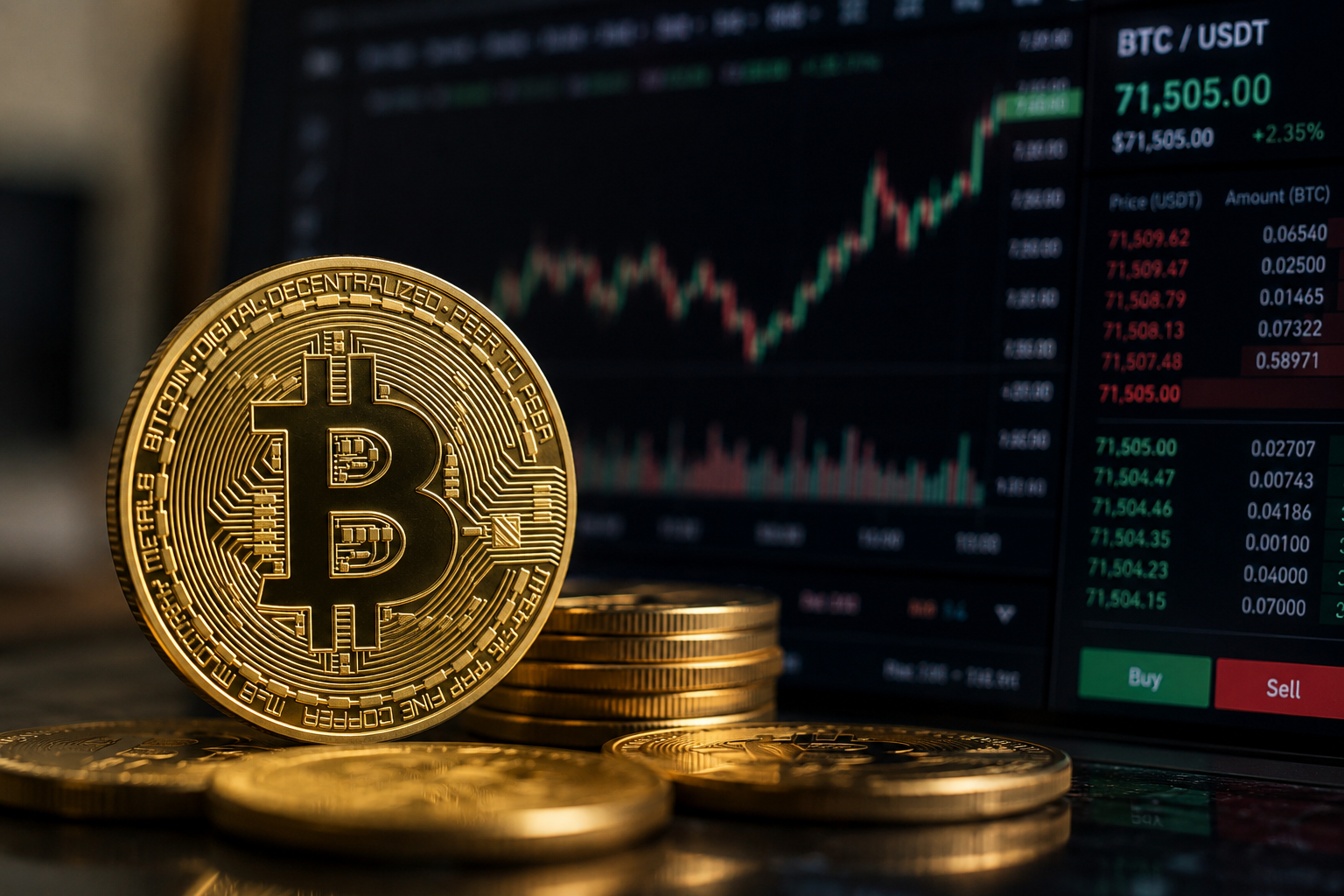
On August 20, 2026, Bitcoin rose above $70,000 during a broader cryptocurrency rally. Reuters reported Bitcoin at approximately $71,505 after a 3.48% rise during the day’s trading. Reuters also reported that the move occurred alongside broader improvements in risk sentiment and developments involving U.S. cryptocurrency legislation.
This is only a dated market snapshot. Bitcoin’s price changes continuously and prices can differ slightly between exchanges.
A rising price also does not prove that Bitcoin will continue rising. Short-term market movements should not be confused with long-term certainty.
Bitcoin as an Investment
Bitcoin can be purchased as an investment, but it should not be confused with a guaranteed savings product.
The U.S. Securities and Exchange Commission has repeatedly warned investors that Bitcoin and other crypto assets can involve substantial volatility, speculation, fraud and other risks.
Someone who buys Bitcoin can potentially make a profit if its market value increases, but the opposite is also possible. A substantial decline in price can result in significant losses.
For that reason, Bitcoin is generally considered a high-risk and speculative asset rather than a replacement for ordinary savings or money needed for essential expenses.
The SEC’s investor guidance specifically warns that crypto-asset investments can be exceptionally volatile and speculative and that investors should understand the possibility of significant losses.
Bitcoin is sometimes called digital gold because both assets are associated with scarcity and are sometimes discussed as potential stores of value.
The comparison has important limits.
Gold is a physical commodity with thousands of years of history. Bitcoin is a relatively new digital network whose operation depends on computers, cryptography and network infrastructure.
Gold can exist without an internet connection. Bitcoin requires its network and supporting infrastructure to function.
The two assets can therefore share some characteristics without being equivalent investments.
Characteristic
Bitcoin
Gold
Form
Digital
Physical
Supply
Protocol-defined maximum
Naturally limited
Central issuer
No
No central issuer
Internet required for digital transfer
Yes
No
Price volatility
Historically high
Generally lower than Bitcoin
History as an asset
Since 2009
Thousands of years
This comparison is descriptive rather than a recommendation to choose one asset over the other.
What Is a Bitcoin Wallet?
A Bitcoin wallet is a tool used to manage the cryptographic credentials required to control and transfer Bitcoin.
A common misunderstanding is that the Bitcoin itself is physically stored inside the wallet.
The blockchain contains the transaction history. The wallet manages the information needed to authorize transactions associated with the user’s Bitcoin.
Wallets can take several forms, including software wallets and hardware wallets. The security of the private keys or recovery credentials associated with a wallet is extremely important.
If someone obtains unauthorized access to those credentials, they may be able to transfer the Bitcoin.
Bitcoin.org and Investor.gov both explain that wallets do not literally contain the underlying crypto assets. Instead, they manage the keys or credentials used to access and control those assets.
Bitcoin does not work exactly like a conventional bank account.
If a person loses the credentials required to control their Bitcoin and has no usable backup, recovering the assets may be extremely difficult or impossible.
A traditional bank can sometimes restore access to an account after verifying the customer’s identity. Bitcoin does not have a central authority that can simply reset a lost private key.
This gives users significant direct control over their assets, but it also places greater responsibility on them to protect their credentials and recovery information.
Bitcoin.org warns that funds permanently lost from a self-custodied wallet generally cannot be recovered by developers, miners, wallet providers or exchanges.
Bitcoin is often described as anonymous, but that description is misleading.
Bitcoin transactions are recorded publicly on the blockchain. Users normally interact through addresses rather than placing their real names directly on every transaction.
This makes Bitcoin better described as pseudonymous rather than completely anonymous.
Blockchain analysis and information obtained from cryptocurrency services can sometimes connect an address with a real-world identity.
Bitcoin should therefore not be considered an untraceable payment system.
Bitcoin.org explicitly warns that Bitcoin transactions are publicly stored on the network and that Bitcoin is not an anonymous system.
It is important to distinguish the Bitcoin network from the devices and services used to access it.
Bitcoin uses cryptography and a decentralized consensus system to protect its blockchain. However, users can still lose Bitcoin through stolen private keys, malware, compromised devices, fraudulent websites or scams.
Cryptocurrency exchanges and other third-party services can also experience security breaches or operational failures.
Therefore, saying that Bitcoin is completely impossible to hack is inaccurate. The underlying protocol is designed to provide strong security, but the wider ecosystem still contains risks.
Bitcoin.org recommends protecting wallets carefully, keeping software updated and being cautious with online services that hold cryptocurrency on behalf of users.
Bitcoin’s popularity has created opportunities for scammers.
Fraudsters may use Bitcoin’s name to promote fake investments, fraudulent trading platforms, impersonation schemes, fake giveaways or promises of guaranteed profits.
A particularly important warning sign is a financial offer that promises extremely high returns while claiming there is little or no risk.
Other warning signs include:
Pressure to send money immediately.
Requests for passwords or recovery information.
Guaranteed investment returns.
Unverified trading platforms.
Requests to send cryptocurrency to an unfamiliar address.
Claims that an opportunity must remain secret.
People pretending to be financial institutions, government officials or cryptocurrency support staff.
The safest approach is to independently verify a person, company and investment opportunity before transferring money.
Bitcoin.org specifically advises users to verify the receiving address before sending Bitcoin and states that legitimate support services should not ask for a seed phrase or private key.
Bitcoin’s legal and regulatory treatment varies around the world.
Some countries allow cryptocurrency ownership and trading within regulated frameworks. Other jurisdictions impose restrictions on particular activities, while some have introduced more extensive controls.
Tax treatment can also differ significantly.
For this reason, there is no universal answer to whether Bitcoin is “legal” worldwide. Anyone using Bitcoin should check the current rules applicable in their own country.
A financial rule that applies in one jurisdiction may have no relevance in another.
Regulations can also change, so information about cryptocurrency law should always be checked against current official government or regulatory sources.
Bitcoin and the Environment
Bitcoin mining consumes electricity because miners use computing equipment to perform the proof-of-work process.
The environmental impact depends partly on how much electricity mining uses and where that electricity comes from.
This has created an ongoing debate. Critics focus on energy consumption and environmental effects, while supporters point to mining operations that use renewable energy or electricity that might otherwise be underused.
The environmental question is therefore more complicated than simply describing Bitcoin as either environmentally friendly or environmentally harmful.
Bitcoin.org acknowledges the energy requirements associated with proof-of-work mining while explaining the role mining plays in securing and maintaining the network.
Can Bitcoin Replace Normal Money?
Bitcoin can transfer value between users, but its role as everyday money remains different from that of national currencies.
People around the world use national currencies for salaries, taxes, food, housing and ordinary purchases. Bitcoin is accepted by a much smaller proportion of businesses for everyday transactions.
Its price volatility can also make it difficult to function as a stable unit of account.
Bitcoin may be useful for certain types of transfers and financial applications, but that does not automatically mean it will replace traditional currencies.
Bitcoin.org describes Bitcoin as both a payment network and a form of digital money, while actual adoption and use vary considerably between countries and businesses.
Why Do People Buy Bitcoin?
There is no single reason why people buy Bitcoin.
Some people are attracted to its decentralized structure. Others are interested in its limited supply and believe it could function as a long-term store of value. Some purchase it for speculative purposes, while others are interested in the technology or the possibility of transferring value without depending entirely on traditional financial infrastructure.
These motivations can coexist.
Two people can own Bitcoin while having completely different opinions about what it should be used for and what it might be worth in the future.
Major Risks of Bitcoin
Bitcoin combines financial, technological and regulatory risks.
The major risks include:
Large price fluctuations.
Loss or theft of wallet credentials.
Cryptocurrency scams.
Exchange and platform failures.
Regulatory changes.
Cybersecurity threats.
Limited consumer protection in some situations.
Environmental concerns related to mining.
The SEC has emphasized that crypto-related investments can involve significant risks, including volatility, fraud, cybersecurity problems and regulatory uncertainty.
Bitcoin’s technological design and Bitcoin as an investment are two different questions.
A person can believe that Bitcoin technology is important while also recognizing that buying Bitcoin involves substantial financial risk.
Bitcoin and Other Cryptocurrencies
Bitcoin is only one cryptocurrency among thousands of digital assets.
Other cryptocurrencies can have completely different technical designs, supply models, governance structures and purposes.
Some are designed primarily as digital assets, while others are connected to decentralized applications, payment systems or other blockchain-based projects.
Bitcoin’s long operating history, decentralized structure and large global market make it different from many newer cryptocurrency projects.
It is therefore not accurate to treat Bitcoin as a perfect representation of the entire cryptocurrency industry.
Each crypto asset needs to be evaluated according to its own technology, purpose, market structure and risks.
Bitcoin in 2026
Bitcoin remains one of the most closely watched digital assets in the world.
Its market has become increasingly connected with traditional financial markets, while governments and regulators continue to develop different approaches toward cryptocurrency.
August 2026 has also demonstrated how quickly market conditions can change. On August 20, Bitcoin moved above $70,000 during a broader cryptocurrency rally, with Reuters reporting a price of approximately $71,505 at one point during the day’s trading.
Reuters linked the day’s cryptocurrency rally partly to improved risk sentiment following developments in U.S. financial markets and renewed political attention surrounding cryptocurrency legislation.
This current price should not be interpreted as a forecast. Bitcoin’s market value can change substantially after this article is published, which is why this article includes a publication and review date.
Article date: August 20, 2026 Last reviewed: August 20, 2026
Bitcoin’s future cannot be predicted with certainty.
Its development could be influenced by cryptocurrency adoption, regulation, institutional participation, technological improvements, competition from other digital assets and broader economic conditions.
Supporters believe Bitcoin could become increasingly important in global finance. Critics point to its volatility, environmental questions, regulatory uncertainty and limitations as reasons its role could remain restricted.
Both possibilities remain subjects of debate.
Anyone claiming to know Bitcoin’s exact future price should be treated cautiously. Market forecasts are opinions or models, not guarantees.
Why Bitcoin Matters Even If You Never Own It
Bitcoin’s importance extends beyond its market price.
It demonstrated that a digital network could maintain a shared record of transactions without relying on a single institution to control the entire system.
Its development influenced the broader growth of blockchain technology and forced governments, banks, technology companies and researchers to consider new questions about digital ownership and financial infrastructure.
Bitcoin has raised questions such as whether value can be transferred directly over the internet, whether a monetary network can operate without a central issuer and how decentralized financial technology should be regulated.
Those questions remain relevant even to people who never purchase Bitcoin.
Frequently Asked Questions
Who created Bitcoin?
Bitcoin was introduced by an individual or group using the name Satoshi Nakamoto. The real identity behind the name has never been conclusively established.
When did Bitcoin start?
The Bitcoin design was introduced publicly in 2008 through the original Bitcoin whitepaper, and the network began operating in 2009.
The Bitcoin protocol is designed around a maximum supply of 21 million bitcoins.
What is Bitcoin mining?
Bitcoin mining is the computational process used by the network’s proof-of-work system to add blocks to the blockchain and help maintain network security.
What is a satoshi?
A satoshi is the smallest commonly recognized unit of Bitcoin. One Bitcoin is equal to 100 million satoshis.
Is Bitcoin anonymous?
No. Bitcoin transactions are publicly recorded. Users generally transact through addresses rather than their names, so Bitcoin is better described as pseudonymous.
Can Bitcoin lose its value?
Yes. Bitcoin’s market price is highly volatile and can decline significantly.
Is Bitcoin legal everywhere?
No. Cryptocurrency laws and regulations differ between countries and can change over time.
Is Bitcoin safe?
The Bitcoin network uses cryptographic security, but owning Bitcoin still involves risks such as price volatility, scams, stolen credentials, malware and failures of third-party services.
Can Bitcoin be hacked?
The Bitcoin network is designed around cryptographic and decentralized security, but individual users, wallets, exchanges and other services can still be compromised. Saying that the entire Bitcoin ecosystem is completely impossible to hack would therefore be misleading.
Can Bitcoin replace traditional money?
Bitcoin can perform some functions associated with money, but it has not replaced national currencies as the primary form of everyday money worldwide.
Why is Bitcoin valuable?
Bitcoin’s market value is determined by supply and demand. People may value its limited supply, decentralized design, ability to transfer value digitally or potential role as a digital asset, while others purchase it primarily for speculation.
Why is Bitcoin so volatile?
Bitcoin’s price can respond quickly to changes in investor sentiment, liquidity, regulation, economic conditions, institutional activity and expectations about the future.
What happens if I lose my Bitcoin wallet?
If the wallet’s private keys or recovery credentials are permanently lost and no usable backup exists, recovering the Bitcoin may be impossible. Unlike a conventional bank account, there is no central Bitcoin authority that can reset a lost private key.
Does a Bitcoin wallet store Bitcoin?
Not in the conventional sense. The blockchain records transactions and ownership information, while the wallet manages the cryptographic keys or credentials required to control Bitcoin.
Should everyone invest in Bitcoin?
No investment is appropriate for everyone. Bitcoin is a speculative and volatile asset, and anyone considering it should understand the risks and rules applicable to their circumstances.
Final Takeaway
Bitcoin is more than a digital coin whose price appears on a cryptocurrency exchange.
It is a decentralized network designed to allow digital value to move between participants using cryptography, a public blockchain and a proof-of-work consensus system. Its monetary rules include a maximum supply of 21 million bitcoins, while its decentralized design gives users a level of direct control that differs from traditional banking.
Those characteristics have made Bitcoin one of the most influential experiments in digital finance.
At the same time, Bitcoin has substantial risks. Its market price can change dramatically, users can lose access to their assets, scams are common, cryptocurrency services can fail, and regulations differ between countries.
Understanding Bitcoin therefore requires more than watching whether its price is going up or down. It requires understanding what the network is, how it works, why people value it and what risks come with using or owning it.
Bitcoin may or may not become the form of money imagined by its earliest supporters. What is already clear is that it has permanently changed the conversation about digital ownership, decentralized networks and the future of finance.
Understanding the technology is important. Understanding the risks is equally important.
Financial Disclaimer
This article is provided for general educational and informational purposes only. It is not personalized investment, financial, tax or legal advice.
Bitcoin and other crypto assets can be highly volatile and may result in substantial or complete loss of money. Laws, regulations, taxation and consumer protections vary between countries.
Readers should verify current information with appropriate official authorities and qualified professionals before making financial decisions.
Sources and Further Reading
The following sources were used for the factual and current portions of this article. Source links open the original publications or official information pages.